
European seabass
Dicentrarchus labrax
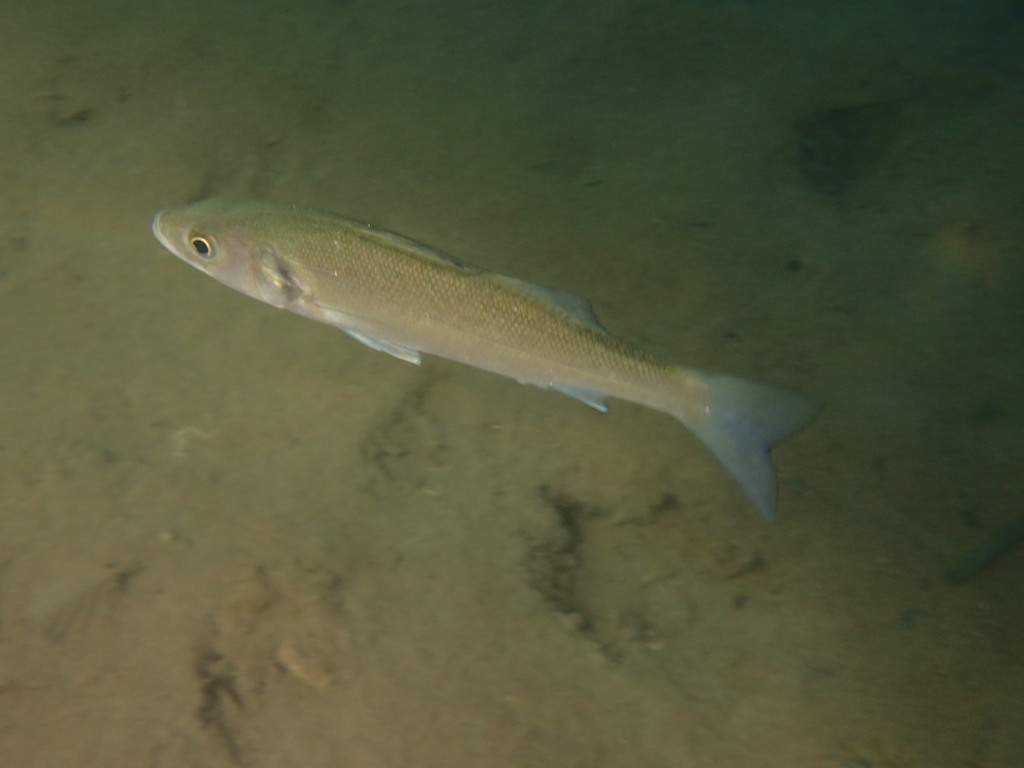
European seabass (Dicentrarchus labrax), also known as branzino, European bass, sea bass, common bass, white bass, capemouth, white salmon, white mullet, sea dace, levrek or loup de mer, is a primarily ocean-going fish native to the…
- Kingdom
- Animalia
- Phylum
- Chordata
- Order
- Perciformes
- Family
- Moronidae
- Genus
- Dicentrarchus
- Species
- Dicentrarchus labrax
Description
European seabass (Dicentrarchus labrax), also known as branzino, European bass, sea bass, common bass, white bass, capemouth, white salmon, white mullet, sea dace, levrek or loup de mer, is a primarily ocean-going fish native to the waters off Europe's western and southern and Africa's northern coasts, though it can also be found in shallow coastal waters and river mouths during the summer months and late autumn. It is one of only six species in its family, Moronidae, collectively called the temperate basses. It is fished and raised commercially and is considered the most important fish currently cultured in the Mediterranean. In Ireland and the United Kingdom, the popular restaurant fish sold and consumed as sea bass is exclusively the European bass. In North America, it is widely known by one of its Italian names, branzino. European seabass is a slow-growing species that takes several years to reach adulthood. An adult European seabass usually weighs around 2.5 kg (5 lb 8 oz). European seabass can reach measurements of up to 1 m (3 ft 3 in) in length and 12 kg (26 lb) in weight, though the most common size is only about half of that at 0.5 m (1 ft 8 in). Individuals are silvery grey and sometimes a dark-bluish color on the back. Juveniles form schools and feed on invertebrates, while adults are less social and prefer to consume other fish. They are generally found in the littoral zone near the banks of rivers, lagoons, and estuaries during the summer and migrate offshore during the winter. European sea bass feed on prawns, crabs and small fish. It is a sought-after game fish and is listed as Near Threatened by the International Union for Conservation of Nature due to a decreasing population.
En aquarium
Espèce d'eau douce et saumâtre et eau de mer évoluant plutôt près du fond. Paramètres d'eau relevés dans son milieu : température de 8 à 24 °C. Sur le plan biologique, elle atteint jusqu'à 103 cm, vit jusqu'à 30 ans, son régime est carnivore.
Paramètres relevés dans le milieu naturel de l’espèce (données scientifiques FishBase ; voir aussi la fiche Fishipedia). À adapter aux besoins précis de l’espèce en captivité.
Gallery
Ajouter des photos
Partagez vos photos de cette espèce (jusqu'à 20 à la fois) : elles sont vérifiées automatiquement, puis publiées.
Sources et crédits
Informations provenant de plusieurs sources vérifiées. Dernière mise à jour : .
Crédits photos (4)
- Photo : @romain_bth · CC BY-NC 4.0 · via iNaturalist
- Photo : @manjos · CC BY-NC 4.0 · via iNaturalist
- Photo : @ninaele · CC BY-NC 4.0 · via iNaturalist
- Photo : Francesco Cecere (@francescocecere) · CC0 (domaine public) · via iNaturalist
Mentions de licence
Texte disponible sous licence CC BY-SA 4.0. Il adapte notamment Bar commun, Wikipedia (CC BY-SA) : European seabass (Wikipédia, auteurs dans l’historique de l’article).
- Taxonomie : GBIF Backbone Taxonomy (CC BY 4.0)
- Statut de conservation : Liste rouge de l'UICN, via Wikidata (CC0)
- Paramètres d'aquarium : FishBase (faits reformulés)
Détail : Sources et licences.
Discussion (0)
Aucun message pour l’instant. Lancez la discussion sur cette fiche (sources, précisions, débats éditoriaux).
Connectez-vous pour participer à la discussion.