
Coral catshark
Atelomycterus marmoratus
The coral catshark (Atelomycterus marmoratus) is a species of coloured catshark belonging to the family Atelomycteridae.
- Kingdom
- Animalia
- Phylum
- Chordata
- Class
- Elasmobranchii
- Order
- Carcharhiniformes
- Family
- Scyliorhinidae
- Genus
- Atelomycterus
- Species
- Atelomycterus marmoratus
Description
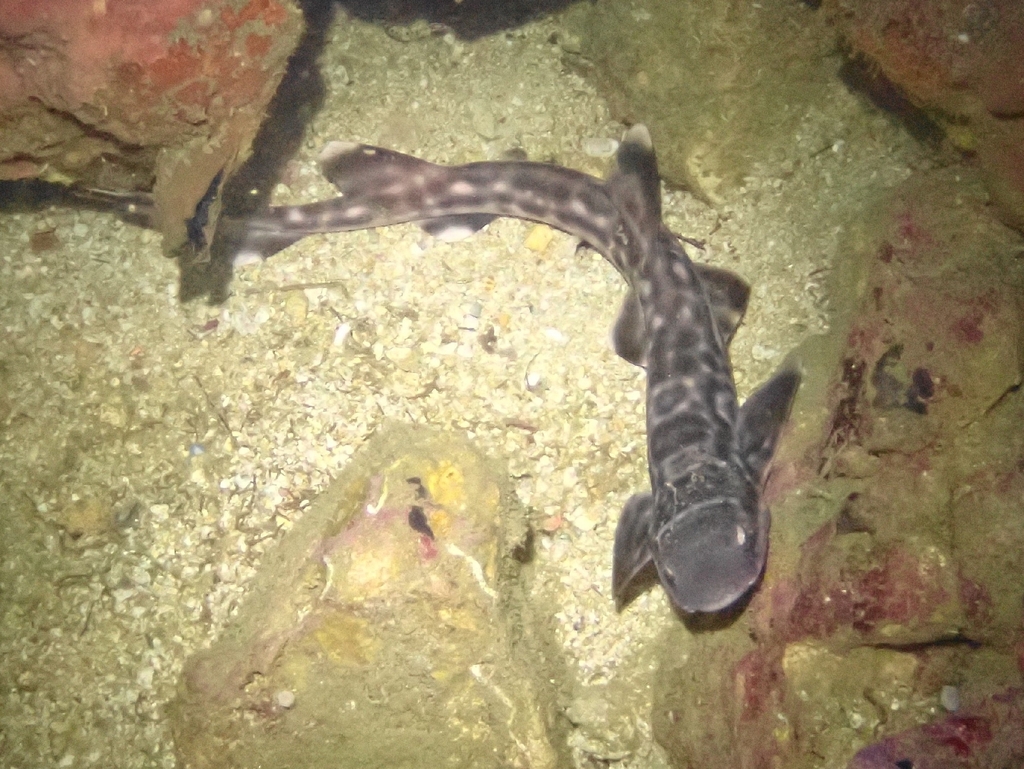
The coral catshark (Atelomycterus marmoratus) is a species of coloured catshark belonging to the family Atelomycteridae. It is common on shallow coral reefs across the Indo-West Pacific, from Pakistan to New Guinea. Reaching up to 70 cm (28 in) in length, the coral catshark has an extremely slender body, a short head and tail, and two dorsal fins that are angled backwards. It can be identified by the numerous black and white spots on its back, sides, and fins, which often merge to form horizontal bars. Furthermore, adult males have distinctively long and thin claspers. Reclusive and inactive during the day, at dusk and at night, the coral catshark actively forages for small, bottom-living invertebrates and bony fishes. Its slender form allows it to access tight spaces on the reef. It is oviparous; females lay purse-shaped egg capsules two at a time on the bottom, and the young hatch after 4–6 months. This small, harmless shark adapts well to captivity and has reproduced in the aquarium; it is regarded as one of the most suitable shark species for private aquarists. The coral catshark is a minor bycatch of reef fisheries, with minimal commercial value. Increasing fishing activity and extensive habitat degradation occur within its range, leading to concern over its population and its assessment as near threatened by the International Union for Conservation of Nature.
En aquarium
Espèce d'eau de mer évoluant plutôt autour des récifs. Sur le plan biologique, elle atteint jusqu'à 70 cm, son régime est piscivore.
Paramètres relevés dans le milieu naturel de l’espèce (données scientifiques FishBase ; voir aussi la fiche Fishipedia). À adapter aux besoins précis de l’espèce en captivité.
Gallery
Ajouter des photos
Partagez vos photos de cette espèce (jusqu'à 20 à la fois) : elles sont vérifiées automatiquement, puis publiées.
Répartition
Occurrences observées (données GBIF). Les zones hors aire d'origine peuvent indiquer une présence introduite ou invasive.
Sources et crédits
Informations provenant de plusieurs sources vérifiées. Dernière mise à jour : .
Crédits photos (5)
- Photo : Ben Costamagna (@bencostamagna) · CC BY 4.0 · via iNaturalist
- Photo : @evolution_dive_resort · CC BY-NC 4.0 · via iNaturalist
- Photo : Tsu Soo Tan (@tantsusoo) · CC BY-NC 4.0 · via iNaturalist
- Photo : Dan Schofield (@djscho) · CC BY 4.0 · via iNaturalist
- Photo : Thanyarat Sukruan (@thanyarat_bo) · CC BY-NC 4.0 · via iNaturalist
Mentions de licence
Texte disponible sous licence CC BY-SA 4.0. Il adapte notamment Wikipedia (CC BY-SA) : Coral catshark (Wikipédia, auteurs dans l’historique de l’article).
- Taxonomie : GBIF Backbone Taxonomy (CC BY 4.0)
- Carte : occurrences GBIF, fond © contributeurs OpenStreetMap (ODbL)
- Statut de conservation : Liste rouge de l'UICN, via Wikidata (CC0)
- Paramètres d'aquarium : FishBase (faits reformulés)
Détail : Sources et licences.
Discussion (0)
Aucun message pour l’instant. Lancez la discussion sur cette fiche (sources, précisions, débats éditoriaux).
Connectez-vous pour participer à la discussion.