
American eel
Anguilla rostrata
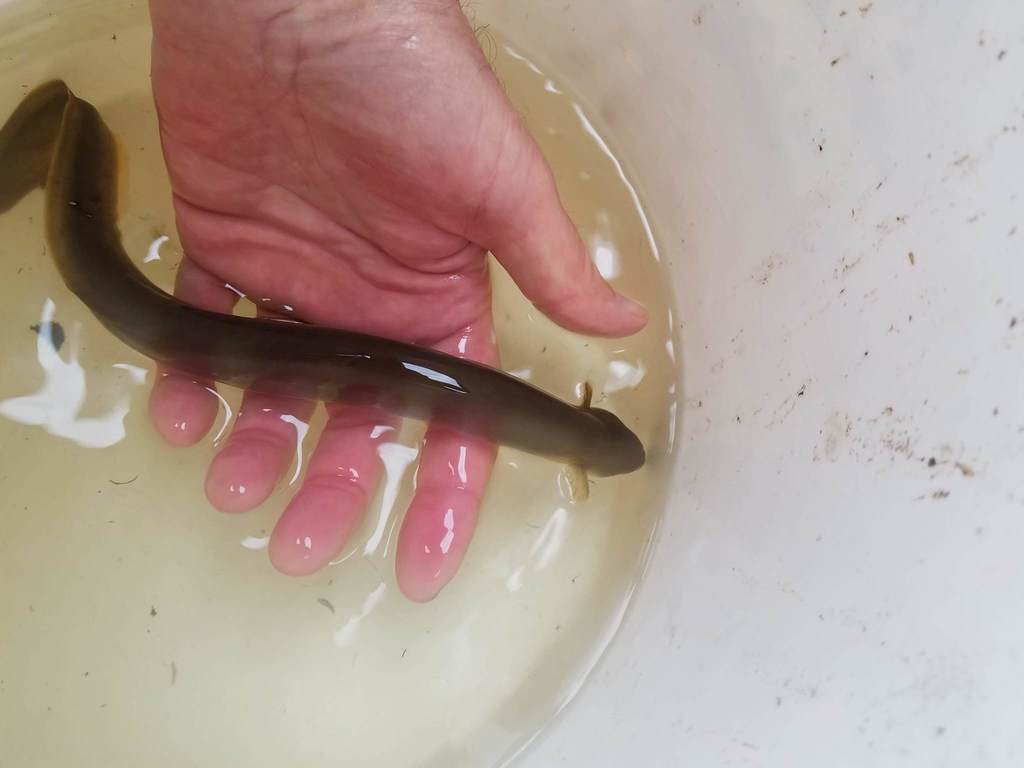
The American eel (Anguilla rostrata) is a facultative catadromous eel found on the eastern coast of North America.
- Kingdom
- Animalia
- Phylum
- Chordata
- Order
- Anguilliformes
- Family
- Anguillidae
- Genus
- Anguilla
- Species
- Anguilla rostrata
Description
The American eel (Anguilla rostrata) is a facultative catadromous eel found on the eastern coast of North America. Freshwater eels are fish belonging to the elopomorph superorder, a group of phylogenetically ancient teleosts. The American eel has a slender, supple, snake-like body that is covered with a mucus layer, which makes the eel appear to be naked and slimy despite the presence of minute scales. A long dorsal fin runs from the middle of the back and is continuous with a similar ventral fin. Pelvic fins are absent, and relatively small pectoral fins can be found near the midline, followed by the head and gill covers. Variations exist in coloration, from olive green, brown shading to greenish-yellow and light gray or white on the belly. Eels from clear water are often lighter than those from dark, tannic acid streams. The eel lives in fresh water and estuaries and only leaves these habitats to enter the Atlantic Ocean to make its spawning migration to the Sargasso Sea. Spawning takes place far offshore, where the eggs hatch. The female can lay up to 4 million buoyant eggs and dies after egg-laying. After the eggs hatch and the early-stage larvae develop into leptocephali, the young eels move toward North America, where they metamorphose into glass eels and enter freshwater systems where they grow as yellow eels until they begin to mature. The American eel is found along the Atlantic coast including the tributaries of the Chesapeake Bay, the Delaware River, and the Hudson River, and as far north as the Saint Lawrence River. It is also present in the river systems of the eastern Gulf of Mexico and in some areas further south. Like all anguillid eels, American eels hunt predominantly at night, and during the day they hide in mud, sand, or gravel very close to shore, at depths of roughly 5–6 feet (1.5–1.8 m). They feed on crustaceans, aquatic insects, small insects, and probably any aquatic organisms that they can find and eat. Eels were once an abundant species in rivers and were an important fishery for aboriginal people. The construction of hydroelectric dams has blocked their migrations and locally extirpated eels in many watersheds. For example, in Canada, the vast numbers of eels in the St. Lawrence and Ottawa Rivers have dwindled.
En aquarium
Espèce d'eau douce et saumâtre et eau de mer évoluant plutôt près du fond. Paramètres d'eau relevés dans son milieu : température de 4 à 25 °C. Sur le plan biologique, elle atteint jusqu'à 152 cm, vit jusqu'à 43 ans, son régime est piscivore.
Paramètres relevés dans le milieu naturel de l’espèce (données scientifiques FishBase). À adapter aux besoins précis de l’espèce en captivité.
Gallery
Ajouter des photos
Partagez vos photos de cette espèce (jusqu'à 20 à la fois) : elles sont vérifiées automatiquement, puis publiées.
Répartition
Occurrences observées (données GBIF). Les zones hors aire d'origine peuvent indiquer une présence introduite ou invasive.
Sources et crédits
Informations provenant de plusieurs sources vérifiées. Dernière mise à jour : .
Crédits photos (2)
- Photo : @greenwichnaturalist · CC BY-NC 4.0 · via iNaturalist
- Photo : @licomice · CC BY-NC 4.0 · via iNaturalist
Mentions de licence
Texte disponible sous licence CC BY-SA 4.0. Il adapte notamment Wikipedia (CC BY-SA) : American eel (Wikipédia, auteurs dans l’historique de l’article).
- Taxonomie : GBIF Backbone Taxonomy (CC BY 4.0)
- Carte : occurrences GBIF, fond © contributeurs OpenStreetMap (ODbL)
- Paramètres d'aquarium : FishBase (faits reformulés)
Détail : Sources et licences.
Discussion (0)
Aucun message pour l’instant. Lancez la discussion sur cette fiche (sources, précisions, débats éditoriaux).
Connectez-vous pour participer à la discussion.