
Bowfin
Amia calva
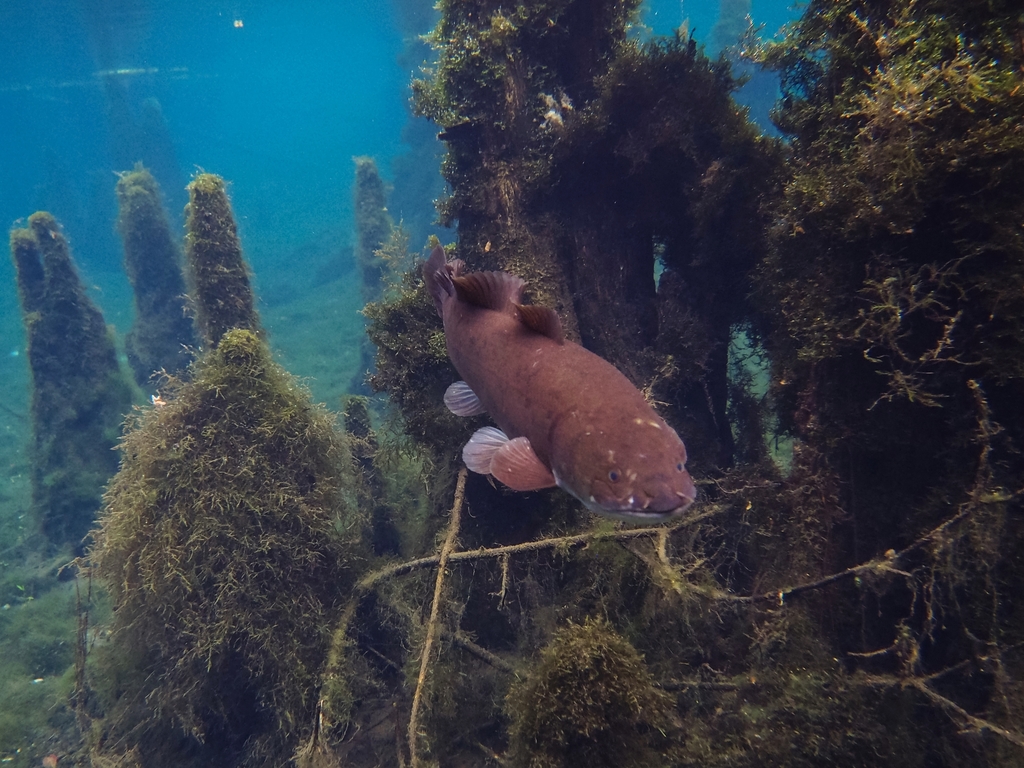
The ruddy bowfin (Amia calva) is a ray-finned fish native to North America.
- Kingdom
- Animalia
- Phylum
- Chordata
- Order
- Amiiformes
- Family
- Amiidae
- Genus
- Amia
- Species
- Amia calva
Description
The ruddy bowfin (Amia calva) is a ray-finned fish native to North America. Common names include mudfish, mud pike, dogfish, grindle, grinnel, swamp trout, and choupique. It is regarded as a relict, being one of only two surviving species of the Halecomorphi, a group of fish that first appeared during the Early Triassic, around 250 million years ago. The bowfin is often considered a "living fossil" because it has retained some morphological characteristics of its early ancestors. It is one of two species in the genus Amia, along with Amia ocellicauda, the eyespot bowfin. The closest living relatives of bowfins are gars, with the two groups being united in the clade Holostei. Bowfins are demersal, freshwater piscivores, commonly found throughout much of the Eastern United States, and southern Ontario and Quebec. Fossil deposits indicate the Amiiformes were once widespread in both freshwater and marine environments across North and South America, Europe, Asia, and Africa. Now, their range is limited to much of the Eastern United States and adjacent southern Canada, including the drainage basins of the Mississippi River, Great Lakes, and various rivers exiting in the Eastern Seaboard or Gulf of Mexico. Their preferred habitat includes vegetated sloughs, lowland rivers and lakes, swamps, and backwater areas; they are also occasionally found in brackish water. They are stalking, ambush predators known to move into the shallows at night to prey on fish and aquatic invertebrates such as crawfish, mollusks, and aquatic insects. Like gars, bowfin are bimodal breathers-they have the capacity to breathe both water and air. Their gills exchange gases in the water, allowing them to breathe, but they also have a gas bladder that serves to maintain buoyancy and also allows them to breathe air by means of a small pneumatic duct connected from the foregut to the gas bladder. They can break the surface to gulp air, which allows them to survive conditions of aquatic hypoxia that would be lethal to most other species. The bowfin is long-lived, with ages up to 33 years reported.
En aquarium
Espèce d'eau douce évoluant plutôt près du fond. Paramètres d'eau relevés dans son milieu : température de 15 à 20 °C. Sur le plan biologique, elle atteint jusqu'à 109 cm, vit jusqu'à 30 ans, son régime est piscivore.
Paramètres relevés dans le milieu naturel de l’espèce (données scientifiques FishBase). À adapter aux besoins précis de l’espèce en captivité.
Gallery
Ajouter des photos
Partagez vos photos de cette espèce (jusqu'à 20 à la fois) : elles sont vérifiées automatiquement, puis publiées.
Répartition
Occurrences observées (données GBIF). Les zones hors aire d'origine peuvent indiquer une présence introduite ou invasive.
Sources et crédits
Informations provenant de plusieurs sources vérifiées. Dernière mise à jour : .
Crédits photos (3)
- Photo : Phil's 1stPix (@phils1stpix) · CC BY-NC 4.0 · via iNaturalist
- Photo : Moses J. Michelsohn (@pecosvalleydiamond) · CC BY-NC 4.0 · via iNaturalist
- Photo : @kalenottheveggie · CC BY-NC 4.0 · via iNaturalist
Mentions de licence
Texte disponible sous licence CC BY-SA 4.0. Il adapte notamment Wikipedia (CC BY-SA) : Bowfin (Wikipédia, auteurs dans l’historique de l’article).
- Taxonomie : GBIF Backbone Taxonomy (CC BY 4.0)
- Carte : occurrences GBIF, fond © contributeurs OpenStreetMap (ODbL)
- Statut de conservation : Liste rouge de l'UICN, via Wikidata (CC0)
- Paramètres d'aquarium : FishBase (faits reformulés)
Détail : Sources et licences.
Discussion (0)
Aucun message pour l’instant. Lancez la discussion sur cette fiche (sources, précisions, débats éditoriaux).
Connectez-vous pour participer à la discussion.