
Pelagic thresher
Alopias pelagicus
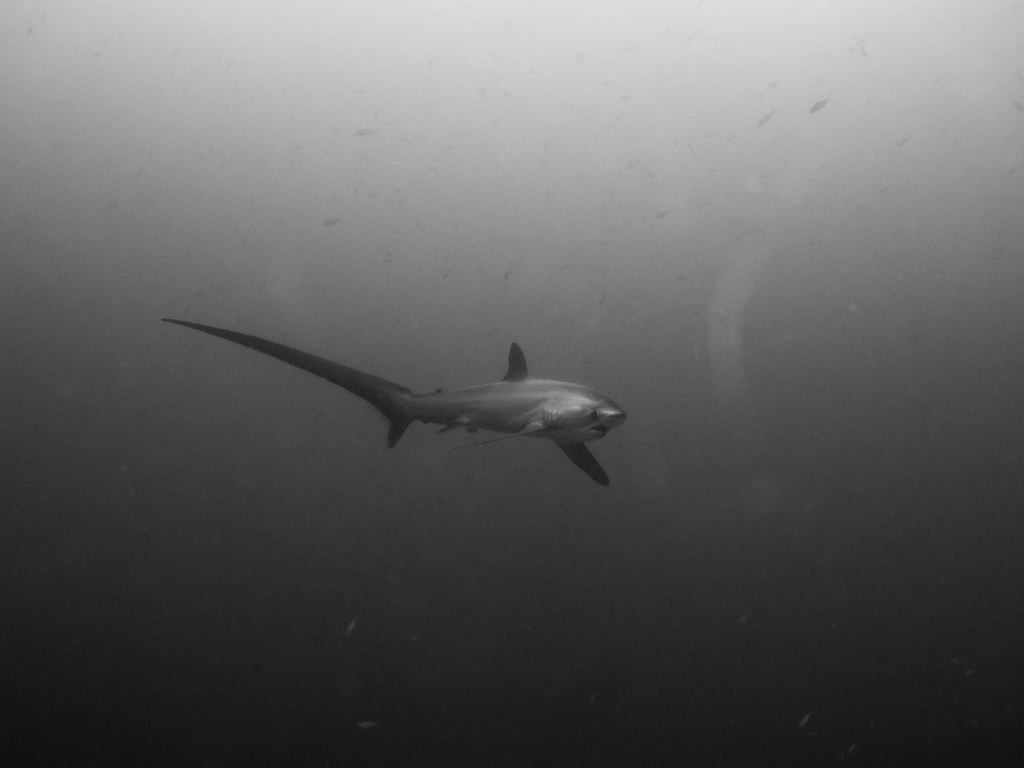
The pelagic thresher (Alopias pelagicus) is a species of thresher shark, family Alopiidae; this group of sharks is characterized by the greatly elongated upper lobes of their caudal fins.
- Kingdom
- Animalia
- Phylum
- Chordata
- Class
- Elasmobranchii
- Order
- Lamniformes
- Family
- Alopiidae
- Genus
- Alopias
- Species
- Alopias pelagicus
Description
The pelagic thresher (Alopias pelagicus) is a species of thresher shark, family Alopiidae; this group of sharks is characterized by the greatly elongated upper lobes of their caudal fins. The pelagic thresher occurs in the tropical and subtropical waters of the Indian and Pacific Oceans, usually far from shore, but occasionally entering coastal habitats. It is often confused with the common thresher (A. vulpinus), even in professional publications, but can be distinguished by the dark, rather than white, color over the bases of its pectoral fins. The smallest of the three thresher species, the pelagic thresher typically measures 3 m (9.8 ft) long. The diet of the pelagic thresher consists mainly of small midwater fishes, which are stunned with whip-like strikes of its tail. Along with all other mackerel sharks, the pelagic thresher exhibits ovoviviparity and usually gives birth to litters of two. The developing embryos are oophagous, feeding on unfertilized eggs produced by the mother. The young are born unusually large, up to 43% the length of the mother. Pelagic threshers are valued by commercial fisheries for their meat, skin, liver oil, and fins, and are also pursued by sport fishers. The International Union for Conservation of Nature assessed this species as endangered in 2019.
En aquarium
Espèce d'eau de mer évoluant plutôt en pleine eau. Sur le plan biologique, elle atteint jusqu'à 428 cm, vit jusqu'à 29 ans, son régime est piscivore.
Paramètres relevés dans le milieu naturel de l’espèce (données scientifiques FishBase ; voir aussi la fiche Fishipedia). À adapter aux besoins précis de l’espèce en captivité.
Gallery
Ajouter des photos
Partagez vos photos de cette espèce (jusqu'à 20 à la fois) : elles sont vérifiées automatiquement, puis publiées.
Répartition
Occurrences observées (données GBIF). Les zones hors aire d'origine peuvent indiquer une présence introduite ou invasive.
Sources et crédits
Informations provenant de plusieurs sources vérifiées. Dernière mise à jour : .
Crédits photos (4)
- Photo : @boussion_magali · CC BY-NC 4.0 · via iNaturalist
- Photo : Albert Kang (@albertkang) · CC BY-NC 4.0 · via iNaturalist
- Photo : @louvanhaeren · CC BY-NC 4.0 · via iNaturalist
- Photo : Ale’s Pokédex (@alejandro_mateos) · CC BY-NC 4.0 · via iNaturalist
Mentions de licence
Texte disponible sous licence CC BY-SA 4.0. Il adapte notamment Wikipedia (CC BY-SA) : Pelagic thresher (Wikipédia, auteurs dans l’historique de l’article).
- Taxonomie : GBIF Backbone Taxonomy (CC BY 4.0)
- Carte : occurrences GBIF, fond © contributeurs OpenStreetMap (ODbL)
- Paramètres d'aquarium : FishBase (faits reformulés)
Détail : Sources et licences.
Discussion (0)
Aucun message pour l’instant. Lancez la discussion sur cette fiche (sources, précisions, débats éditoriaux).
Connectez-vous pour participer à la discussion.