
Golden white-eye
Cleptornis marchei
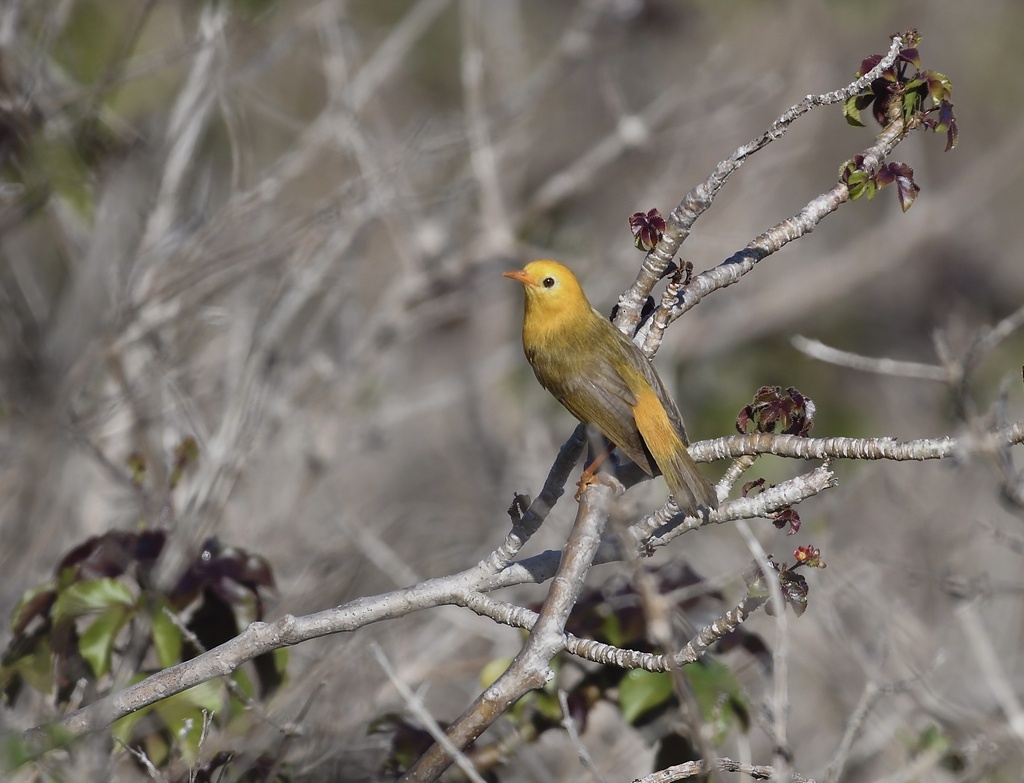
The golden white-eye (Cleptornis marchei) is a species of bird in the white-eye family, Zosteropidae.
- Kingdom
- Animalia
- Phylum
- Chordata
- Class
- Aves
- Order
- Passeriformes
- Family
- Zosteropidae
- Genus
- Cleptornis
- Species
- Cleptornis marchei
Description
The golden white-eye (Cleptornis marchei) is a species of bird in the white-eye family, Zosteropidae. It is the only species within the genus Cleptornis. The golden white-eye was once considered to be a honeyeater in the family Meliphagidae and although it is now known to be a white-eye, its position within that family is still uncertain. The species is restricted to the islands of Saipan and Aguijan in the Northern Mariana Islands, where it is sympatric (shares its range) and competes with the related bridled white-eye. The golden white-eye has golden plumage and a pale eye-ring. It feeds on insects, fruit, and nectar and forages in pairs or small family groups. The bird is monogamous and lays two eggs in a small cup nest. Fossil evidence shows the golden white-eye once also occurred on Tinian and Rota but was extirpated in those locations through the impact of human activities. Despite its current abundance on Saipan and Aguijan, and the fact that it has among the highest recorded densities for any bird, it is nevertheless considered to be Endangered. It is threatened by the invasive brown tree snake, which has become established on nearby Guam, and this predator is expected to cause a rapid decline in the population if it reaches Saipan. Efforts are under way to control the snakes and breed the white-eye in zoos.
Gallery
Ajouter des photos
Partagez vos photos de cette espèce (jusqu'à 20 à la fois) : elles sont vérifiées automatiquement, puis publiées.
Répartition
Occurrences observées (données GBIF). Les zones hors aire d'origine peuvent indiquer une présence introduite ou invasive.
Sources et crédits
Informations provenant de plusieurs sources vérifiées. Dernière mise à jour : .
Crédits photos (8)
- Photo : Kalin Antonio Ocaña (@kalinocana) · CC BY-NC 4.0 · via iNaturalist
- Photo : Kayla Garcia (@kayla_layne) · CC BY-NC 4.0 · via iNaturalist
- Photo : @ajpate · CC BY-NC 4.0 · via iNaturalist
- Photo : @drgonfly · CC BY-NC 4.0 · via iNaturalist
- Photo : @cap1096 · CC BY-NC 4.0 · via iNaturalist
- Photo : @kaeliswift · CC BY-NC 4.0 · via iNaturalist
- Photo : @mangoat1 · CC BY-NC 4.0 · via iNaturalist
- Photo : @ctallo · CC BY-NC 4.0 · via iNaturalist
Mentions de licence
Texte disponible sous licence CC BY-SA 4.0. Il adapte notamment Wikipedia (CC BY-SA) : Golden white-eye (Wikipédia, auteurs dans l’historique de l’article).
- Taxonomie : GBIF Backbone Taxonomy (CC BY 4.0)
- Carte : occurrences GBIF, fond © contributeurs OpenStreetMap (ODbL)
Détail : Sources et licences.
Discussion (0)
Aucun message pour l’instant. Lancez la discussion sur cette fiche (sources, précisions, débats éditoriaux).
Connectez-vous pour participer à la discussion.