
Long-tailed Paradise Whydah
Vidua paradisaea
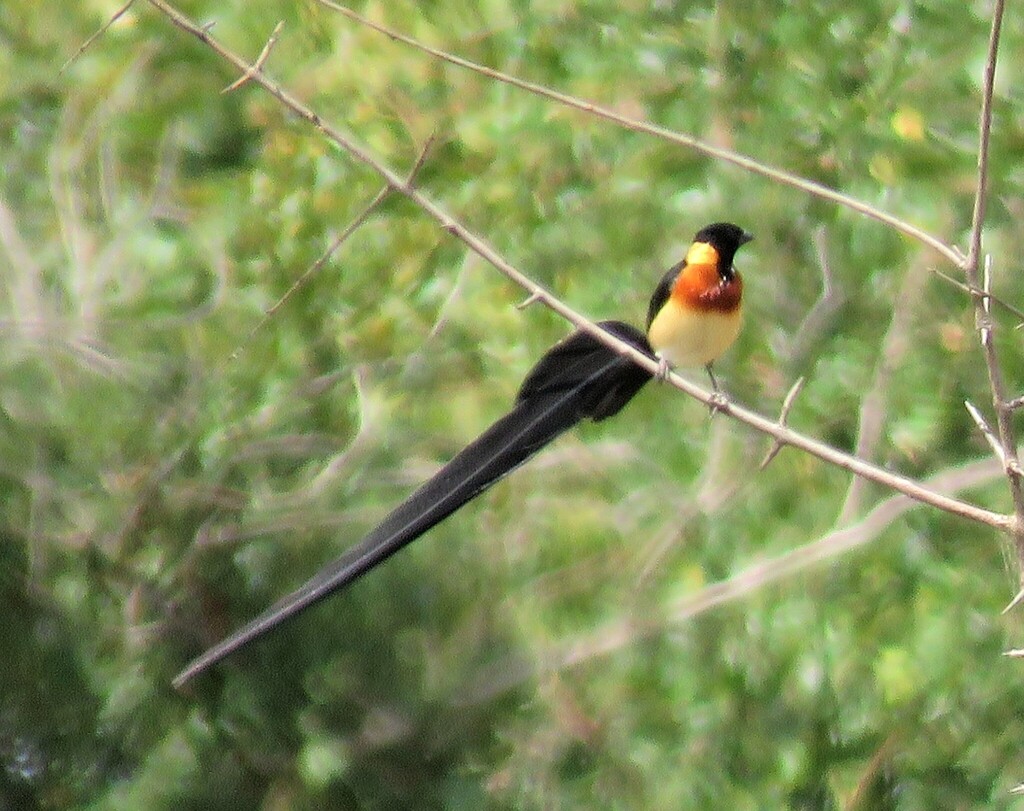
The long-tailed paradise whydah or eastern paradise whydah (Vidua paradisaea) is a bird in the family Viduidae of the order Passeriformes.
- Kingdom
- Animalia
- Phylum
- Chordata
- Class
- Aves
- Order
- Passeriformes
- Family
- Viduidae
- Genus
- Vidua
- Species
- Vidua paradisaea
Description
The long-tailed paradise whydah or eastern paradise whydah (Vidua paradisaea) is a bird in the family Viduidae of the order Passeriformes. It is a small passerine with a short, stubby bill, found across eastern and southern Africa from Ethiopia south to South Africa and west to Angola. It is mostly granivorous, and feed on seeds that have ripened and fallen on the ground. The ability to distinguish between males and females is quite difficult unless it is breeding season. During this time, the males moult into breeding plumage where they have a distinctive long tail. This can be up to three times longer than its own body or even more. Males are able to mimic songs where females can use that to discover their mate. However, there are some cases where females don't use songs to choose their mate but they use either male characteristics like plumage or they can have a shortage of options with song mimicry. Paradise whydahs are brood parasites. They do not destroy the host eggs that are originally there, but lay their own eggs alogside in the other bird's nest. Overall, these whydahs are considered least concern, based on the IUCN Red List of threatened species.
Gallery
Ajouter des photos
Partagez vos photos de cette espèce (jusqu'à 20 à la fois) : elles sont vérifiées automatiquement, puis publiées.
Répartition
Occurrences observées (données GBIF). Les zones hors aire d'origine peuvent indiquer une présence introduite ou invasive.
Sources et crédits
Informations provenant de plusieurs sources vérifiées. Dernière mise à jour : .
Crédits photos (8)
- Photo : @emskakoon · CC BY-NC 4.0 · via iNaturalist
- Photo : @rjq · CC BY-NC 4.0 · via iNaturalist
- Photo : Laura Gaudette (@gaudettelaura) · CC BY 4.0 · via iNaturalist
- Photo : Andrew Cauldwell (@littlechippie) · CC BY-NC 4.0 · via iNaturalist
- Photo : Peter Archdale (@pma) · CC BY 4.0 · via iNaturalist
- Photo : TScheepers (@talita0203) · CC BY-NC 4.0 · via iNaturalist
- Photo : Jonas Kraft (@jonas_kraft) · CC BY 4.0 · via iNaturalist
- Photo : @alanvannorman · CC BY-NC 4.0 · via iNaturalist
Mentions de licence
Texte disponible sous licence CC BY-SA 4.0. Il adapte notamment Wikipedia (CC BY-SA) : Long-tailed paradise whydah (Wikipédia, auteurs dans l’historique de l’article).
- Taxonomie : GBIF Backbone Taxonomy (CC BY 4.0)
- Carte : occurrences GBIF, fond © contributeurs OpenStreetMap (ODbL)
- Statut de conservation : Liste rouge de l'UICN, via Wikidata (CC0)
Détail : Sources et licences.
Discussion (0)
Aucun message pour l’instant. Lancez la discussion sur cette fiche (sources, précisions, débats éditoriaux).
Connectez-vous pour participer à la discussion.