
African Wattled Lapwing
Vanellus senegallus
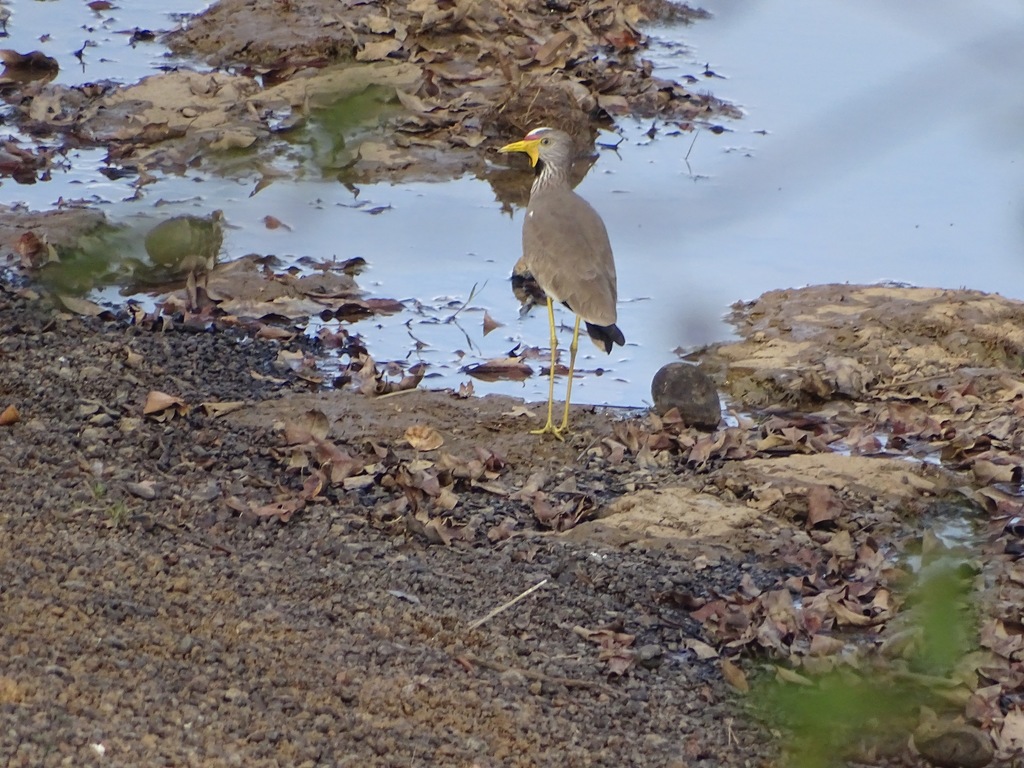
The African wattled lapwing (Vanellus senegallus), also known as the Senegal wattled plover or simply wattled lapwing, is a large lapwing, a group of largish waders in the family Charadriidae.
- Kingdom
- Animalia
- Phylum
- Chordata
- Class
- Aves
- Order
- Charadriiformes
- Family
- Charadriidae
- Genus
- Vanellus
- Species
- Vanellus senegallus
Description
The African wattled lapwing (Vanellus senegallus), also known as the Senegal wattled plover or simply wattled lapwing, is a large lapwing, a group of largish waders in the family Charadriidae. It is a resident breeder in most of sub-Saharan Africa outside the rainforests, although it has seasonal movements. These are conspicuous and unmistakable birds. They are large brown waders with a black crown, white forehead and large yellow facial wattles. The tail is white, tipped black, and the long legs are yellow. In flight, the upperwings have black flight feathers and brown coverts separated by a white bar. The underwings are white with black flight feathers. The African wattled lapwing has a loud peep-peep call. This species is a common breeder in wet lowland habitats, especially damp grassland. It often feeds in drier habitats, such as golf courses, picking insects and other invertebrates from the ground. It lays three or four eggs on a ground scrape. The African wattled lapwing is one of the species to which the Agreement on the Conservation of African-Eurasian Migratory Waterbirds (AEWA) applies.
Gallery
Ajouter des photos
Partagez vos photos de cette espèce (jusqu'à 20 à la fois) : elles sont vérifiées automatiquement, puis publiées.
Répartition
Occurrences observées (données GBIF). Les zones hors aire d'origine peuvent indiquer une présence introduite ou invasive.
Sources et crédits
Informations provenant de plusieurs sources vérifiées. Dernière mise à jour : .
Crédits photos (8)
- Photo : ONG OeBenin (@oebenin) · CC BY-NC 4.0 · via iNaturalist
- Photo : AMADOU BAHLEMAN FARID (@bahleman) · CC BY-NC 4.0 · via iNaturalist
- Photo : Zuzana Holubova (@zuzaholub) · CC BY-NC 4.0 · via iNaturalist
- Photo : @msmarcia · CC BY-NC 4.0 · via iNaturalist
- Photo : ONG OeBenin (@oebenin) · CC BY-NC 4.0 · via iNaturalist
- Photo : Matthieu Gauvain (@matthieu_gauvain) · CC BY-NC 4.0 · via iNaturalist
- Photo : Christiaan Viljoen (@christiaan_viljoen) · CC BY 4.0 · via iNaturalist
- Photo : Gert (@genat) · CC BY-NC 4.0 · via iNaturalist
Mentions de licence
Texte disponible sous licence CC BY-SA 4.0. Il adapte notamment Vanneau du Sénégal, Wikipedia (CC BY-SA) : African wattled lapwing (Wikipédia, auteurs dans l’historique de l’article).
- Taxonomie : GBIF Backbone Taxonomy (CC BY 4.0)
- Carte : occurrences GBIF, fond © contributeurs OpenStreetMap (ODbL)
- Statut de conservation : Liste rouge de l'UICN, via Wikidata (CC0)
Détail : Sources et licences.
Discussion (0)
Aucun message pour l’instant. Lancez la discussion sur cette fiche (sources, précisions, débats éditoriaux).
Connectez-vous pour participer à la discussion.