
Turkey Vulture
Cathartes aura
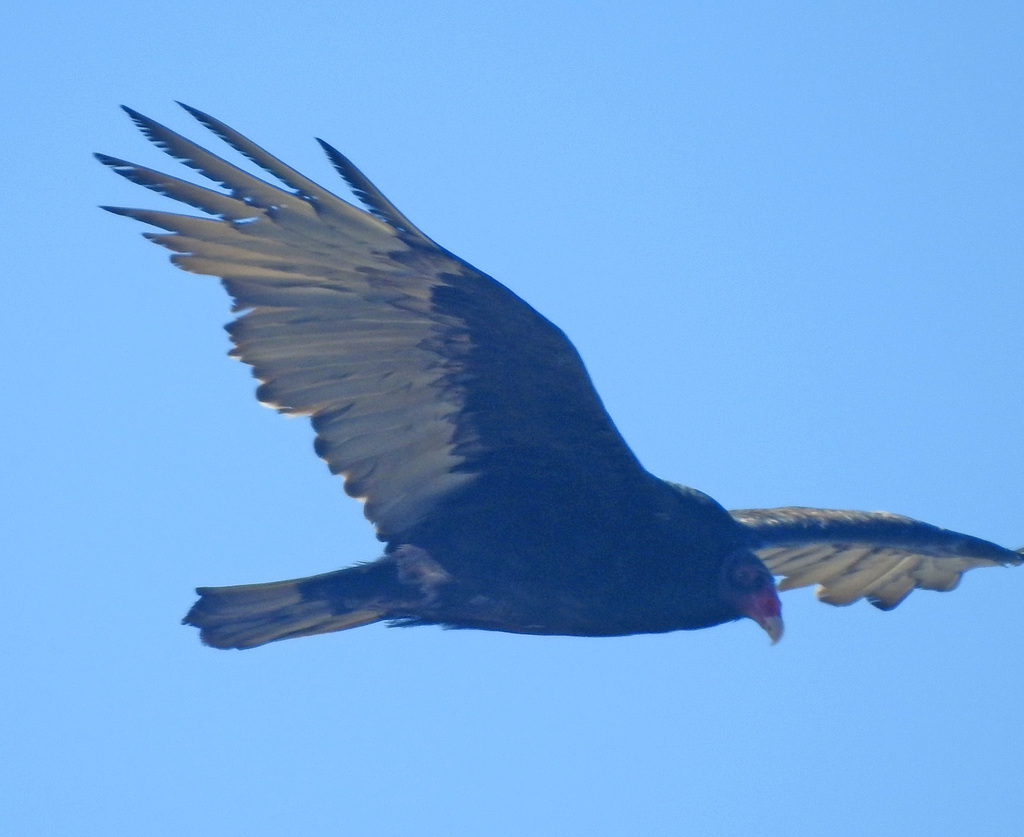
The turkey vulture (Cathartes aura) is the most widespread of the New World vultures.
- Kingdom
- Animalia
- Phylum
- Chordata
- Class
- Aves
- Order
- Accipitriformes
- Family
- Cathartidae
- Genus
- Cathartes
- Species
- Cathartes aura
Description
The turkey vulture (Cathartes aura) is the most widespread of the New World vultures. One of three species in the genus Cathartes of the family Cathartidae, the turkey vulture ranges from southern Canada to the southernmost tip of South America. It inhabits a variety of open and semi-open areas, including subtropical forests, shrublands, pastures, and deserts. Like all New World vultures, it is not closely related to the Old World vultures of Europe, Africa, and Asia. However, the two groups strongly resemble each other due to convergent evolution. The turkey vulture is a scavenger and feeds almost exclusively on carrion. It finds its food using its keen eyes and sense of smell, flying low enough to detect the gasses produced by the early stages of decay in dead animals. In flight, it uses thermals to move through the air, flapping its wings infrequently. It roosts in large community groups. Lacking a syrinx-the vocal organ of birds-its only vocalizations are grunts or low hisses. It nests in caves, hollow trees, or thickets. Each year it generally raises two chicks, which it feeds by regurgitation. It has very few natural predators. In the United States, the vulture receives legal protection under the Migratory Bird Treaty Act of 1918.
Gallery
Ajouter des photos
Partagez vos photos de cette espèce (jusqu'à 20 à la fois) : elles sont vérifiées automatiquement, puis publiées.
Répartition
Occurrences observées (données GBIF). Les zones hors aire d'origine peuvent indiquer une présence introduite ou invasive.
Sources et crédits
Informations provenant de plusieurs sources vérifiées. Dernière mise à jour : .
Crédits photos (8)
- Photo : Ross Millikan (@ross2) · CC BY-NC 4.0 · via iNaturalist
- Photo : Joshua Almansa (@almansa) · CC BY-NC 4.0 · via iNaturalist
- Photo : Leila Dasher (@supertiger) · CC BY 4.0 · via iNaturalist
- Photo : @chelshaq · CC BY-NC 4.0 · via iNaturalist
- Photo : Keith P (@keithpittluck) · CC BY-NC 4.0 · via iNaturalist
- Photo : Felipe Castilla Lattke (@felipecastilla) · CC BY-NC 4.0 · via iNaturalist
- Photo : Donna Pomeroy (@dpom) · CC BY-NC 4.0 · via iNaturalist
- Photo : Michael Bakker Paiva (@michaelbakkerpaiva) · CC BY 4.0 · via iNaturalist
Mentions de licence
Texte disponible sous licence CC BY-SA 4.0. Il adapte notamment Wikipedia (CC BY-SA) : Turkey vulture (Wikipédia, auteurs dans l’historique de l’article).
- Taxonomie : GBIF Backbone Taxonomy (CC BY 4.0)
- Carte : occurrences GBIF, fond © contributeurs OpenStreetMap (ODbL)
- Statut de conservation : Liste rouge de l'UICN, via Wikidata (CC0)
Détail : Sources et licences.
Discussion (0)
Aucun message pour l’instant. Lancez la discussion sur cette fiche (sources, précisions, débats éditoriaux).
Connectez-vous pour participer à la discussion.