
Black-breasted Buttonquail
Turnix melanogaster
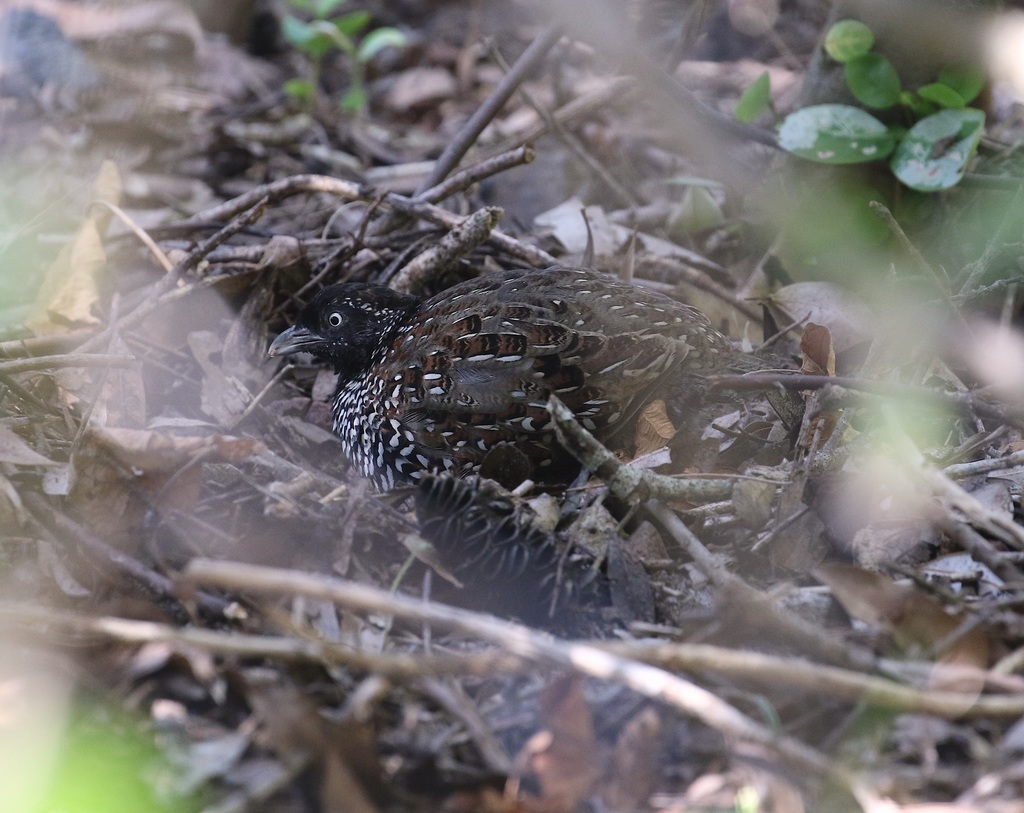
The black-breasted buttonquail (Turnix melanogaster) is a rare buttonquail endemic to eastern Australia.
- Kingdom
- Animalia
- Phylum
- Chordata
- Class
- Aves
- Order
- Charadriiformes
- Family
- Turnicidae
- Genus
- Turnix
- Species
- Turnix melanogaster
Description
The black-breasted buttonquail (Turnix melanogaster) is a rare buttonquail endemic to eastern Australia. As with other buttonquails, it is unrelated to the true quails. The black-breasted buttonquail is a plump quail-shaped bird 17–19 cm (6.7–7.5 in) in length with predominantly marbled black, rufous, and pale brown plumage, marked prominently with white spots and stripes, and white eyes. Like other buttonquails, the female is larger and more boldly coloured than the male, with a distinctive black head and neck sprinkled with fine white markings. The usual sex roles are reversed, as the female mates with multiple male partners and leaves them to incubate the eggs. The black-breasted buttonquail is usually found in rainforests, foraging on the ground for invertebrates in large areas of thick leaf litter. Most of its original habitat has been cleared and the remaining populations are fragmented. The species is rated as vulnerable on the International Union for Conservation of Nature (IUCN)'s Red List of Endangered species and is listed as vulnerable under the Environment Protection and Biodiversity Conservation Act 1999. A three-year conservation project has been under way since 2021.
Gallery
Ajouter des photos
Partagez vos photos de cette espèce (jusqu'à 20 à la fois) : elles sont vérifiées automatiquement, puis publiées.
Répartition
Occurrences observées (données GBIF). Les zones hors aire d'origine peuvent indiquer une présence introduite ou invasive.
Sources et crédits
Informations provenant de plusieurs sources vérifiées. Dernière mise à jour : .
Crédits photos (8)
- Photo : Mikael Bauer (@neomorphus) · CC BY-NC 4.0 · via iNaturalist
- Photo : Andrew Taylor - Dundas Nature Refuge - D'Aguilar Ranges (@dundas_nature_refuge) · CC BY-NC 4.0 · via iNaturalist
- Photo : Martin Bennett (@martinbennett) · CC BY-NC 4.0 · via iNaturalist
- Photo : @andreamvee · CC BY-NC 4.0 · via iNaturalist
- Photo : Steve Murray (@sjmurray55) · CC BY-NC 4.0 · via iNaturalist
- Photo : Indra Bone (@indrabone) · CC BY-NC 4.0 · via iNaturalist
- Photo : @peterwest · CC BY-NC 4.0 · via iNaturalist
- Photo : James H (@jamesh111) · CC BY 4.0 · via iNaturalist
Mentions de licence
Texte disponible sous licence CC BY-SA 4.0. Il adapte notamment Wikipedia (CC BY-SA) : Black-breasted buttonquail (Wikipédia, auteurs dans l’historique de l’article).
- Taxonomie : GBIF Backbone Taxonomy (CC BY 4.0)
- Carte : occurrences GBIF, fond © contributeurs OpenStreetMap (ODbL)
- Statut de conservation : Liste rouge de l'UICN, via Wikidata (CC0)
Détail : Sources et licences.
Discussion (0)
Aucun message pour l’instant. Lancez la discussion sur cette fiche (sources, précisions, débats éditoriaux).
Connectez-vous pour participer à la discussion.