
Eurasian Wren
Troglodytes troglodytes
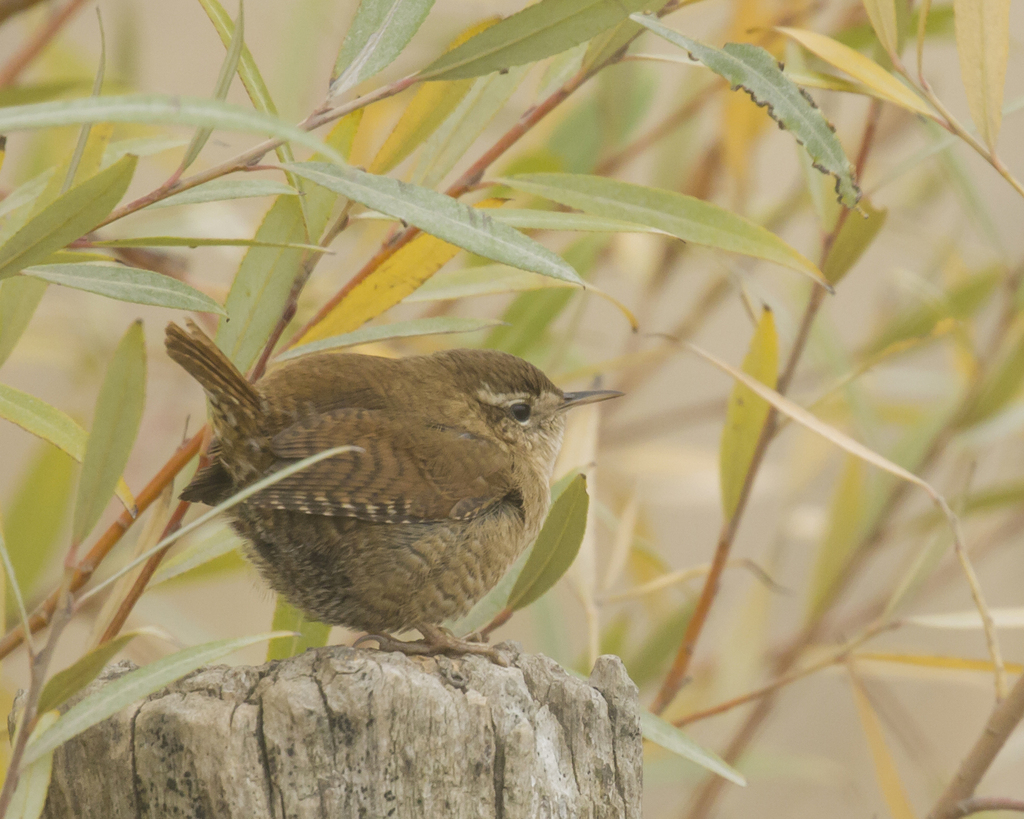
The Eurasian wren (Troglodytes troglodytes) is a very small insectivorous bird and the only member of the wren family found in the Old World, specifically in Eurasia and Africa (Maghreb).
- Kingdom
- Animalia
- Phylum
- Chordata
- Class
- Aves
- Order
- Passeriformes
- Family
- Troglodytidae
- Genus
- Troglodytes
- Species
- Troglodytes troglodytes
Description
The Eurasian wren (Troglodytes troglodytes) is a very small insectivorous bird and the only member of the wren family found in the Old World, specifically in Eurasia and Africa (Maghreb). In Anglophone Europe, it is commonly known simply as the wren. It has a very short tail which is often held erect, a short neck and a relatively long thin bill. It is russet brown above, paler buff-brown below, overall finely barred darker, and has a cream buff supercilium. The sexes are alike. The Eurasian wren occurs in Europe and across the Palearctic, including a belt of Asia from northern Iran and Afghanistan across to Japan. It is migratory in the northern (particularly northeastern), parts of its range, and sedentary in the west and south of its range. It is also highly polygynous, an unusual mating system for passerines. The species was formerly lumped together with winter wren (Troglodytes hiemalis) of eastern North America and Pacific wren (Troglodytes pacificus) of western North America under the merged name of northern wren. The scientific name is taken from the Greek word "troglodytes" (from τρώγλη troglē "hole", and δῠ́ειν dyein, "creep"), meaning "hole-dweller", and refers to its habit of disappearing into cavities or crevices whilst hunting arthropods or to roost. The taxonomy of the genus Troglodytes is currently unresolved, as recent molecular studies have suggested that the genera Cistothorus and Thryorchilus are within the clade currently defined by Troglodytes.
Gallery
Ajouter des photos
Partagez vos photos de cette espèce (jusqu'à 20 à la fois) : elles sont vérifiées automatiquement, puis publiées.
Répartition
Occurrences observées (données GBIF). Les zones hors aire d'origine peuvent indiquer une présence introduite ou invasive.
Sources et crédits
Informations provenant de plusieurs sources vérifiées. Dernière mise à jour : .
Crédits photos (5)
- Photo : Tobias S. Radmer (@tostra97) · CC BY-NC 4.0 · via iNaturalist
- Photo : Alexandra Laking (@lakinga) · CC BY-NC 4.0 · via iNaturalist
- Photo : Mika Tomta (@mikat78) · CC BY-NC 4.0 · via iNaturalist
- Photo : Aurélien Coste (@aureliencoste) · CC BY 4.0 · via iNaturalist
- Photo : @skanji · CC BY-NC 4.0 · via iNaturalist
Mentions de licence
Texte disponible sous licence CC BY-SA 4.0. Il adapte notamment Wikipedia (CC BY-SA) : Eurasian wren (Wikipédia, auteurs dans l’historique de l’article).
- Taxonomie : GBIF Backbone Taxonomy (CC BY 4.0)
- Carte : occurrences GBIF, fond © contributeurs OpenStreetMap (ODbL)
- Statut de conservation : Liste rouge de l'UICN, via Wikidata (CC0)
Détail : Sources et licences.
Discussion (0)
Aucun message pour l’instant. Lancez la discussion sur cette fiche (sources, précisions, débats éditoriaux).
Connectez-vous pour participer à la discussion.