
Thrush-like Wren
Campylorhynchus turdinus
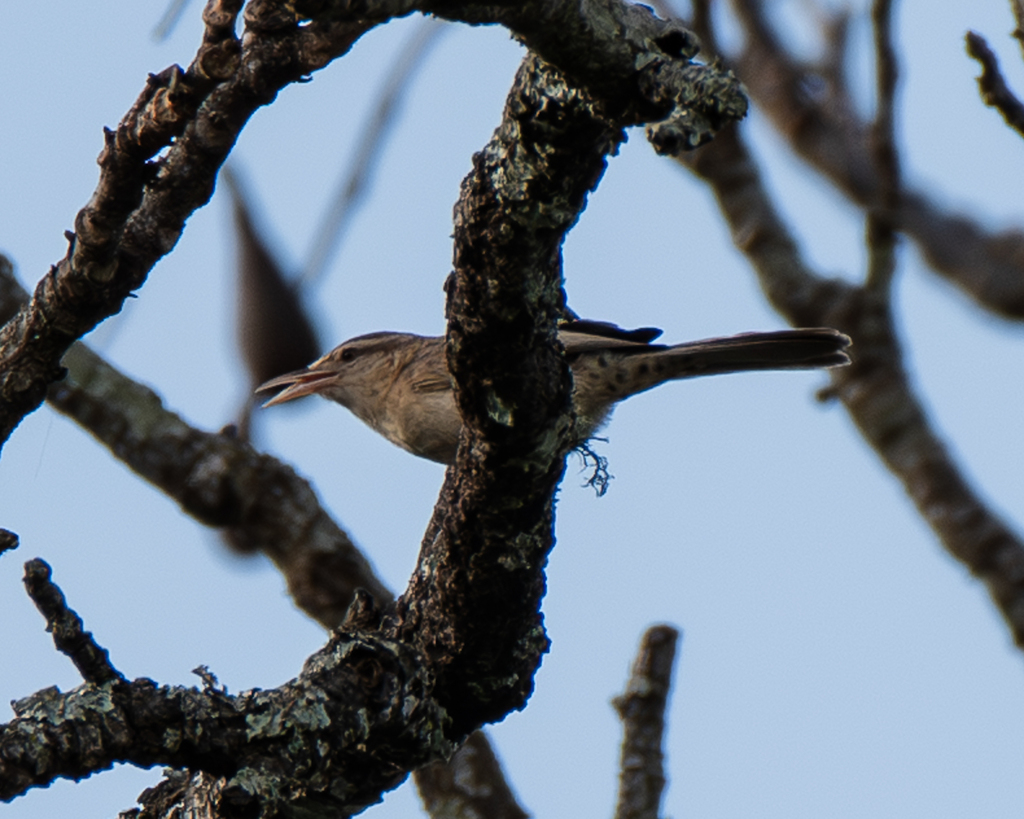
The thrush-like wren (Campylorhynchus turdinus) is a South American species of bird in the family Troglodytidae, the wrens.
- Kingdom
- Animalia
- Phylum
- Chordata
- Class
- Aves
- Order
- Passeriformes
- Family
- Troglodytidae
- Genus
- Campylorhynchus
- Species
- Campylorhynchus turdinus
Description
The thrush-like wren (Campylorhynchus turdinus) is a South American species of bird in the family Troglodytidae, the wrens. As suggested by its common and scientific name, its size and coloration are vaguely reminiscent of that of a thrush, although the general impression it gives in life is very different and not at all "thrush-like". With a total length of approximately 20 cm (8 in), it is among the largest species of wrens. The head and mantle are brownish-gray. The wings and upper tail are dull brown with dense blackish barring. The whitish underparts are heavily spotted with dusky, except on the throat. It typically shows a distinctive whitish eyebrow and the relatively long tail is commonly held cocked. The slightly decurved bill is relatively long, and, for a wren, thick. The irides are dull amber, maroon or brown. Unlike most other wrens, it is typically found from mid-levels to canopy height. Despite its size, it is relatively inconspicuous, and usually revealed only by its loud, complex voice, which is highly characteristic. It feeds primarily on insects, but will also take vegetable matter and small invertebrates. Typically forages in pairs or small groups.
Gallery
Ajouter des photos
Partagez vos photos de cette espèce (jusqu'à 20 à la fois) : elles sont vérifiées automatiquement, puis publiées.
Répartition
Occurrences observées (données GBIF). Les zones hors aire d'origine peuvent indiquer une présence introduite ou invasive.
Sources et crédits
Informations provenant de plusieurs sources vérifiées. Dernière mise à jour : .
Crédits photos (8)
- Photo : Oleg Rouvinski Vasilieva (@olegvasiliev) · CC BY-NC 4.0 · via iNaturalist
- Photo : Vanesa Cruz Jumbo (@vkcruzjumbo) · CC BY-NC 4.0 · via iNaturalist
- Photo : Vanesa Cruz Jumbo (@vkcruzjumbo) · CC BY-NC 4.0 · via iNaturalist
- Photo : @fabiologopro · CC BY-NC 4.0 · via iNaturalist
- Photo : Pedro Henrique Maloso Ramos (@pedro1203) · CC BY 4.0 · via iNaturalist
- Photo : Romer Miserendino Salazar (@romer_miserendino) · CC BY-NC 4.0 · via iNaturalist
- Photo : Gabriel Bienzobas Fernández (@gabrielbz) · CC BY-NC 4.0 · via iNaturalist
- Photo : Nicolas Olejnik (@nicoolejnik) · CC BY 4.0 · via iNaturalist
Mentions de licence
Texte disponible sous licence CC BY-SA 4.0. Il adapte notamment Wikipedia (CC BY-SA) : Thrush-like wren, Troglodyte grivelé (Wikipédia, auteurs dans l’historique de l’article).
- Taxonomie : GBIF Backbone Taxonomy (CC BY 4.0)
- Carte : occurrences GBIF, fond © contributeurs OpenStreetMap (ODbL)
- Statut de conservation : Liste rouge de l'UICN, via Wikidata (CC0)
Détail : Sources et licences.
Discussion (0)
Aucun message pour l’instant. Lancez la discussion sur cette fiche (sources, précisions, débats éditoriaux).
Connectez-vous pour participer à la discussion.