
Cactus Wren
Campylorhynchus brunneicapillus
The cactus wren (Campylorhynchus brunneicapillus) is a species of wren that is endemic to the deserts of the southwestern United States and northern and central Mexico.
- Kingdom
- Animalia
- Phylum
- Chordata
- Class
- Aves
- Order
- Passeriformes
- Family
- Troglodytidae
- Genus
- Campylorhynchus
- Species
- Campylorhynchus brunneicapillus
Description
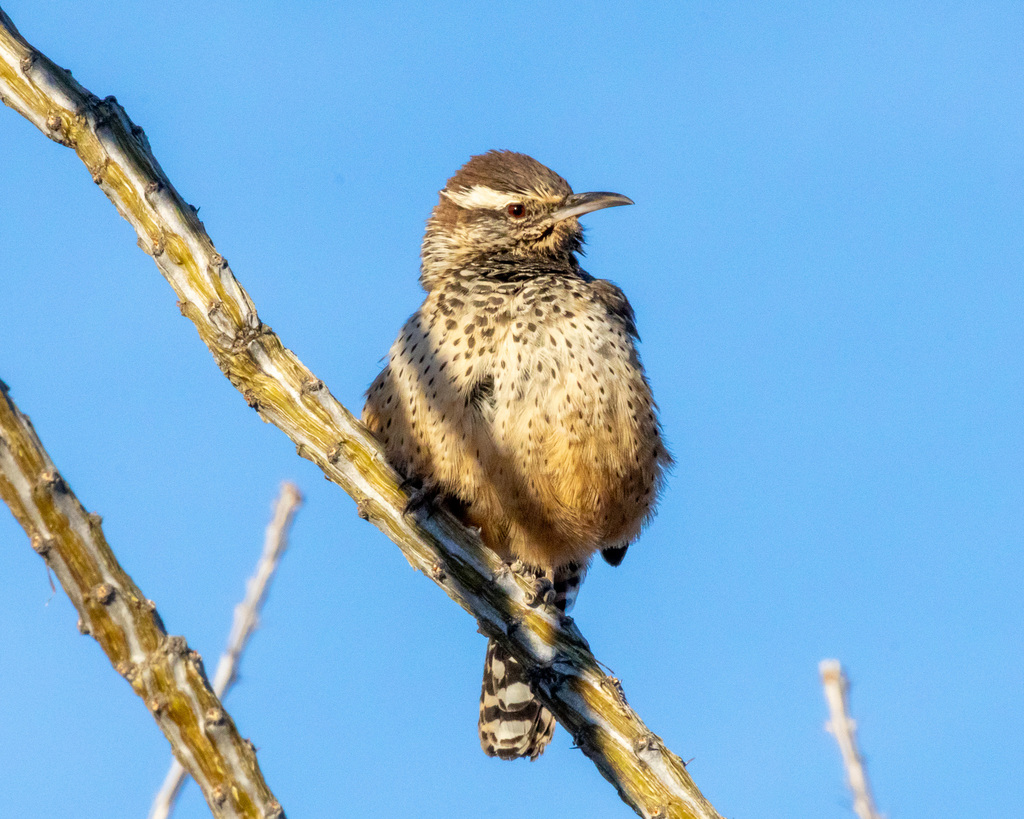
The cactus wren (Campylorhynchus brunneicapillus) is a species of wren that is endemic to the deserts of the southwestern United States and northern and central Mexico. It is the state bird of Arizona, and the largest wren in the United States. Its plumage is brown, with black and white spots as markings. It has a distinctive white eyebrow that sweeps to the nape of the neck. The chest is white, whereas the underparts are cinnamon-buff colored. Both sexes appear similar. The tail, as well as flight feathers, are barred in black and white. Their song is a loud raspy chirrup; akin in the description of some ornithologists to the sound of a car engine that will not start. It is well-adapted to its native desert environment, and the birds can meet their water needs from their diet which consists chiefly of insects, but also of some plant matter. The cactus wren is a poor flier and generally forages for food on the ground. Ornithologists generally recognize seven subspecies, with the exact taxonomy under dispute. Its common name derives from their frequenting desert cactus plants such as the saguaro and cholla, building nests, roosting, and seeking protection from predators among them. Its bulky and globular nests are constructed of plant material and lined with feathers. They do not migrate; instead, they establish and defend the territories around their nests where they live all year-round. It lives in pairs, or as family groups from late spring through winter. Pairing among cactus wrens is monogamous; in each breeding season, the males chiefly build nests, the females incubate eggs, and both parents feed the young. Populations have declined as the species faces threats related to human activities and habitat loss, although the species remains abundant. Habitat fragmentation and fire have been of particular concern, as the cactus wren is slow to disperse into new habitats. Introduced species have also hurt populations. Feral cats hunt many birds in urban settings, and invasive grasses take up valuable foraging space, reducing habitat size. Despite these threats, the cactus wren has proved adaptable. Cactus wrens have learned to coexist with humans effectively, using human materials and structures for nesting, and even learning to take insects from vehicle radiator grilles. The population still numbers in the millions, leading the International Union for Conservation of Nature to consider the cactus wren a species of least concern.
Gallery
Ajouter des photos
Partagez vos photos de cette espèce (jusqu'à 20 à la fois) : elles sont vérifiées automatiquement, puis publiées.
Répartition
Occurrences observées (données GBIF). Les zones hors aire d'origine peuvent indiquer une présence introduite ou invasive.
Sources et crédits
Informations provenant de plusieurs sources vérifiées. Dernière mise à jour : .
Crédits photos (8)
- Photo : @anyagor · CC BY-NC 4.0 · via iNaturalist
- Photo : Gilberto Ponce Tejeda (@poncetejedai) · CC BY-NC 4.0 · via iNaturalist
- Photo : Morgan G. (@dedicatedzoologist) · CC BY-NC 4.0 · via iNaturalist
- Photo : @jas1105 · CC BY-NC 4.0 · via iNaturalist
- Photo : Rachel Stringham (@restringham) · CC BY 4.0 · via iNaturalist
- Photo : Tyler Bishop (@zoology123) · CC BY 4.0 · via iNaturalist
- Photo : Rebecca Cowser (@becca_nh) · CC BY-NC 4.0 · via iNaturalist
- Photo : Daryl Bernard (@dbernard) · CC BY-NC 4.0 · via iNaturalist
Mentions de licence
Texte disponible sous licence CC BY-SA 4.0. Il adapte notamment Wikipedia (CC BY-SA) : Cactus wren (Wikipédia, auteurs dans l’historique de l’article).
- Taxonomie : GBIF Backbone Taxonomy (CC BY 4.0)
- Carte : occurrences GBIF, fond © contributeurs OpenStreetMap (ODbL)
- Statut de conservation : Liste rouge de l'UICN, via Wikidata (CC0)
Détail : Sources et licences.
Discussion (0)
Aucun message pour l’instant. Lancez la discussion sur cette fiche (sources, précisions, débats éditoriaux).
Connectez-vous pour participer à la discussion.