
Red-billed Quelea
Quelea quelea
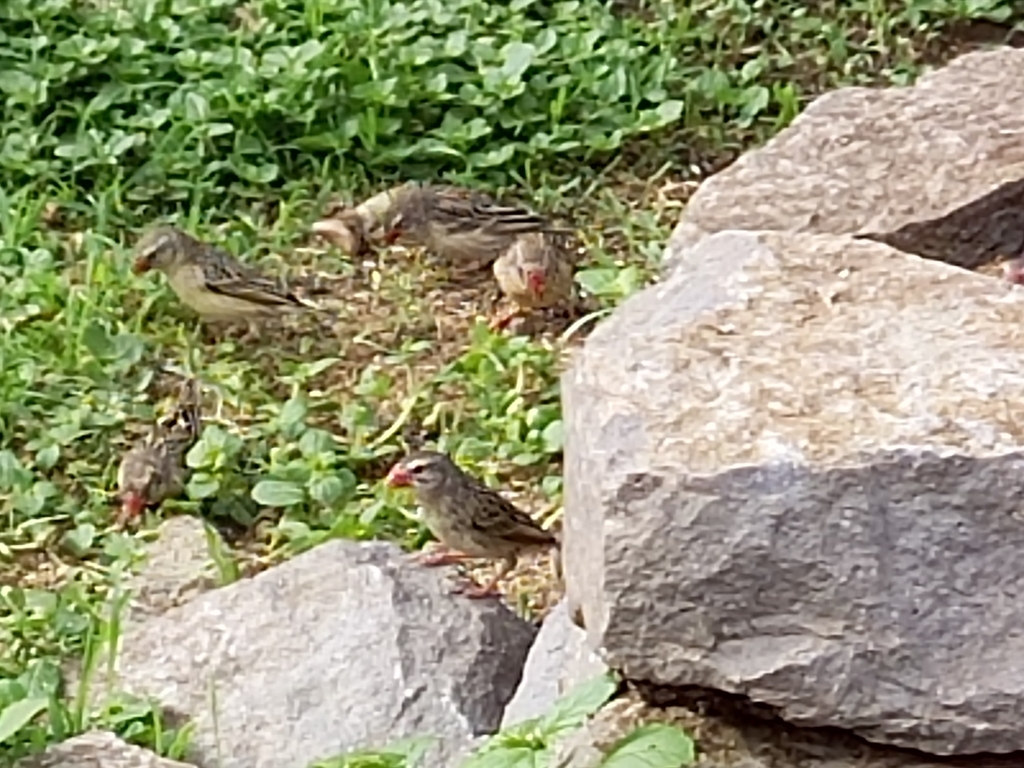
The red-billed quelea (; Quelea quelea), also known as the red-billed weaver or red-billed dioch, is a small, seasonally nomadic, sparrow-like bird of the weaver family, Ploceidae, native to sub-Saharan Africa.
- Kingdom
- Animalia
- Phylum
- Chordata
- Class
- Aves
- Order
- Passeriformes
- Family
- Ploceidae
- Genus
- Quelea
- Species
- Quelea quelea
Description
The red-billed quelea (; Quelea quelea), also known as the red-billed weaver or red-billed dioch, is a small, seasonally nomadic, sparrow-like bird of the weaver family, Ploceidae, native to sub-Saharan Africa. It is approximately 12 cm (4.7 in) long and weighs 15 to 26 g (0.53 to 0.92 oz). It was named by Linnaeus in 1758, who considered it a bunting, but Ludwig Reichenbach assigned it in 1850 to the new genus Quelea. Three subspecies are recognised, with Q. q. quelea occurring roughly from Senegal to Chad, Q. q. aethiopica from Sudan to Somalia and Tanzania, and Q. q. lathamii from Gabon to Mozambique and South Africa. Non-breeding birds have light underparts, striped brown upper parts, yellow-edged flight feathers and a reddish bill. Breeding females attain a yellowish bill. Breeding males have a black (or rarely white) facial mask, surrounded by a purplish, pinkish, rusty or yellowish wash on the head and breast. The species avoids forests, deserts and colder areas such as those at high altitude and in southern South Africa. It constructs oval roofed nests woven from strips of grass hanging from thorny branches, sugar cane or reeds. It breeds in very large colonies. The red-billed quelea feeds primarily on seeds of annual grasses, but also causes extensive damage to cereal crops. Therefore, it is sometimes called "Africa's feathered locust". The usual pest-control measures are spraying avicides or detonating fire-bombs in the enormous colonies during the night. Extensive control measures have been largely unsuccessful in limiting the quelea population. When food runs out, the species moves to locations of recent rainfall and plentiful grass seed; hence it exploits its food source very efficiently. It is regarded as the most numerous undomesticated bird on earth, with the total post-breeding population sometimes peaking at an estimated 1.5 billion individuals. It feeds in huge flocks of millions of individuals, with birds that run out of food at the rear flying over the entire group to a fresh feeding zone at the front, creating an image of a rolling cloud. The conservation status of red-billed quelea is least concern according to the IUCN Red List.
Gallery
Ajouter des photos
Partagez vos photos de cette espèce (jusqu'à 20 à la fois) : elles sont vérifiées automatiquement, puis publiées.
Répartition
Occurrences observées (données GBIF). Les zones hors aire d'origine peuvent indiquer une présence introduite ou invasive.
Sources et crédits
Informations provenant de plusieurs sources vérifiées. Dernière mise à jour : .
Crédits photos (8)
- Photo : A. Geremew (@ethio_nature) · CC BY-NC 4.0 · via iNaturalist
- Photo : @afropavo · CC BY-NC 4.0 · via iNaturalist
- Photo : @leuli · CC BY-NC 4.0 · via iNaturalist
- Photo : Deon du Plessis (@deondup) · CC BY-NC 4.0 · via iNaturalist
- Photo : Frank Hartmann (@frankhart) · CC BY-NC 4.0 · via iNaturalist
- Photo : Michael Bakker Paiva (@michaelbakkerpaiva) · CC BY 4.0 · via iNaturalist
- Photo : Ricardo Rodero Henández (@ricardo-anapri) · CC BY-NC 4.0 · via iNaturalist
- Photo : @bedazlesa · CC BY-NC 4.0 · via iNaturalist
Mentions de licence
Texte disponible sous licence CC BY-SA 4.0. Il adapte notamment Wikipedia (CC BY-SA) : Red-billed quelea (Wikipédia, auteurs dans l’historique de l’article).
- Taxonomie : GBIF Backbone Taxonomy (CC BY 4.0)
- Carte : occurrences GBIF, fond © contributeurs OpenStreetMap (ODbL)
- Statut de conservation : Liste rouge de l'UICN, via Wikidata (CC0)
Détail : Sources et licences.
Discussion (0)
Aucun message pour l’instant. Lancez la discussion sur cette fiche (sources, précisions, débats éditoriaux).
Connectez-vous pour participer à la discussion.