
Pied wheatear
Oenanthe pleschanka
The pied wheatear (Oenanthe pleschanka) is a wheatear, a small insectivorous passerine bird that was formerly classed as a member of the thrush family Turdidae, but is now more generally considered to be an Old World flycatcher (family…
- Kingdom
- Animalia
- Phylum
- Chordata
- Class
- Aves
- Order
- Passeriformes
- Family
- Muscicapidae
- Genus
- Oenanthe
- Species
- Oenanthe pleschanka
Description
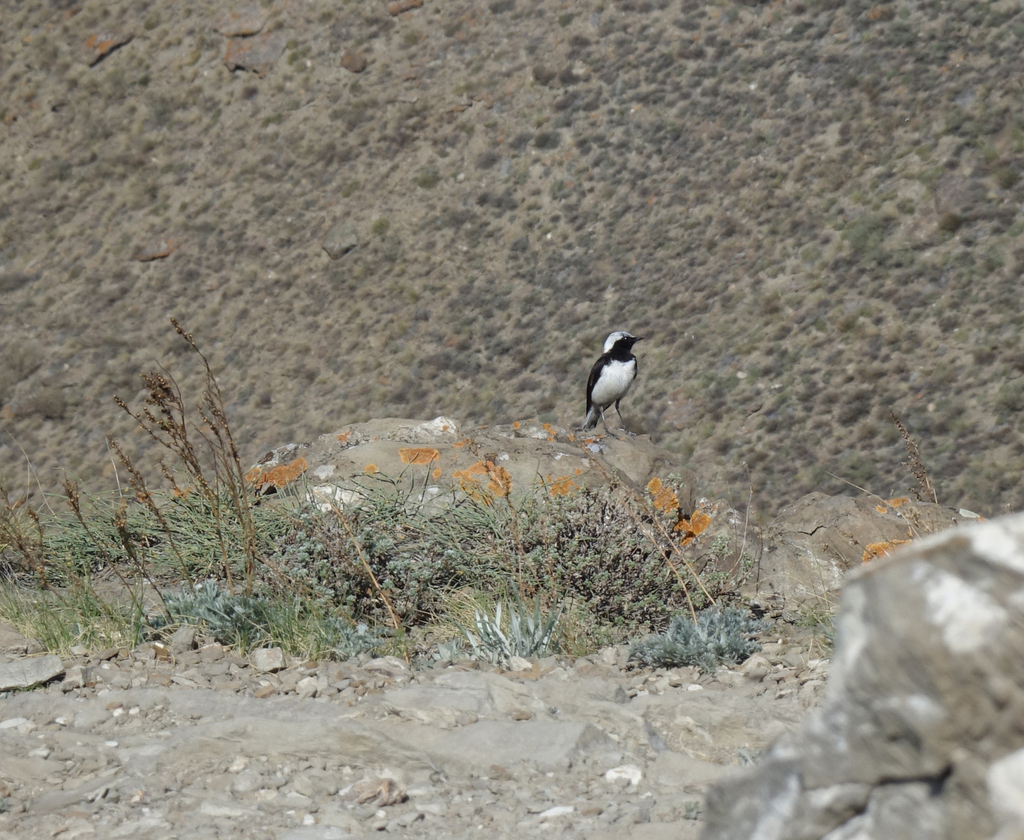
The pied wheatear (Oenanthe pleschanka) is a wheatear, a small insectivorous passerine bird that was formerly classed as a member of the thrush family Turdidae, but is now more generally considered to be an Old World flycatcher (family Muscicapidae). This migratory central Asiatic wheatear occurs from the extreme southeast of Europe to China, and has been found wintering in India and northeastern Africa. It is a very rare vagrant to western Europe. The male is a boldly marked white-and-black bird. The white crown tinged with brown contrasts with the black face and throat and white rump. The female is browner, and the head is washed with sandy buff. Females are darker than the females of the northern wheatear, look smaller and show less white on the rump. The tail feathers are white with characteristic black markings, which form an inverted black "T" pattern that resembles the tail of the western black-eared wheatear. This 14 centimetres (5.5 in) bird nests in open, stony, sparsely vegetated regions, laying four to six eggs in a hole, under a stone or in a rock crevice. The pied wheatear primarily eats insects but will also take seeds.
Gallery
Ajouter des photos
Partagez vos photos de cette espèce (jusqu'à 20 à la fois) : elles sont vérifiées automatiquement, puis publiées.
Répartition
Occurrences observées (données GBIF). Les zones hors aire d'origine peuvent indiquer une présence introduite ou invasive.
Sources et crédits
Informations provenant de plusieurs sources vérifiées. Dernière mise à jour : .
Crédits photos (8)
- Photo : Oleg Kosterin (@oleg_kosterin) · CC BY 4.0 · via iNaturalist
- Photo : Сергей Викторович Леденков (@serega1974) · CC BY-NC 4.0 · via iNaturalist
- Photo : @leuli · CC BY-NC 4.0 · via iNaturalist
- Photo : Dmitrii Risenberg (@dmitrii13) · CC BY-NC 4.0 · via iNaturalist
- Photo : Diana Kovacheva (@irtastan) · CC BY-NC 4.0 · via iNaturalist
- Photo : Иван Матершев (@merlu) · CC BY-NC 4.0 · via iNaturalist
- Photo : SIA (@igor_sikorskiy) · CC BY 4.0 · via iNaturalist
- Photo : @upandiyan · CC BY-NC 4.0 · via iNaturalist
Mentions de licence
Texte disponible sous licence CC BY-SA 4.0. Il adapte notamment Wikipedia (CC BY-SA) : Pied wheatear, Traquet pie (Wikipédia, auteurs dans l’historique de l’article).
- Taxonomie : GBIF Backbone Taxonomy (CC BY 4.0)
- Carte : occurrences GBIF, fond © contributeurs OpenStreetMap (ODbL)
- Statut de conservation : Liste rouge de l'UICN, via Wikidata (CC0)
Détail : Sources et licences.
Discussion (0)
Aucun message pour l’instant. Lancez la discussion sur cette fiche (sources, précisions, débats éditoriaux).
Connectez-vous pour participer à la discussion.