
Desert wheatear
Oenanthe deserti
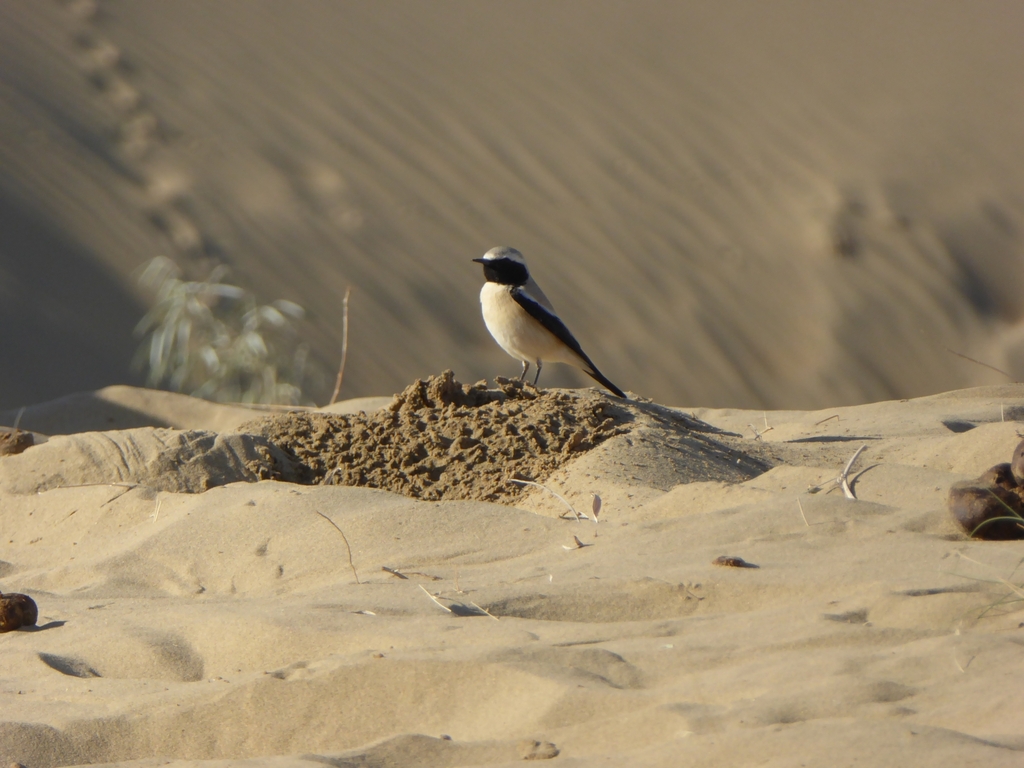
The desert wheatear (Oenanthe deserti) is a wheatear, a small passerine bird that was formerly classed as a member of the thrush family Turdidae, but is now more generally considered to be an Old World flycatcher (Muscicapidae).
- Kingdom
- Animalia
- Phylum
- Chordata
- Class
- Aves
- Order
- Passeriformes
- Family
- Muscicapidae
- Genus
- Oenanthe
- Species
- Oenanthe deserti
Description
The desert wheatear (Oenanthe deserti) is a wheatear, a small passerine bird that was formerly classed as a member of the thrush family Turdidae, but is now more generally considered to be an Old World flycatcher (Muscicapidae). It is a migratory insectivorous species, 14.5 to 15 cm (5.7 to 5.9 in) in length. Both western and eastern forms of the desert wheatear are rare vagrants to western Europe. The western desert wheatear breeds in the Sahara and the northern Arabian Peninsula. The eastern race is found in the semi-deserts of Central Asia and in winter in Pakistan and northeast Africa. The plumage of the upper parts of the male in summer is buff. The underparts are white with a buff tinge on the breast. The black on the face and throat extends to the shoulders, and there is distinct white superciliary stripe. The female is greyer above and buffer below and has no black on the throat, and in the winter plumage the black on the throat of the male is partially obscured by the white tips of the feathers. A distinguishing characteristic, in both sexes of all ages, is that the entire tail is black to the level of the upper tail-coverts. The desert wheatear feeds largely on insects which it picks up off the ground. It breeds in the spring when a clutch of usually four pale blue, slightly speckled eggs is laid in a well-concealed nest made of grasses, mosses and stems.
Gallery
Ajouter des photos
Partagez vos photos de cette espèce (jusqu'à 20 à la fois) : elles sont vérifiées automatiquement, puis publiées.
Répartition
Occurrences observées (données GBIF). Les zones hors aire d'origine peuvent indiquer une présence introduite ou invasive.
Sources et crédits
Informations provenant de plusieurs sources vérifiées. Dernière mise à jour : .
Crédits photos (8)
- Photo : Ben Costamagna (@bencostamagna) · CC BY 4.0 · via iNaturalist
- Photo : Ricardo Rodero Henández (@ricardo-anapri) · CC BY-NC 4.0 · via iNaturalist
- Photo : Алина Боксорн (@alinaboksorn) · CC BY-NC 4.0 · via iNaturalist
- Photo : Santiago Martín-Bravo (@martin-bravo) · CC BY 4.0 · via iNaturalist
- Photo : Houman Doroudi (@houman_doroudi) · CC BY-NC 4.0 · via iNaturalist
- Photo : @diklon · CC BY-NC 4.0 · via iNaturalist
- Photo : @kesangchunit · CC BY-NC 4.0 · via iNaturalist
- Photo : Hopeland (@hopeland) · CC BY 4.0 · via iNaturalist
Mentions de licence
Texte disponible sous licence CC BY-SA 4.0. Il adapte notamment Wikipedia (CC BY-SA) : Desert wheatear (Wikipédia, auteurs dans l’historique de l’article).
- Taxonomie : GBIF Backbone Taxonomy (CC BY 4.0)
- Carte : occurrences GBIF, fond © contributeurs OpenStreetMap (ODbL)
- Statut de conservation : Liste rouge de l'UICN, via Wikidata (CC0)
Détail : Sources et licences.
Discussion (0)
Aucun message pour l’instant. Lancez la discussion sur cette fiche (sources, précisions, débats éditoriaux).
Connectez-vous pour participer à la discussion.