
Passenger Pigeon
Ectopistes migratorius
The passenger pigeon or wild pigeon (Ectopistes migratorius) is an extinct species of pigeon that was endemic to North America.
- Kingdom
- Animalia
- Phylum
- Chordata
- Class
- Aves
- Order
- Columbiformes
- Family
- Columbidae
- Genus
- Ectopistes
- Species
- Ectopistes migratorius
Description
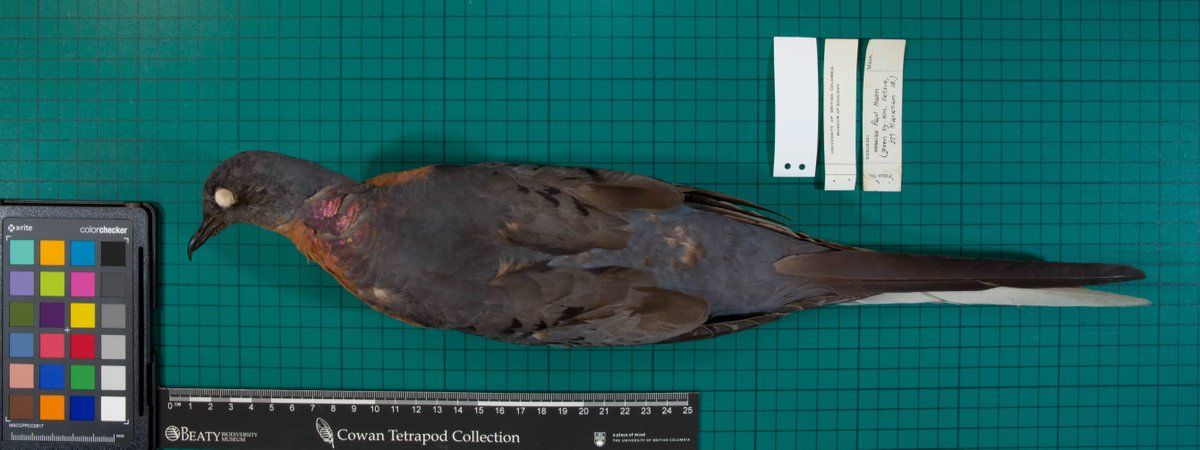
The passenger pigeon or wild pigeon (Ectopistes migratorius) is an extinct species of pigeon that was endemic to North America. Its common name is derived from the French word passager, meaning "passing by", due to the migratory habits of the species. The scientific name also refers to its migratory characteristics. The morphologically similar mourning dove (Zenaida macroura) was long thought to be its closest relative, and the two were at times confused, but genetic analysis has shown that the genus Patagioenas is more closely related to it than the Zenaida doves. The passenger pigeon was sexually dimorphic in size and coloration. The male was 390 to 410 mm (15.4 to 16.1 in) in length, mainly gray on the upperparts, lighter on the underparts, with iridescent bronze feathers on the neck, and black spots on the wings. The female was 380 to 400 mm (15.0 to 15.7 in), and was duller and browner than the male overall. The juvenile was similar to the female, but without iridescence. It mainly inhabited the deciduous forests of eastern North America and was also recorded elsewhere, but bred primarily around the Great Lakes. The pigeon migrated in enormous flocks, constantly searching for food, shelter, and breeding grounds, and was once the most abundant bird in North America, numbering around 3 billion, and possibly up to 5 billion. A very fast flyer, the passenger pigeon could reach a speed of 100 km/h (62 mph). The bird fed mainly on mast, and also fruits and invertebrates. It practiced communal roosting and communal breeding, and its extreme gregariousness may have been linked with searching for food and predator satiation. Passenger pigeons were hunted by Native Americans, but hunting intensified after the arrival of Europeans, particularly in the 19th century. Pigeon meat was commercialized as cheap food, resulting in hunting on a massive scale for many decades. There were several other factors contributing to the decline and subsequent extinction of the species, including shrinking of the large breeding populations necessary for preservation of the species and widespread deforestation, which destroyed its habitat. A slow decline between about 1800 and 1870 was followed by a rapid decline between 1870 and 1890. A historical plaque in Indiana states that the last confirmed wild passenger pigeon was shot in Laurel in 1902. The last captive birds were divided in three groups around the turn of the 20th century, some of which were photographed alive. Martha, thought to be the last passenger pigeon, died on September 1, 1914, at the Cincinnati Zoo. The eradication of the species is a notable example of anthropogenic extinction.
Gallery
Ajouter des photos
Partagez vos photos de cette espèce (jusqu'à 20 à la fois) : elles sont vérifiées automatiquement, puis publiées.
Répartition
Occurrences observées (données GBIF). Les zones hors aire d'origine peuvent indiquer une présence introduite ou invasive.
Sources et crédits
Informations provenant de plusieurs sources vérifiées. Dernière mise à jour : .
Crédits photos (10)
- Photo : Royal Ontario Museum Exhib. · CC0 (domaine public) · via GBIF
- Photo : Division of Birds · CC0 (domaine public) · via GBIF
- Photo : Division of Birds · CC0 (domaine public) · via GBIF
- Photo : Division of Birds · CC0 (domaine public) · via GBIF
- Photo : Division of Birds · CC0 (domaine public) · via GBIF
- Photo : David Sjölander · CC0 (domaine public) · via GBIF
- Photo : Donald E. Hurlbert · CC0 (domaine public) · via GBIF
- Photo : YPM Vertebrate Zoology staff · CC0 (domaine public) · via GBIF
- Photo : Division of Birds · CC0 (domaine public) · via GBIF
- Photo : Katie Sayers · CC0 (domaine public) · via GBIF
Mentions de licence
Texte disponible sous licence CC BY-SA 4.0. Il adapte notamment Wikipedia (CC BY-SA) : Passenger pigeon (Wikipédia, auteurs dans l’historique de l’article).
- Taxonomie : GBIF Backbone Taxonomy (CC BY 4.0)
- Carte : occurrences GBIF, fond © contributeurs OpenStreetMap (ODbL)
- Statut de conservation : Liste rouge de l'UICN, via Wikidata (CC0)
Détail : Sources et licences.
Discussion (0)
Aucun message pour l’instant. Lancez la discussion sur cette fiche (sources, précisions, débats éditoriaux).
Connectez-vous pour participer à la discussion.