
Village Weaver
Ploceus cucullatus
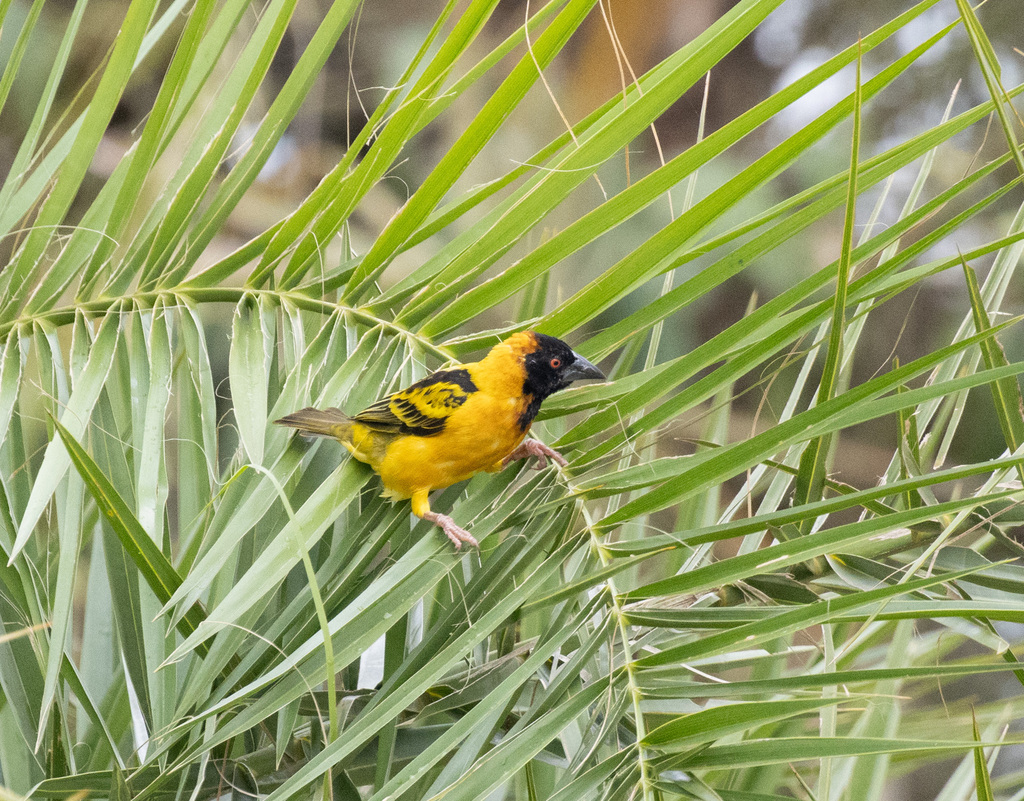
The village weaver (Ploceus cucullatus), also known as the spotted-backed weaver or black-headed weaver (the latter leading to easy confusion with P. melanocephalus), is a bird species in the family Ploceidae found in much of…
- Kingdom
- Animalia
- Phylum
- Chordata
- Class
- Aves
- Order
- Passeriformes
- Family
- Ploceidae
- Genus
- Ploceus
- Species
- Ploceus cucullatus
Description
The village weaver (Ploceus cucullatus), also known as the spotted-backed weaver or black-headed weaver (the latter leading to easy confusion with P. melanocephalus), is a bird species in the family Ploceidae found in much of sub-Saharan Africa. It has also been introduced to Portugal and Venezuela as well as to the islands of Hispaniola, Martinique, Puerto Rico, Mauritius and Réunion. This often abundant species occurs in a wide range of open or semi-open habitats, including woodlands and human habitation, and frequently forms large noisy colonies in towns, villages, and hotel grounds. This weaver builds a large coarsely woven nest made of grass and leaf strips with a downward-facing entrance, which is suspended from a branch in a tree. Two or three eggs are laid. Village weavers are colonial breeders, so many nests may hang from one tree. Village weavers feed principally on seeds and grain, and can be a crop pest, but readily take insects, especially when feeding young, which partially redresses the damage to agriculture. The calls of this bird include harsh buzzes and chattering.
Gallery
Ajouter des photos
Partagez vos photos de cette espèce (jusqu'à 20 à la fois) : elles sont vérifiées automatiquement, puis publiées.
Répartition
Occurrences observées (données GBIF). Les zones hors aire d'origine peuvent indiquer une présence introduite ou invasive.
Sources et crédits
Informations provenant de plusieurs sources vérifiées. Dernière mise à jour : .
Crédits photos (8)
- Photo : @avocat · CC BY 4.0 · via iNaturalist
- Photo : Oswaldo Hernández (@ozzhernandez) · CC BY-NC 4.0 · via iNaturalist
- Photo : Roland Godon (@rolandgodon) · CC BY 4.0 · via iNaturalist
- Photo : Monica Ndlovu (@monica_ndlovu) · CC BY-NC 4.0 · via iNaturalist
- Photo : @thierry_aebischer_chinko · CC BY-NC 4.0 · via iNaturalist
- Photo : Nicolaas Myburgh (@nicolaasmyburgh) · CC BY-NC 4.0 · via iNaturalist
- Photo : Thomas Desloges (@tdesloges) · CC BY-NC 4.0 · via iNaturalist
- Photo : @leekelai · CC BY-NC 4.0 · via iNaturalist
Mentions de licence
Texte disponible sous licence CC BY-SA 4.0. Il adapte notamment Wikipedia (CC BY-SA) : Village weaver (Wikipédia, auteurs dans l’historique de l’article).
- Taxonomie : GBIF Backbone Taxonomy (CC BY 4.0)
- Carte : occurrences GBIF, fond © contributeurs OpenStreetMap (ODbL)
- Statut de conservation : Liste rouge de l'UICN, via Wikidata (CC0)
Détail : Sources et licences.
Discussion (0)
Aucun message pour l’instant. Lancez la discussion sur cette fiche (sources, précisions, débats éditoriaux).
Connectez-vous pour participer à la discussion.