
Sage Grouse
Centrocercus urophasianus
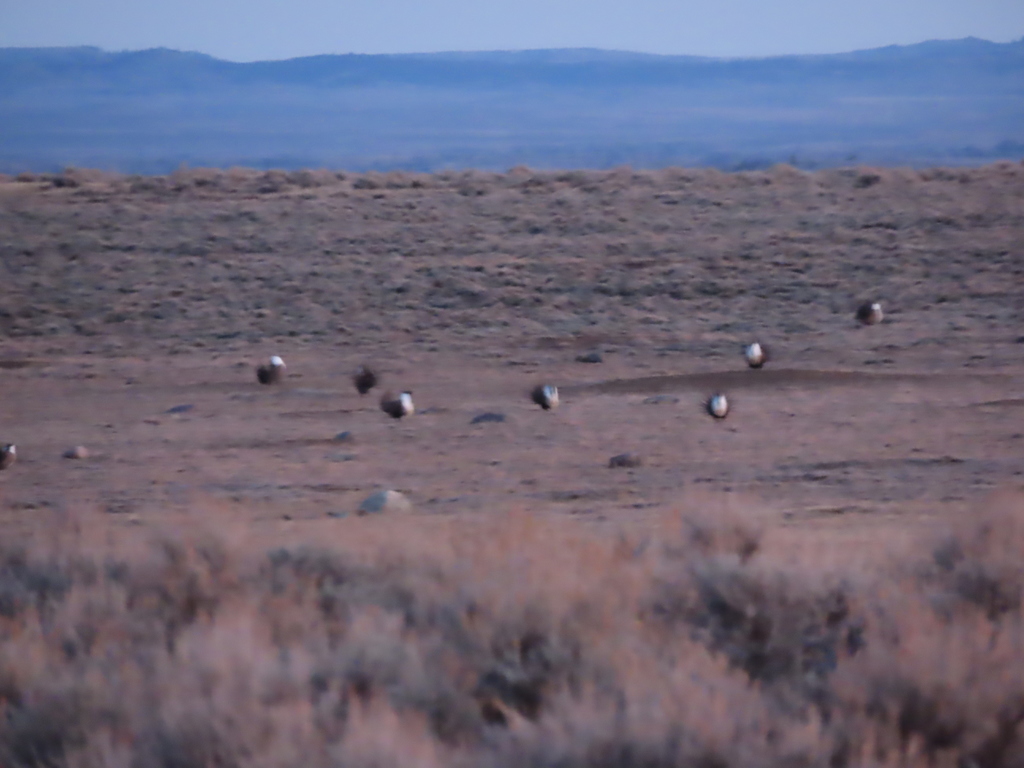
The greater sage-grouse (Centrocercus urophasianus), also known as the sagehen, is the largest grouse in North America.
- Kingdom
- Animalia
- Phylum
- Chordata
- Class
- Aves
- Order
- Galliformes
- Family
- Phasianidae
- Genus
- Centrocercus
- Species
- Centrocercus urophasianus
Description
The greater sage-grouse (Centrocercus urophasianus), also known as the sagehen, is the largest grouse in North America. Its range is sagebrush country in the western United States and southern Alberta and Saskatchewan, Canada. It was known as simply the sage grouse until the Gunnison sage-grouse was recognized as a separate species in 2000. The Mono Basin population of sage grouse may also be distinct. The greater sage-grouse is a permanent resident in its breeding grounds but may move short distances to lower elevations during winter. It makes use of a complex lek system in mating and nests on the ground under sagebrush or grass patches. It forages on the ground, mainly eating sagebrush but also other plants and insects. Greater sage-grouse do not have a muscular crop and are not able to digest hard seeds like other grouse. The species is in decline across its range due to habitat loss, and has been recognized as threatened or near threatened by several national and international organizations.
Gallery
Ajouter des photos
Partagez vos photos de cette espèce (jusqu'à 20 à la fois) : elles sont vérifiées automatiquement, puis publiées.
Répartition
Occurrences observées (données GBIF). Les zones hors aire d'origine peuvent indiquer une présence introduite ou invasive.
Sources et crédits
Informations provenant de plusieurs sources vérifiées. Dernière mise à jour : .
Crédits photos (8)
- Photo : Mike Lesnik (@mikelesnik) · CC BY-NC 4.0 · via iNaturalist
- Photo : Amelia Ryan (@abr) · CC BY-NC 4.0 · via iNaturalist
- Photo : Mike Lesnik (@mikelesnik) · CC BY-NC 4.0 · via iNaturalist
- Photo : Duane A. Dyer (@duanedyer) · CC BY-NC 4.0 · via iNaturalist
- Photo : Giavanna (Gigi) Fernandez (@wildergeeg) · CC BY-NC 4.0 · via iNaturalist
- Photo : @jamesjarrett00 · CC BY-NC 4.0 · via iNaturalist
- Photo : @luisalza · CC BY-NC 4.0 · via iNaturalist
- Photo : Liam Pentangelo (@liam_pentangelo) · CC BY-NC 4.0 · via iNaturalist
Mentions de licence
Texte disponible sous licence CC BY-SA 4.0. Il adapte notamment Wikipedia (CC BY-SA) : Greater sage-grouse (Wikipédia, auteurs dans l’historique de l’article).
- Taxonomie : GBIF Backbone Taxonomy (CC BY 4.0)
- Carte : occurrences GBIF, fond © contributeurs OpenStreetMap (ODbL)
- Statut de conservation : Liste rouge de l'UICN, via Wikidata (CC0)
Détail : Sources et licences.
Discussion (0)
Aucun message pour l’instant. Lancez la discussion sur cette fiche (sources, précisions, débats éditoriaux).
Connectez-vous pour participer à la discussion.