
Plushcap
Catamblyrhynchus diadema
The plushcap (Catamblyrhynchus diadema) is a species of bird in the tanager family Thraupidae and it is the only member of the genus Catamblyrhynchus.
- Kingdom
- Animalia
- Phylum
- Chordata
- Class
- Aves
- Order
- Passeriformes
- Family
- Thraupidae
- Genus
- Catamblyrhynchus
- Species
- Catamblyrhynchus diadema
Description
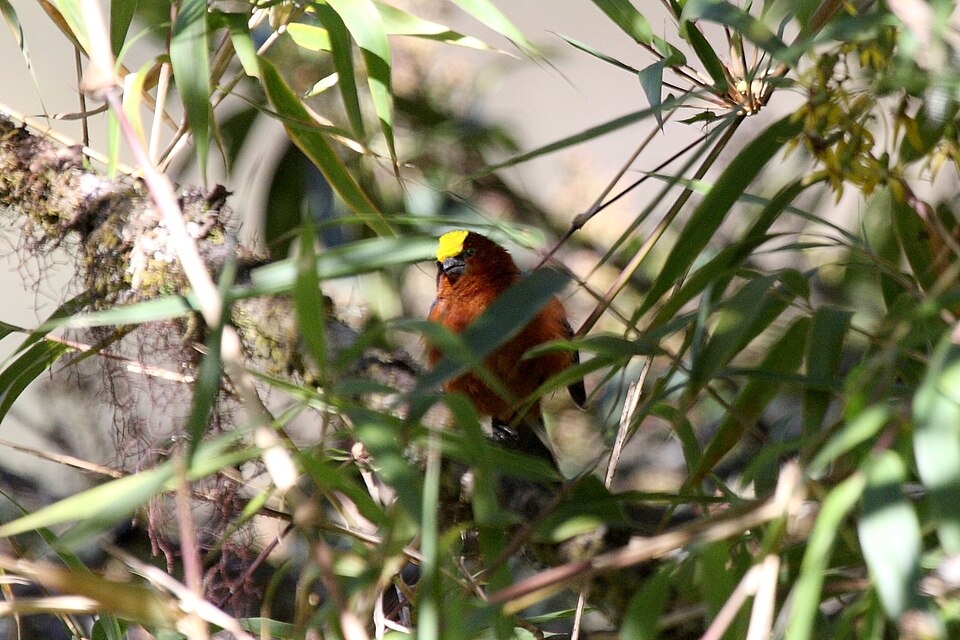
The plushcap (Catamblyrhynchus diadema) is a species of bird in the tanager family Thraupidae and it is the only member of the genus Catamblyrhynchus. The plushcap is one of the most distinctive of all Neotropical passerines in both its appearance and behavior. The plushcap was in its own family until recently when it was grouped with the tanagers. The bill is broad and black. The body is a chestnut color with a bright golden-yellow forecrown. The forecrown is made up of stiff feathers. It has been speculated that these short, dense feathers are less susceptible to feather wear and more resistant to moisture than typical feathers. This may be an adaptation for its specialized feeding mode, in which it probes into dense whorls of bamboo for its prey items. They are found at high elevations from northern Venezuela south to Argentina, including the coastal mountains of Venezuela and the Andes of Colombia, Ecuador, Peru, Bolivia, and extreme northwestern Argentina. They live in montane forests and secondary forests near bamboo. They forage for insects inside the bamboo. They will eat small insects, berries, and small plant matter. The bird is very distinct and is not confused with many other birds. It stands out from the other tanagers, only possibly being confused with the golden-crowned tanager despite the golden-crowned tanager being blue. Its natural habitat is humid montane forests and it is always found in close association with Chusquea bamboo. It is typically found at elevations between 1,800 and 3,500 m (5,900–11,500 ft).
Gallery
Ajouter des photos
Partagez vos photos de cette espèce (jusqu'à 20 à la fois) : elles sont vérifiées automatiquement, puis publiées.
Répartition
Occurrences observées (données GBIF). Les zones hors aire d'origine peuvent indiquer une présence introduite ou invasive.
Sources et crédits
Informations provenant de plusieurs sources vérifiées. Dernière mise à jour : .
Crédits photos (6)
- Photo : Dominic Sherony · CC BY-SA 2.0
- Photo : Oswaldo Hernández (@ozzhernandez) · CC BY-NC 4.0 · via iNaturalist
- Photo : Edwin Múnera Chavarría (@edwinmunera) · CC BY-NC 4.0 · via iNaturalist
- Photo : Sebas Arango (@sebasjuglans) · CC BY-NC 4.0 · via iNaturalist
- Photo : Don Wellmann (@don54) · CC0 (domaine public) · via iNaturalist
- Photo : Mark Brown (@markb249) · CC BY-NC 4.0 · via iNaturalist
Mentions de licence
Texte disponible sous licence CC BY-SA 4.0. Il adapte notamment Tête-de-peluche couronné, Wikipedia (CC BY-SA) : Plushcap (Wikipédia, auteurs dans l’historique de l’article).
- Taxonomie : GBIF Backbone Taxonomy (CC BY 4.0)
- Carte : occurrences GBIF, fond © contributeurs OpenStreetMap (ODbL)
- Statut de conservation : Liste rouge de l'UICN, via Wikidata (CC0)
Détail : Sources et licences.
Discussion (0)
Aucun message pour l’instant. Lancez la discussion sur cette fiche (sources, précisions, débats éditoriaux).
Connectez-vous pour participer à la discussion.