
Indian Paradise Flycatcher
Terpsiphone paradisi
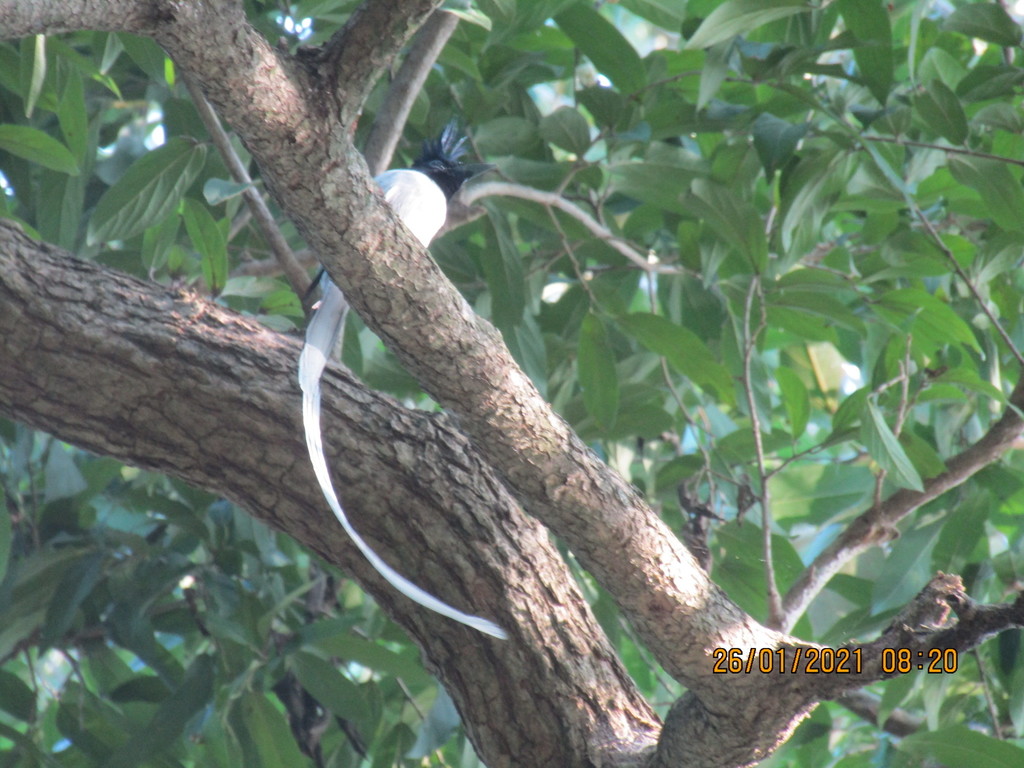
The Indian paradise flycatcher (Terpsiphone paradisi) is a medium-sized passerine bird in the monarch flycatcher family, Monarchidae.
- Kingdom
- Animalia
- Phylum
- Chordata
- Class
- Aves
- Order
- Passeriformes
- Family
- Monarchidae
- Genus
- Terpsiphone
- Species
- Terpsiphone paradisi
Description
The Indian paradise flycatcher (Terpsiphone paradisi) is a medium-sized passerine bird in the monarch flycatcher family, Monarchidae. As the global population is considered stable, it has been listed as Least Concern on the IUCN Red List since 2004. It is native to the Indian subcontinent, with resident and breeding populations in most of Bangladesh, India and Sri Lanka, as well as parts of Afghanistan, Bhutan, China, Myanmar, Nepal, Pakistan, Tajikistan and Turkmenistan. The Indian paradise flycatcher has a length of 20–50 cm (7.9–19.7 in) from beak to tail. Males have elongated central tail feathers, and a black and rufous plumage in some populations, while others have white plumage. Females are short-tailed with rufous wings and a black head. Indian paradise flycatchers feed on insects, including grasshoppers, butterflies and praying mantises, as well as flies. The Indian paradise flycatcher typically captures prey in the air, kills it by hitting it on a rock, and then extracts the inner parts. often below a densely canopied tree.
Gallery
Ajouter des photos
Partagez vos photos de cette espèce (jusqu'à 20 à la fois) : elles sont vérifiées automatiquement, puis publiées.
Répartition
Occurrences observées (données GBIF). Les zones hors aire d'origine peuvent indiquer une présence introduite ou invasive.
Sources et crédits
Informations provenant de plusieurs sources vérifiées. Dernière mise à jour : .
Crédits photos (8)
- Photo : Vidhya Swaminathan (@vidswami) · CC BY-NC 4.0 · via iNaturalist
- Photo : Priyadarshini (@devispiders) · CC BY-NC 4.0 · via iNaturalist
- Photo : Sunandav (@sunandav) · CC BY-NC 4.0 · via iNaturalist
- Photo : Bhanu Prakash (@bhanuprakash1) · CC BY-NC 4.0 · via iNaturalist
- Photo : Jagdish Singh Negi (@negi) · CC BY 4.0 · via iNaturalist
- Photo : Afsar Nayakkan (@afsarnayakkan) · CC BY 4.0 · via iNaturalist
- Photo : Anil Kumar Verma (@anil_kumar_verma) · CC BY-NC 4.0 · via iNaturalist
- Photo : Siddhant Mhetre (@siddhantmhetre09) · CC BY-NC 4.0 · via iNaturalist
Mentions de licence
Texte disponible sous licence CC BY-SA 4.0. Il adapte notamment Wikipedia (CC BY-SA) : Indian paradise flycatcher (Wikipédia, auteurs dans l’historique de l’article).
- Taxonomie : GBIF Backbone Taxonomy (CC BY 4.0)
- Carte : occurrences GBIF, fond © contributeurs OpenStreetMap (ODbL)
- Statut de conservation : Liste rouge de l'UICN, via Wikidata (CC0)
Détail : Sources et licences.
Discussion (0)
Aucun message pour l’instant. Lancez la discussion sur cette fiche (sources, précisions, débats éditoriaux).
Connectez-vous pour participer à la discussion.