
African Paradise Flycatcher
Terpsiphone viridis
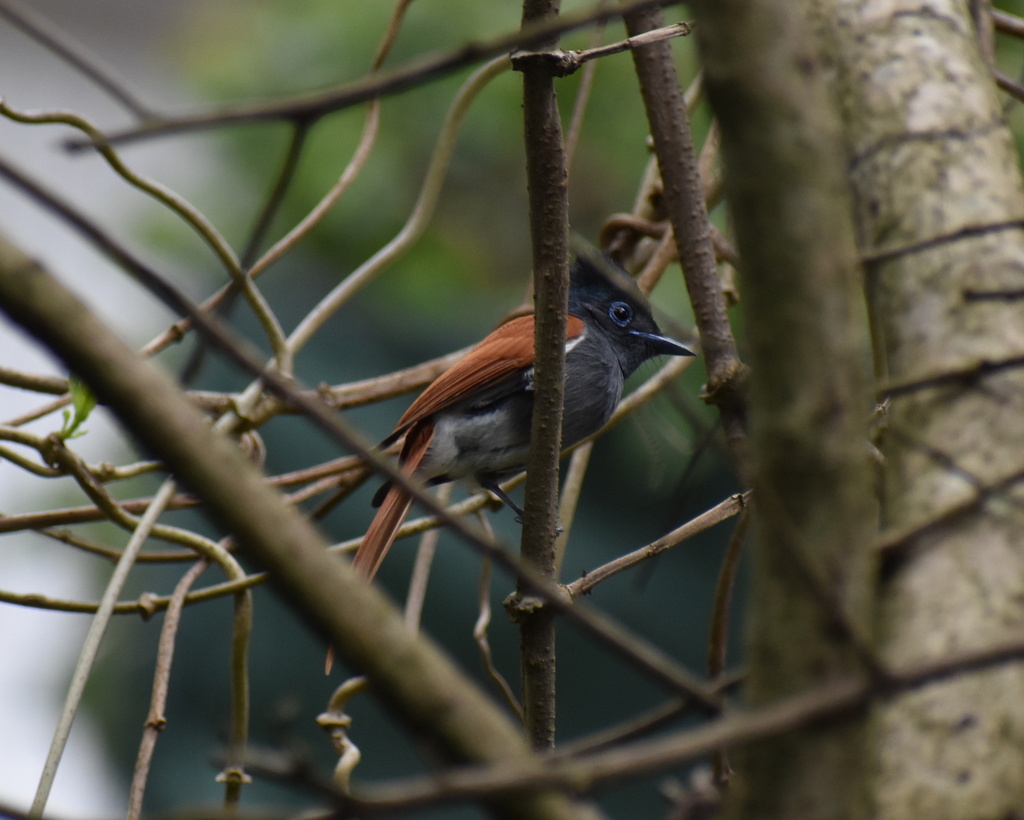
The African paradise flycatcher (Terpsiphone viridis) is a medium-sized passerine bird.
- Kingdom
- Animalia
- Phylum
- Chordata
- Class
- Aves
- Order
- Passeriformes
- Family
- Monarchidae
- Genus
- Terpsiphone
- Species
- Terpsiphone viridis
Description
The African paradise flycatcher (Terpsiphone viridis) is a medium-sized passerine bird. The two central tail feathers of the male are extended into streamers that commonly are more than twice as long as the body. The female tail feathers are of moderate length and without streamers. The upper parts of the male body, wings, and tail are boldly coloured in chestnut or rusty shades, but the underparts and the head are variably grey to blue-gray, with the head of the mature male being darker, commonly glossy black with greenish highlights. The beak and other bare areas, including a wattle ring round the eye, match the colour of the surrounding feathers. The female coloration is similar, though not so showy and glossy and with the head paler. The African paradise flycatcher feeds mainly on insects. It builds a neat cup nest in which it lays a clutch, usually of two or three eggs. It generally inhabits open forest and savanna, and is a locally common resident breeder in Africa south of the Sahara. The International Union for Conservation of Nature has listed it as being of "least concern". This is the original bird known as ọ̀kín in Yorùbá language instead of the peacock.
Gallery
Ajouter des photos
Partagez vos photos de cette espèce (jusqu'à 20 à la fois) : elles sont vérifiées automatiquement, puis publiées.
Répartition
Occurrences observées (données GBIF). Les zones hors aire d'origine peuvent indiquer une présence introduite ou invasive.
Sources et crédits
Informations provenant de plusieurs sources vérifiées. Dernière mise à jour : .
Crédits photos (8)
- Photo : Sunčana Bradley (@suncana) · CC BY 4.0 · via iNaturalist
- Photo : Decklan (@decklan) · CC BY-NC 4.0 · via iNaturalist
- Photo : Clayton H. Ziemke (@chziemke) · CC BY-NC 4.0 · via iNaturalist
- Photo : Sadam MAMA (@sadam_toro) · CC BY-NC 4.0 · via iNaturalist
- Photo : Nicolaas Myburgh (@nicolaasmyburgh) · CC BY-NC 4.0 · via iNaturalist
- Photo : Joyal Ak (@joyboi) · CC BY-NC 4.0 · via iNaturalist
- Photo : Roy Holtzkampf (@royholtzkampf) · CC BY-NC 4.0 · via iNaturalist
- Photo : Claude Kolwelter (@claudekolwelter) · CC BY 4.0 · via iNaturalist
Mentions de licence
Texte disponible sous licence CC BY-SA 4.0. Il adapte notamment Wikipedia (CC BY-SA) : African paradise flycatcher (Wikipédia, auteurs dans l’historique de l’article).
- Taxonomie : GBIF Backbone Taxonomy (CC BY 4.0)
- Carte : occurrences GBIF, fond © contributeurs OpenStreetMap (ODbL)
- Statut de conservation : Liste rouge de l'UICN, via Wikidata (CC0)
Détail : Sources et licences.
Discussion (0)
Aucun message pour l’instant. Lancez la discussion sur cette fiche (sources, précisions, débats éditoriaux).
Connectez-vous pour participer à la discussion.