
Tufted Tit-tyrant
Anairetes parulus
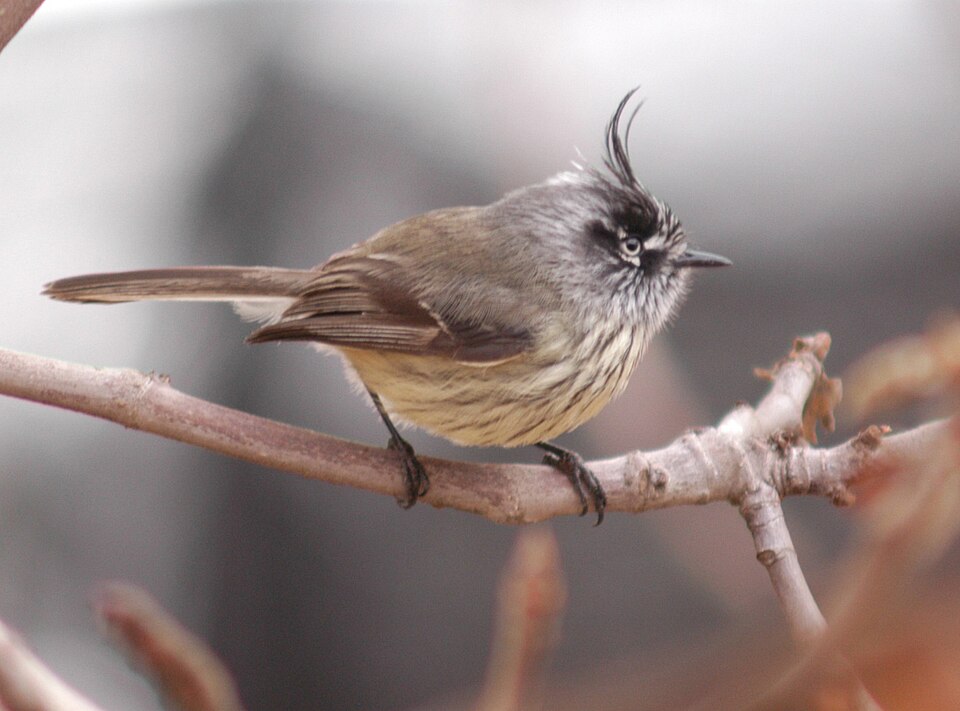
The tufted tit-tyrant (Anairetes parulus) is a species of bird in the tyrant flycatcher family Tyrannidae.
- Kingdom
- Animalia
- Phylum
- Chordata
- Class
- Aves
- Order
- Passeriformes
- Family
- Tyrannidae
- Genus
- Anairetes
- Species
- Anairetes parulus
Description
The tufted tit-tyrant (Anairetes parulus) is a species of bird in the tyrant flycatcher family Tyrannidae. This species is found in western South America; its range stretches from southern Colombia south along the Andes mountains to Tierra del Fuego. It prefers to live in upper montane forests and shrublands; however, it is a habitat generalist and can be found across a wide range of ecosystems. The tufted tit-tyrant has three subspecies, including the nominate subspecies Anairetes parulus parulus, A. p. aequatorialis, and A. p. patagonicus, and is very closely related to the Juan Fernández tit-tyrant. It is very small with a distinctive and conspicuous crest. The bird's head is black overall with white supraloral and postocular stripes. Its dull grayish-brown back contrasts with its white throat and breast that are covered with black streaks and pale, unmarked yellow underbelly. There are few noticeable differences in plumage between the subspecies. It is a vocal flycatcher with a broad repertoire of songs. This tit-tyrant defends its territory only against other tit-tyrants and, except for the southernmost population, is non-migratory. The tufted tit-tyrant feeds mainly on a variety of insects that it hunts on or from small shrubs, typically by perch gleaning. It normally hunts in pairs. The breeding season varies for this bird depending on its geographical location. Two to three eggs are normally laid twice a year in a cup-shaped nest made of root fibers, grasses, and lichens and lined with small feathers. The tufted tit-tyrant is listed as a species of least concern due to its large range and population.
Gallery
Ajouter des photos
Partagez vos photos de cette espèce (jusqu'à 20 à la fois) : elles sont vérifiées automatiquement, puis publiées.
Répartition
Occurrences observées (données GBIF). Les zones hors aire d'origine peuvent indiquer une présence introduite ou invasive.
Sources et crédits
Informations provenant de plusieurs sources vérifiées. Dernière mise à jour : .
Crédits photos (6)
- Photo : Ayna cumplido · CC BY-SA 4.0
- Photo : DANIEL OSCAR MOLINA (@danieloscarmolina) · CC BY-NC 4.0 · via iNaturalist
- Photo : Omar Miranda B. (@frogbo) · CC BY-NC 4.0 · via iNaturalist
- Photo : Fabrício Mil Homens Riella (@bariza) · CC BY 4.0 · via iNaturalist
- Photo : Federico Muñoz (@fede_munoz) · CC0 (domaine public) · via iNaturalist
- Photo : Carlos Schmidtutz (@carlossch) · CC BY-NC 4.0 · via iNaturalist
Mentions de licence
Texte disponible sous licence CC BY-SA 4.0. Il adapte notamment Wikipedia (CC BY-SA) : Tufted tit-tyrant (Wikipédia, auteurs dans l’historique de l’article).
- Taxonomie : GBIF Backbone Taxonomy (CC BY 4.0)
- Carte : occurrences GBIF, fond © contributeurs OpenStreetMap (ODbL)
- Statut de conservation : Liste rouge de l'UICN, via Wikidata (CC0)
Détail : Sources et licences.
Discussion (0)
Aucun message pour l’instant. Lancez la discussion sur cette fiche (sources, précisions, débats éditoriaux).
Connectez-vous pour participer à la discussion.