
Whinchat
Saxicola rubetra
The whinchat (Saxicola rubetra) is a small migratory passerine bird breeding in Europe and western Asia and wintering in central Africa.
- Kingdom
- Animalia
- Phylum
- Chordata
- Class
- Aves
- Order
- Passeriformes
- Family
- Muscicapidae
- Genus
- Saxicola
- Species
- Saxicola rubetra
Description
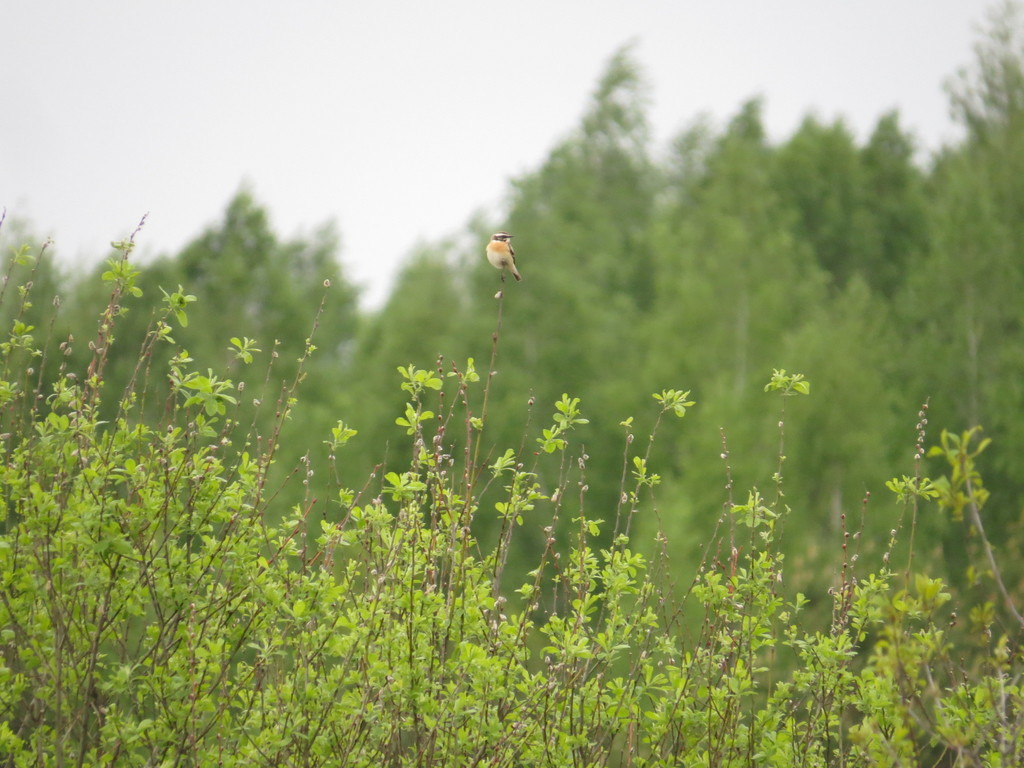
The whinchat (Saxicola rubetra) is a small migratory passerine bird breeding in Europe and western Asia and wintering in central Africa. At one time considered to be in the thrush family, Turdidae, it is now placed in the Old World flycatcher family, Muscicapidae. Both sexes have a strong supercilium, brownish upper parts mottled darker, a pale throat and breast, a pale buff to whitish belly, and a blackish tail with white bases to the outer tail feathers, but in the breeding season, the male has an orange-buff throat and breast. The whinchat is a solitary species, favouring open grassy country with rough vegetation and scattered small shrubs. It perches in elevated locations ready to pounce on the insects and other small invertebrates that form its diet. The nest is built by the female on the ground in coarse vegetation, with a clutch of four to seven eggs being laid. The hen incubates the eggs for about thirteen days and then both parents feed the nestlings. Fledging takes place about eighteen days after hatching and the parents continue to feed the young for another fortnight. Moulting takes place in late summer before the migration southwards, and again on the wintering grounds in Africa before the migration northwards in spring. The whinchat is a common species with a wide range and the International Union for Conservation of Nature has classified it as being of "least concern".
Gallery
Ajouter des photos
Partagez vos photos de cette espèce (jusqu'à 20 à la fois) : elles sont vérifiées automatiquement, puis publiées.
Répartition
Occurrences observées (données GBIF). Les zones hors aire d'origine peuvent indiquer une présence introduite ou invasive.
Sources et crédits
Informations provenant de plusieurs sources vérifiées. Dernière mise à jour : .
Crédits photos (8)
- Photo : Евгений Скляр (@ev_sklyar) · CC BY-NC 4.0 · via iNaturalist
- Photo : Анна Мостовая (@ankhen) · CC BY-NC 4.0 · via iNaturalist
- Photo : @amantedarmanin · CC BY 4.0 · via iNaturalist
- Photo : Nadezhda Kiseleva (@nk2305) · CC BY 4.0 · via iNaturalist
- Photo : Viktor Parkhomenko (@viktor_parkhomenko) · CC BY-NC 4.0 · via iNaturalist
- Photo : Павел (@palfedor) · CC BY-NC 4.0 · via iNaturalist
- Photo : Надежда Поповцева (@nadezhdapopovceva0305) · CC BY-NC 4.0 · via iNaturalist
- Photo : @tj_-_76 · CC BY-NC 4.0 · via iNaturalist
Mentions de licence
Texte disponible sous licence CC BY-SA 4.0. Il adapte notamment Wikipedia (CC BY-SA) : Whinchat (Wikipédia, auteurs dans l’historique de l’article).
- Taxonomie : GBIF Backbone Taxonomy (CC BY 4.0)
- Carte : occurrences GBIF, fond © contributeurs OpenStreetMap (ODbL)
- Statut de conservation : Liste rouge de l'UICN, via Wikidata (CC0)
Détail : Sources et licences.
Discussion (0)
Aucun message pour l’instant. Lancez la discussion sur cette fiche (sources, précisions, débats éditoriaux).
Connectez-vous pour participer à la discussion.