
Cherry-throated Tanager
Nemosia rourei
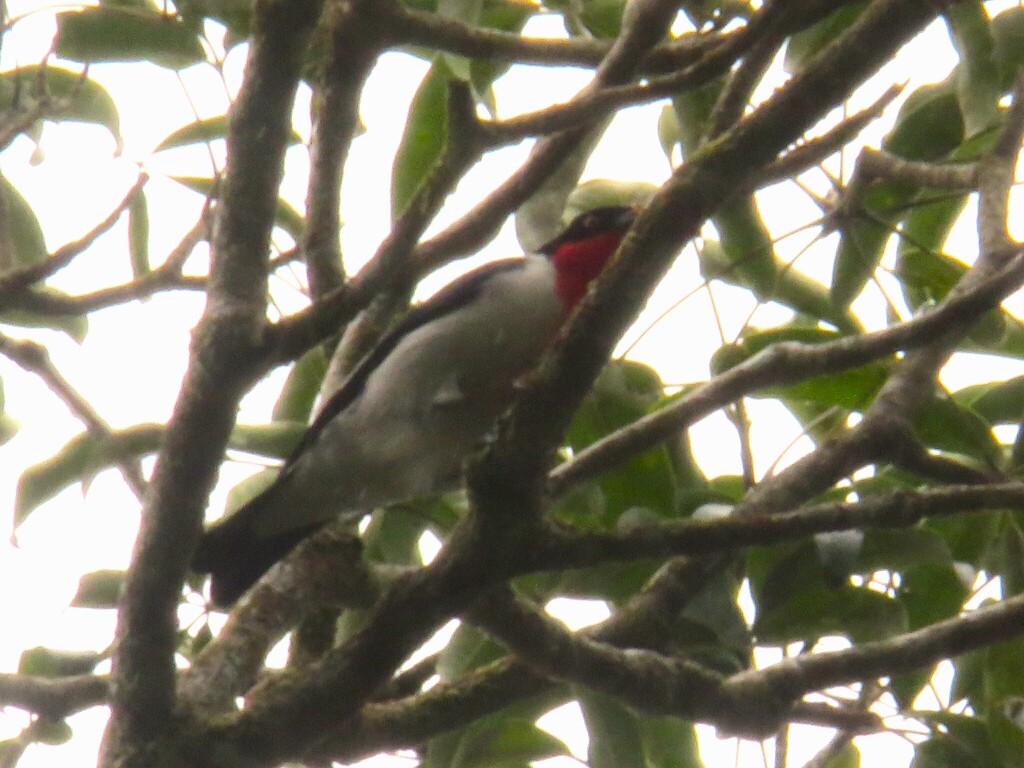
The cherry-throated tanager (Nemosia rourei) is a critically endangered bird native to the Atlantic Forest in Brazil.
- Kingdom
- Animalia
- Phylum
- Chordata
- Class
- Aves
- Order
- Passeriformes
- Family
- Thraupidae
- Genus
- Nemosia
- Species
- Nemosia rourei
Description
The cherry-throated tanager (Nemosia rourei) is a critically endangered bird native to the Atlantic Forest in Brazil. Since its description in 1870, based on a shot specimen, there had been no confirmed sightings for more than 100 years, and by the end of the 20th century, it was thought that the species was already extinct. The cherry-throated tanager was rediscovered in 1998 on a private fazenda in the state of Espírito Santo, and soon after on two other sites in the same state, though it disappeared from the fazenda after 2006. By the end of 2023, 20 individuals were known and the total population was estimated to be fewer than 50 birds. The main threat to its survival is the large-scale destruction of the old-growth rainforest that it requires, and in 2018 it was estimated that the species was restricted to a total area of just 31 km2 (12 sq mi). The cherry-throated tanager belongs to the tanager family Thraupidae. It is thought to be most closely related to the only other member of its genus, the hooded tanager, though this has yet to be confirmed by genetic analysis. It has striking gray, black, and white plumage, with a distinctive red throat patch that tapers towards the breast. The yellow or dark amber eyes contrast with a black face mask. Its call is clear and far-carrying. A social species, it lives in flocks that comprise up to eight birds and have large home ranges, in one case about 420 hectares (1,000 acres). Its diet consists of invertebrates such as ants and caterpillars, preferably picked from the horizontal, lichen-covered branches of large trees; the birds have also been observed feeding on fruit. The birds breed once a year, building a cup nest of beard lichen and spider web. Known nests have contained up to four eggs, and other members of the flock help the breeding pair to construct the nest, feed the chicks, and deter predators.
Gallery
Ajouter des photos
Partagez vos photos de cette espèce (jusqu'à 20 à la fois) : elles sont vérifiées automatiquement, puis publiées.
Répartition
Occurrences observées (données GBIF). Les zones hors aire d'origine peuvent indiquer une présence introduite ou invasive.
Sources et crédits
Informations provenant de plusieurs sources vérifiées. Dernière mise à jour : .
Crédits photos (8)
- Photo : @rogeriotruglio · CC BY-NC 4.0 · via iNaturalist
- Photo : @falquetto · CC BY-NC 4.0 · via iNaturalist
- Photo : @rogeriotruglio · CC BY-NC 4.0 · via iNaturalist
- Photo : Fernando Berg (@natgeoberg) · CC BY-NC 4.0 · via iNaturalist
- Photo : Jens Bokelaar (@jensbokelaar) · CC BY-NC 4.0 · via iNaturalist
- Photo : @gutomag · CC BY-NC 4.0 · via iNaturalist
- Photo : Miguel P. Biasoli (@miguelpbiasoli) · CC BY-NC 4.0 · via iNaturalist
- Photo : Athos José (@athossouza) · CC BY 4.0 · via iNaturalist
Mentions de licence
Texte disponible sous licence CC BY-SA 4.0. Il adapte notamment Wikipedia (CC BY-SA) : Cherry-throated tanager (Wikipédia, auteurs dans l’historique de l’article).
- Taxonomie : GBIF Backbone Taxonomy (CC BY 4.0)
- Carte : occurrences GBIF, fond © contributeurs OpenStreetMap (ODbL)
- Statut de conservation : Liste rouge de l'UICN, via Wikidata (CC0)
Détail : Sources et licences.
Discussion (0)
Aucun message pour l’instant. Lancez la discussion sur cette fiche (sources, précisions, débats éditoriaux).
Connectez-vous pour participer à la discussion.