
Scarlet-and-white Tanager
Chrysothlypis salmoni
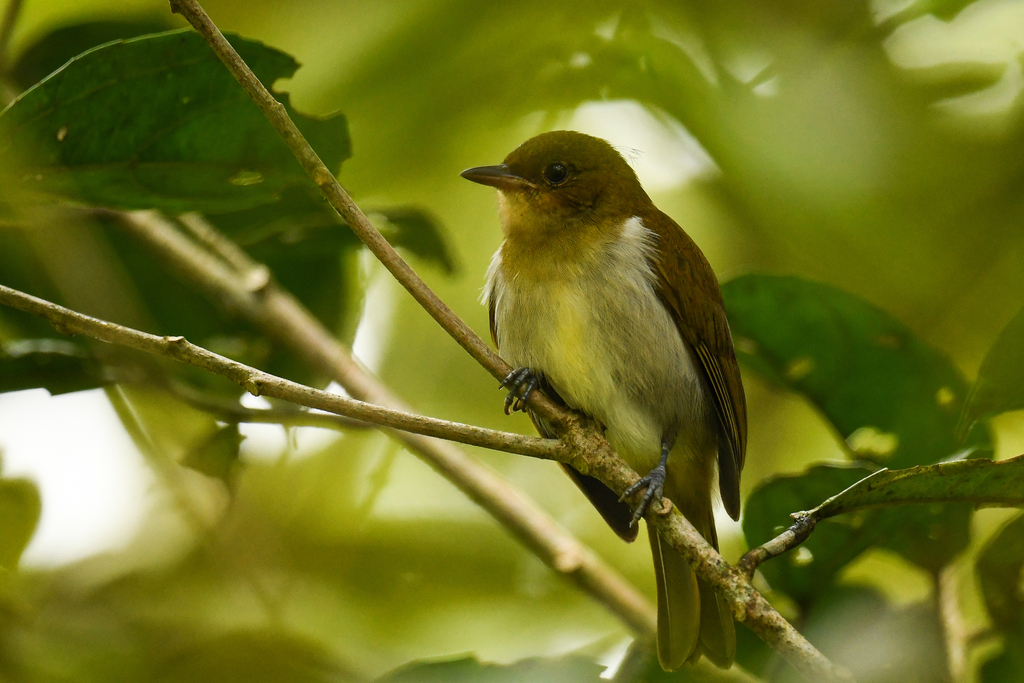
The scarlet-and-white tanager (Chrysothlypis salmoni) is a species of bird in the family Thraupidae.
- Kingdom
- Animalia
- Phylum
- Chordata
- Class
- Aves
- Order
- Passeriformes
- Family
- Thraupidae
- Genus
- Chrysothlypis
- Species
- Chrysothlypis salmoni
Description
The scarlet-and-white tanager (Chrysothlypis salmoni) is a species of bird in the family Thraupidae. It is found in Colombia and northern Ecuador. Its natural habitats are subtropical or tropical moist lowland forests and heavily degraded former forest. The male is highly distinctive and has bright scarlet upperparts, darker red wings and undertail coverts, and white underparts with a scarlet median stripe running down the throat and belly. Females are patterned like the males, but are olive-brown instead of scarlet. The scarlet-and-white tanager is found in secondary growth and disturbed vegetation, mostly between elevations of 25–1,200 m (100–3,900 ft), but sometimes up to elevations of 1,700 m (5,600 ft). It feeds mainly on fruit and arthropods. Foraging occurs singly, in pairs, or in groups of up to six, and it can be found in mixed-species flocks with other tanagers, especially those in the genus Tangara. The scarlet-and-white tanager is listed as least concern by the International Union for Conservation of Nature (IUCN) on the IUCN Red List, due to its large range and relative commonness. It is threatened by increasing deforestation throughout its range, especially in foothills, but is unlikely to be in immediate danger due to its affinity for disturbed habitats.
Gallery
Ajouter des photos
Partagez vos photos de cette espèce (jusqu'à 20 à la fois) : elles sont vérifiées automatiquement, puis publiées.
Répartition
Occurrences observées (données GBIF). Les zones hors aire d'origine peuvent indiquer une présence introduite ou invasive.
Sources et crédits
Informations provenant de plusieurs sources vérifiées. Dernière mise à jour : .
Crédits photos (8)
- Photo : Maryse (@rollier) · CC BY-NC 4.0 · via iNaturalist
- Photo : Jeffrey H. Skevington (@jhskevington) · CC BY-NC 4.0 · via iNaturalist
- Photo : @gabovinasco1 · CC BY-NC 4.0 · via iNaturalist
- Photo : Jeffrey H. Skevington (@jhskevington) · CC BY-NC 4.0 · via iNaturalist
- Photo : Maryse (@rollier) · CC BY-NC 4.0 · via iNaturalist
- Photo : Robert Blackmore (@bobbyblackmore) · CC BY 4.0 · via iNaturalist
- Photo : Christoph Moning (@christoph_moning) · CC BY 4.0 · via iNaturalist
- Photo : Blair Dudeck (@blairdudeck) · CC BY 4.0 · via iNaturalist
Mentions de licence
Texte disponible sous licence CC BY-SA 4.0. Il adapte notamment Tangara rouge, Wikipedia (CC BY-SA) : Scarlet-and-white tanager (Wikipédia, auteurs dans l’historique de l’article).
- Taxonomie : GBIF Backbone Taxonomy (CC BY 4.0)
- Carte : occurrences GBIF, fond © contributeurs OpenStreetMap (ODbL)
- Statut de conservation : Liste rouge de l'UICN, via Wikidata (CC0)
Détail : Sources et licences.
Discussion (0)
Aucun message pour l’instant. Lancez la discussion sur cette fiche (sources, précisions, débats éditoriaux).
Connectez-vous pour participer à la discussion.