
Magpie Tanager
Cissopis leverianus
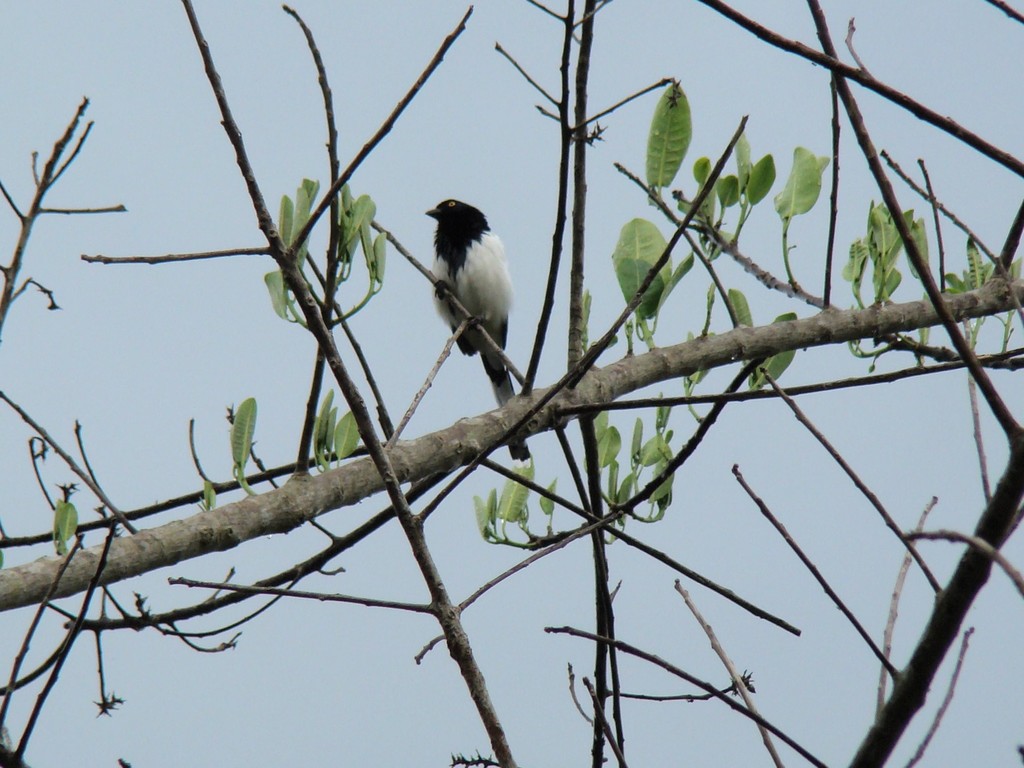
The magpie tanager (Cissopis leverianus) is a South American species of tanager.
- Kingdom
- Animalia
- Phylum
- Chordata
- Class
- Aves
- Order
- Passeriformes
- Family
- Thraupidae
- Genus
- Cissopis
- Species
- Cissopis leverianus
Description
The magpie tanager (Cissopis leverianus) is a South American species of tanager. It is the only member of the monotypic genus Cissopis. As suggested by its common name, this blue-black and white species is superficially reminiscent of a European magpie. With a total length of 25–30 cm (9.8–11.8 in), a large percentage of which is tail, it is the longest species of tanager. It weighs 69–76 g (2.4–2.7 oz). It is widespread in humid tropical and subtropical woodland, plantations, second growth, and parks in South America east of the Andes. It is absent from drier regions (such as the Caatinga) and most of north-eastern Brazil. In densely forested regions, it mainly occurs in relatively open sections (such as near major rivers). In such regions it is spreading with deforestation, which opens up the habitat. It is largely restricted to lowlands, but occurs up to an altitude of 2,000 m (6,600 ft) on the east Andean slopes. It is common throughout most of its range, but rarer in the Guianas. It typically occurs in conspicuous, noisy pairs or groups of up to 10 individuals and commonly takes part in mixed-species flocks. It often moves its long tail up and down. It eats seeds, fruits, and insects. The cup-shaped nest is lined with grass, leaves, or other plant materials and is located low in trees near the ground or in shrubs in dense vegetation. The 2 eggs are reddish-brown with brown spots. The incubation time is 12–13 days in captivity.
Gallery
Ajouter des photos
Partagez vos photos de cette espèce (jusqu'à 20 à la fois) : elles sont vérifiées automatiquement, puis publiées.
Répartition
Occurrences observées (données GBIF). Les zones hors aire d'origine peuvent indiquer une présence introduite ou invasive.
Sources et crédits
Informations provenant de plusieurs sources vérifiées. Dernière mise à jour : .
Crédits photos (8)
- Photo : Edson Guilherme (@edson_guilherme) · CC BY-NC 4.0 · via iNaturalist
- Photo : @rogeriotruglio · CC BY-NC 4.0 · via iNaturalist
- Photo : Yantza Farm, Zamora-Chinchipe, Ecuador (@yantzafarm) · CC BY-NC 4.0 · via iNaturalist
- Photo : Edson Guilherme (@edson_guilherme) · CC BY-NC 4.0 · via iNaturalist
- Photo : Pablo Bombín (@bombin) · CC BY 4.0 · via iNaturalist
- Photo : @roegoo · CC BY-NC 4.0 · via iNaturalist
- Photo : César María Aguilar Gómez (@tiracantos) · CC BY-NC 4.0 · via iNaturalist
- Photo : @rogeriotruglio · CC BY-NC 4.0 · via iNaturalist
Mentions de licence
Texte disponible sous licence CC BY-SA 4.0. Il adapte notamment Tangara pillurion, Wikipedia (CC BY-SA) : Magpie tanager (Wikipédia, auteurs dans l’historique de l’article).
- Taxonomie : GBIF Backbone Taxonomy (CC BY 4.0)
- Carte : occurrences GBIF, fond © contributeurs OpenStreetMap (ODbL)
- Statut de conservation : Liste rouge de l'UICN, via Wikidata (CC0)
Détail : Sources et licences.
Discussion (0)
Aucun message pour l’instant. Lancez la discussion sur cette fiche (sources, précisions, débats éditoriaux).
Connectez-vous pour participer à la discussion.