
Masked Crimson Tanager
Ramphocelus nigrogularis
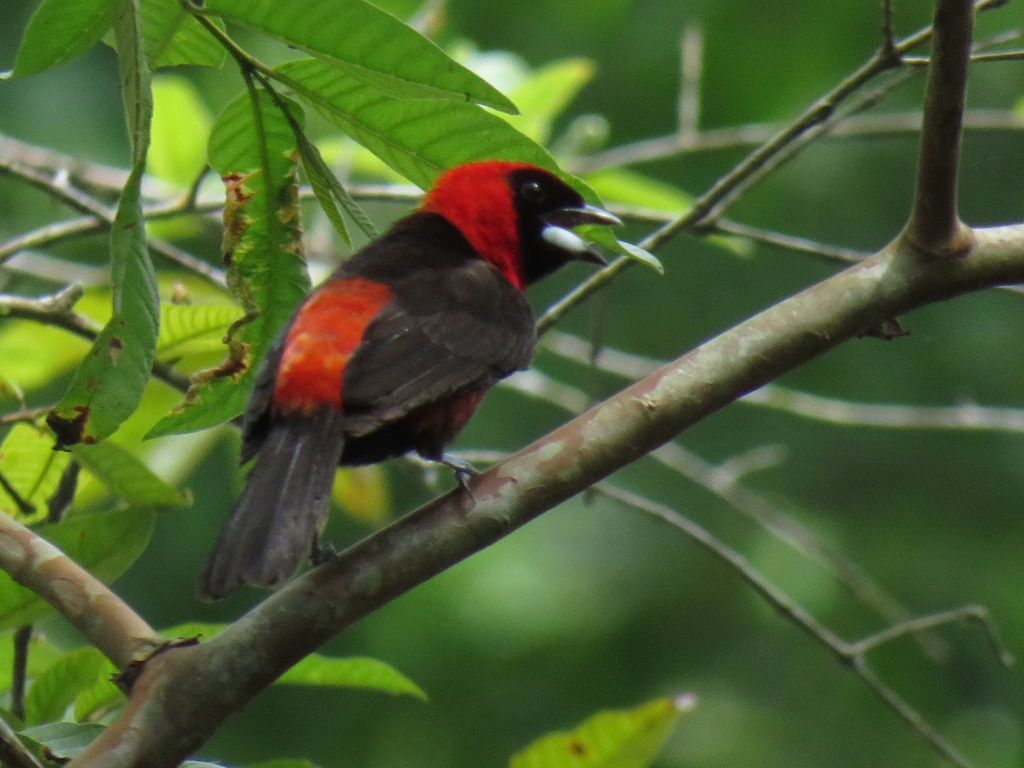
The masked crimson tanager (Ramphocelus nigrogularis) is a species of bird in the family Thraupidae.
- Kingdom
- Animalia
- Phylum
- Chordata
- Class
- Aves
- Order
- Passeriformes
- Family
- Thraupidae
- Genus
- Ramphocelus
- Species
- Ramphocelus nigrogularis
Description
The masked crimson tanager (Ramphocelus nigrogularis) is a species of bird in the family Thraupidae. It is found in Bolivia, Brazil, Colombia, Ecuador, Peru, and Venezuela. Its natural habitats are subtropical or tropical swamps and subtropical or tropical moist shrubland. The masked crimson tanager was first described by German naturalist Johann Baptist von Spix in 1825. Its species name is derived from the Latin words niger "black", and gularis "throated". It is one of nine species of brightly coloured tanagers of the genus Ramphocelus. Mitochondrial DNA evidence indicates its closest relative is the crimson-backed tanager (R. dimidiatus), and the two split around 800,000 years ago. Measuring 18 to 19 cm (7 to 7.5 in) in length, the adult male has a black face, wings, mantle, belly and tail, and is a bright red elsewhere in its plumage. The bill has a silver sheen. The female resembles the male but has a brownish belly and duller plumage overall, while the juvenile is duller still. It resembles the vermilion tanager (Calochaetes coccineus) but the latter lives at higher altitudes. The masked crimson tanager makes a high-pitched single note variously transcribed as tchlink or "tink", and a simple melody often sung at dawn. The masked crimson tanager is found across Amazonia and is abundant. It prefers to dwell near bodies of water such as lakes, swamps or rivers, generally at altitudes below 600 m (2,000 ft). Masked crimson tanagers move about in troops of 10 to 12 birds. The species can form mixed species flocks with the silver-beaked tanager (Ramphocelus carbo). It is frugivorous (fruit-eating).
Gallery
Ajouter des photos
Partagez vos photos de cette espèce (jusqu'à 20 à la fois) : elles sont vérifiées automatiquement, puis publiées.
Répartition
Occurrences observées (données GBIF). Les zones hors aire d'origine peuvent indiquer une présence introduite ou invasive.
Sources et crédits
Informations provenant de plusieurs sources vérifiées. Dernière mise à jour : .
Crédits photos (8)
- Photo : Vanesa Cruz Jumbo (@vkcruzjumbo) · CC BY-NC 4.0 · via iNaturalist
- Photo : @jpmoorman · CC BY-NC 4.0 · via iNaturalist
- Photo : Evan Hessels (@ehessels) · CC BY-NC 4.0 · via iNaturalist
- Photo : Gerold Morrison (@gmcycle) · CC BY-NC 4.0 · via iNaturalist
- Photo : Jeremiah Leach (@sapper11) · CC BY-NC 4.0 · via iNaturalist
- Photo : Holger Beck (@holgerbeck) · CC BY-NC 4.0 · via iNaturalist
- Photo : Tristan Jobin (@ziggypop74) · CC BY 4.0 · via iNaturalist
- Photo : Russ Namitz (@russnamitz) · CC0 (domaine public) · via iNaturalist
Mentions de licence
Texte disponible sous licence CC BY-SA 4.0. Il adapte notamment Wikipedia (CC BY-SA) : Masked crimson tanager (Wikipédia, auteurs dans l’historique de l’article).
- Taxonomie : GBIF Backbone Taxonomy (CC BY 4.0)
- Carte : occurrences GBIF, fond © contributeurs OpenStreetMap (ODbL)
- Statut de conservation : Liste rouge de l'UICN, via Wikidata (CC0)
Détail : Sources et licences.
Discussion (0)
Aucun message pour l’instant. Lancez la discussion sur cette fiche (sources, précisions, débats éditoriaux).
Connectez-vous pour participer à la discussion.