
Silver-beaked Tanager
Ramphocelus carbo
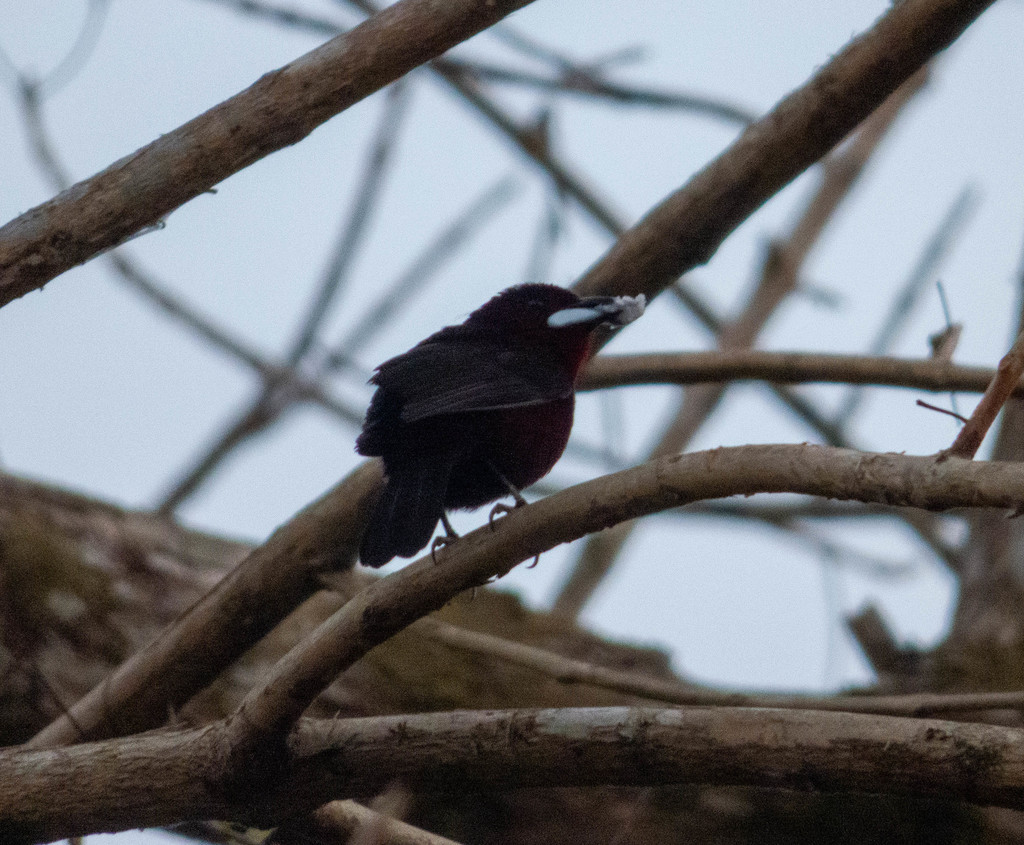
The silver-beaked tanager (Ramphocelus carbo) is a medium-sized passerine bird.
- Kingdom
- Animalia
- Phylum
- Chordata
- Class
- Aves
- Order
- Passeriformes
- Family
- Thraupidae
- Genus
- Ramphocelus
- Species
- Ramphocelus carbo
Description
The silver-beaked tanager (Ramphocelus carbo) is a medium-sized passerine bird. This tanager is a resident breeder in South America from eastern Colombia and Venezuela south to Paraguay and central Brazil, Peru and on Trinidad. It is common and conspicuous. Silver-beaked tanagers are 18 centimetres (7 in) long and weigh 25 grams (0.88 oz). Adult males are velvety crimson black with a deep crimson throat and breast. The upper mandible of the bill is black, but the enlarged lower mandible is bright silver in appearance. The bill is pointed upwards in display. The female is much duller, with brownish upperparts, reddish brown underparts and a black bill. There is considerable plumage variation between the various subspecies, differing mainly in the degree of contrast between the upperparts and the throat and breast. It occurs in light woodland and cultivated areas. The bulky cup nest is usually built in a bush, and the normal clutch is two green-blue eggs blotched with black-brown. The female incubates the eggs for 11–13 days before they hatch. The chicks fledge after another 11–12 days. Individuals may live at least 11 years in the wild. These are social birds which eat mainly fruit, but vines, nectar, short grass and insects are also taken. The silver-beaked tanager is often seen in groups of six to ten, frequently giving a call described as cheeng. Its song is a slow thin kick-wick. The silver-beaked tanager was first described by the German naturalist Peter Simon Pallas in 1764 and given the binomial name Lanius carbo.
Gallery
Ajouter des photos
Partagez vos photos de cette espèce (jusqu'à 20 à la fois) : elles sont vérifiées automatiquement, puis publiées.
Répartition
Occurrences observées (données GBIF). Les zones hors aire d'origine peuvent indiquer une présence introduite ou invasive.
Sources et crédits
Informations provenant de plusieurs sources vérifiées. Dernière mise à jour : .
Crédits photos (8)
- Photo : Manuel Zárate López (@manuelzarate) · CC BY-NC 4.0 · via iNaturalist
- Photo : Odebrecht, Clarisse (@clarisseodebrecht) · CC BY-NC 4.0 · via iNaturalist
- Photo : Lana (@lana_klemencic) · CC BY-NC 4.0 · via iNaturalist
- Photo : Nelson Wisnik (@nelson_wisnik) · CC BY-NC 4.0 · via iNaturalist
- Photo : Vinicius Augusto De Souza (@vinisouza) · CC BY 4.0 · via iNaturalist
- Photo : Giovany Andre Alfonso Forero (@tinguagiovany) · CC BY-NC 4.0 · via iNaturalist
- Photo : @eliot_rbls · CC BY-NC 4.0 · via iNaturalist
- Photo : @jeremdelajungle · CC BY-NC 4.0 · via iNaturalist
Mentions de licence
Texte disponible sous licence CC BY-SA 4.0. Il adapte notamment Wikipedia (CC BY-SA) : Silver-beaked tanager (Wikipédia, auteurs dans l’historique de l’article).
- Taxonomie : GBIF Backbone Taxonomy (CC BY 4.0)
- Carte : occurrences GBIF, fond © contributeurs OpenStreetMap (ODbL)
- Statut de conservation : Liste rouge de l'UICN, via Wikidata (CC0)
Détail : Sources et licences.
Discussion (0)
Aucun message pour l’instant. Lancez la discussion sur cette fiche (sources, précisions, débats éditoriaux).
Connectez-vous pour participer à la discussion.