
Australasian Swamphen
Porphyrio melanotus
The Australasian swamphen (Porphyrio melanotus), commonly known as the pūkeko in New Zealand, is a striking and socially complex bird found in Oceania, including eastern Indonesia (the Moluccas, Aru and Kai Islands), Papua New Guinea,…
- Kingdom
- Animalia
- Phylum
- Chordata
- Class
- Aves
- Order
- Gruiformes
- Family
- Rallidae
- Genus
- Porphyrio
- Species
- Porphyrio melanotus
Description
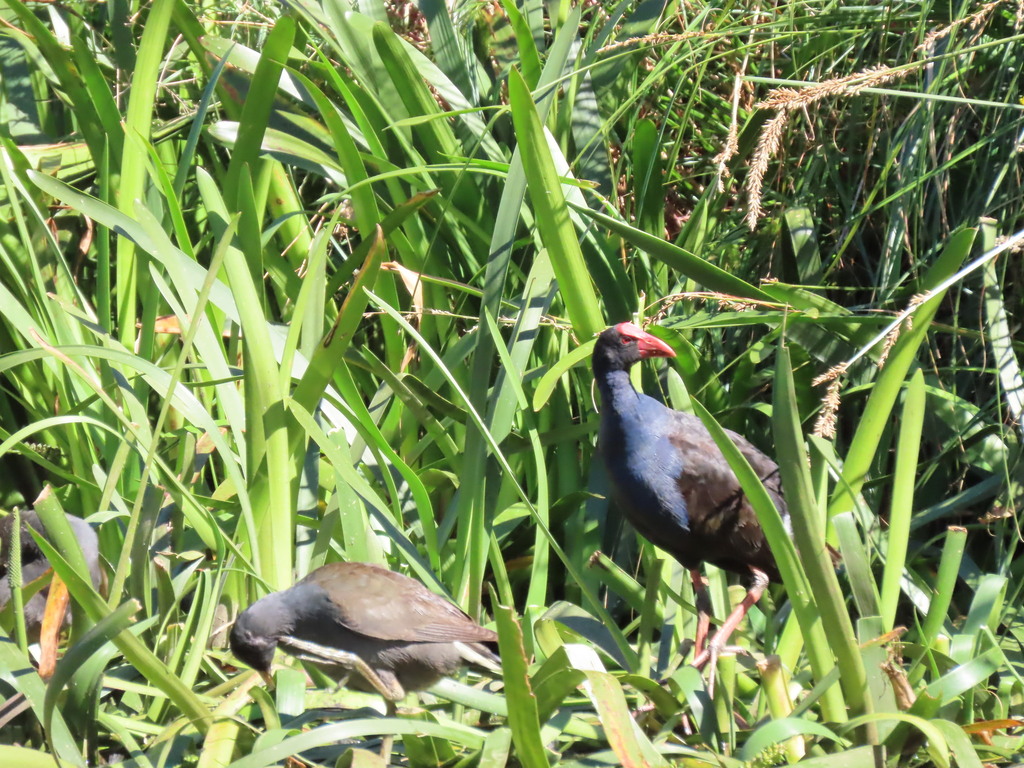
The Australasian swamphen (Porphyrio melanotus), commonly known as the pūkeko in New Zealand, is a striking and socially complex bird found in Oceania, including eastern Indonesia (the Moluccas, Aru and Kai Islands), Papua New Guinea, New Zealand and Australia. A member of the rail family, it is part of the diverse order Gruiformes, which includes species with similar characteristics such as cranes and other rail species. Within the Australasian swamphen species, five recognised subspecies exist, with P. m. melanotus being the most common and widely distributed in New Zealand. They display phenotypic characteristics typical of rails: relatively short wings and strong, elongated bills, adapted to its semi-aquatic lifestyle in wetlands. The swamphen is renowned for its distinctive blue-purple plumage, striking red frontal shield, and strong red legs. It is often found in swamps, marshes, and other wet lowland areas, though its habitat has expanded to include pastures, roadside verges, and farmland, due to significant landscape changes in New Zealand over the last 150 years. Unlike many other wetland birds, it is highly opportunistic and adaptable, thriving in both natural and human-modified environments. Its diet reflects this adaptability, consisting primarily of plant material such as grass stems, shoots, and leaves, but also including animal matter like invertebrates and, occasionally, the young of other bird species. Classified as a communal gallinule, the birds often breed in social groups rather than pairs. These groups typically consist of three to nine individuals, including both males and females, which all contribute to territory defence, nesting, and chick rearing. They exhibit a linear dominance hierarchy within these groups that is reinforced by physical traits, such as the size of the bird's frontal shield, which serves as a signal of social dominance.
Gallery
Ajouter des photos
Partagez vos photos de cette espèce (jusqu'à 20 à la fois) : elles sont vérifiées automatiquement, puis publiées.
Répartition
Occurrences observées (données GBIF). Les zones hors aire d'origine peuvent indiquer une présence introduite ou invasive.
Sources et crédits
Informations provenant de plusieurs sources vérifiées. Dernière mise à jour : .
Crédits photos (8)
- Photo : Elspeth Swan (@cygnet) · CC BY 4.0 · via iNaturalist
- Photo : Andrew Lamb (@lazza) · CC BY-NC 4.0 · via iNaturalist
- Photo : @mushroombeech · CC BY-NC 4.0 · via iNaturalist
- Photo : graeme lunt (@graemelunt) · CC BY 4.0 · via iNaturalist
- Photo : Erik Schiff (@erikschiff) · CC0 (domaine public) · via iNaturalist
- Photo : Ray Turnbull (@ray_turnbull) · CC BY-NC 4.0 · via iNaturalist
- Photo : Monina Gilbey (@mgilbey) · CC BY-NC 4.0 · via iNaturalist
- Photo : Jonathan Mills-Anderson (@jmillsand) · CC BY-NC 4.0 · via iNaturalist
Mentions de licence
Texte disponible sous licence CC BY-SA 4.0. Il adapte notamment Wikipedia (CC BY-SA) : Australasian swamphen (Wikipédia, auteurs dans l’historique de l’article).
- Taxonomie : GBIF Backbone Taxonomy (CC BY 4.0)
- Carte : occurrences GBIF, fond © contributeurs OpenStreetMap (ODbL)
Détail : Sources et licences.
Discussion (0)
Aucun message pour l’instant. Lancez la discussion sur cette fiche (sources, précisions, débats éditoriaux).
Connectez-vous pour participer à la discussion.