
Ruddy Shelduck
Tadorna ferruginea
The ruddy shelduck (Tadorna ferruginea) is a bird species in the family Anatidae.
- Kingdom
- Animalia
- Phylum
- Chordata
- Class
- Aves
- Order
- Anseriformes
- Family
- Anatidae
- Genus
- Tadorna
- Species
- Tadorna ferruginea
Description
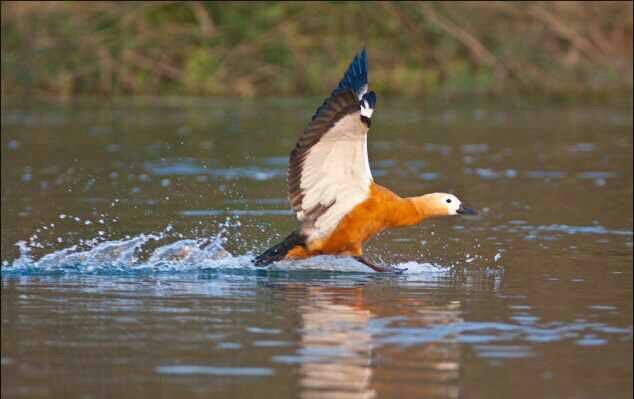
The ruddy shelduck (Tadorna ferruginea) is a bird species in the family Anatidae. It is a distinctive waterfowl, 58 to 70 cm (23 to 28 in) in length with a wingspan of 110 to 135 cm (43 to 53 in). It has orange-brown body plumage with a paler head, while the tail and the flight feathers in the wings are black, contrasting with the white wing-coverts. It is a migratory bird, wintering in the Indian subcontinent and breeding in southeastern Europe and central Asia, though there are small resident populations in North Africa. It has a loud honking call. The ruddy shelduck mostly inhabits inland water-bodies such as lakes, reservoirs and rivers. The male and female form a lasting pair bond and the nest may be well away from water, in a crevice or hole in a cliff, tree or similar site. A clutch of about eight eggs is laid and is incubated solely by the female for about four weeks. The young are cared for by both parents and fledge about eight weeks after hatching. In central and eastern Asia populations are steady or rising, but in Europe they are generally in decline. Altogether, the birds have a wide range and large total population, and the International Union for Conservation of Nature has assessed their conservation status as being of least concern.
Gallery
Ajouter des photos
Partagez vos photos de cette espèce (jusqu'à 20 à la fois) : elles sont vérifiées automatiquement, puis publiées.
Répartition
Occurrences observées (données GBIF). Les zones hors aire d'origine peuvent indiquer une présence introduite ou invasive.
Sources et crédits
Informations provenant de plusieurs sources vérifiées. Dernière mise à jour : .
Crédits photos (7)
- Photo : Jagritipaudel · CC BY-SA 4.0
- Photo : Chansey · CC BY-SA 4.0
- Photo : Светлана Лебедева (@svetlana_lebedeva) · CC BY-NC 4.0 · via iNaturalist
- Photo : ARSENIO GONZALEZ NAVARRO (@arseniogonzalez-anapri) · CC BY-NC 4.0 · via iNaturalist
- Photo : Angel (@amhernando-anapri) · CC BY-NC 4.0 · via iNaturalist
- Photo : @birdwatcher48 · CC BY-NC 4.0 · via iNaturalist
- Photo : Татьяна Косых (@kosykh64) · CC BY-NC 4.0 · via iNaturalist
Mentions de licence
Texte disponible sous licence CC BY-SA 4.0. Il adapte notamment Wikipedia (CC BY-SA) : Ruddy shelduck (Wikipédia, auteurs dans l’historique de l’article).
- Taxonomie : GBIF Backbone Taxonomy (CC BY 4.0)
- Carte : occurrences GBIF, fond © contributeurs OpenStreetMap (ODbL)
- Statut de conservation : Liste rouge de l'UICN, via Wikidata (CC0)
Détail : Sources et licences.
Discussion (0)
Aucun message pour l’instant. Lancez la discussion sur cette fiche (sources, précisions, débats éditoriaux).
Connectez-vous pour participer à la discussion.