
Whiskered Auklet
Aethia pygmaea
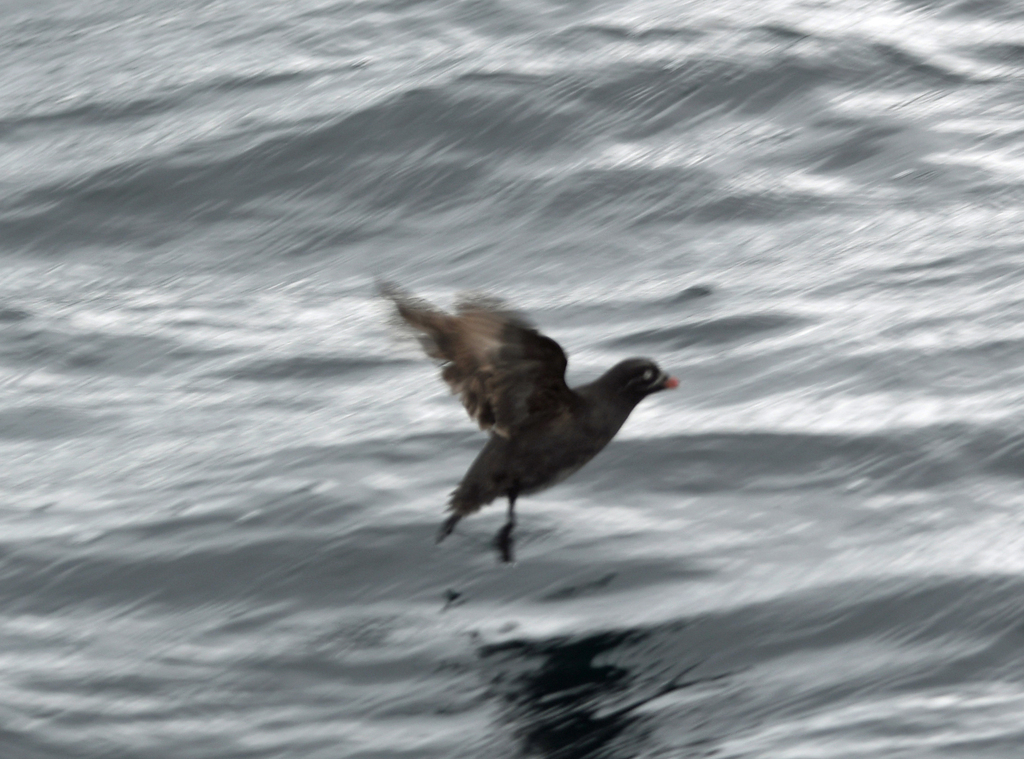
The whiskered auklet (Aethia pygmaea) is a small seabird of the auk family.
- Kingdom
- Animalia
- Phylum
- Chordata
- Class
- Aves
- Order
- Charadriiformes
- Family
- Alcidae
- Genus
- Aethia
- Species
- Aethia pygmaea
Description
The whiskered auklet (Aethia pygmaea) is a small seabird of the auk family. It has a more restricted range than other members of its genus, Aethia, living only around the Aleutian Islands and on some islands off Siberia (like Commander Islands), and breeding on these islands. It is one of the smallest alcids, only the closely related least auklet being smaller. Its name is derived from the long white feathers on its face that are part of its breeding plumage. The whiskered auklet is a poorly studied species and much research needs to be undertaken on the species. It was originally described as two different species, from specimens collected at different ends of its range, however research has shown that it is a single species with clinal variation along its range. It is not thought to undertake migration, but instead attends its breeding islands year round, and has been shown to roost on land all year round, an unusual trait in the family. Whiskered auklets lay a single egg in a rocky crevice, in loose colonies with other whiskered auklets and also other colonial seabirds. Both parents take part in incubation and chick rearing. The whiskers have been shown to help them sense their way to and out of their nests at night. Whiskered auklets feed in the inshore zone, usually within 16 km of land, where tidal currents concentrate their prey into dense swarms. They feed predominantly on copepods during the summer months, mostly on the species Neocalanus plumchrus; and switching to euphausiid krill in the fall and winter.
Gallery
Ajouter des photos
Partagez vos photos de cette espèce (jusqu'à 20 à la fois) : elles sont vérifiées automatiquement, puis publiées.
Répartition
Occurrences observées (données GBIF). Les zones hors aire d'origine peuvent indiquer une présence introduite ou invasive.
Sources et crédits
Informations provenant de plusieurs sources vérifiées. Dernière mise à jour : .
Crédits photos (8)
- Photo : Brian Johnson (@briancriter) · CC BY-NC 4.0 · via iNaturalist
- Photo : IanLJones (@ianljones) · CC BY-NC 4.0 · via iNaturalist
- Photo : Brendan Murtha (@bmurtha) · CC BY-NC 4.0 · via iNaturalist
- Photo : IanLJones (@ianljones) · CC BY-NC 4.0 · via iNaturalist
- Photo : Peter Kappes (@peterkappes) · CC BY-NC 4.0 · via iNaturalist
- Photo : Cameron Eckert (@camerondeckert) · CC BY-NC 4.0 · via iNaturalist
- Photo : Данилова Валерия (@valeriya_xoma) · CC BY-NC 4.0 · via iNaturalist
- Photo : Laura Keene (@laurakeene) · CC BY-NC 4.0 · via iNaturalist
Mentions de licence
Texte disponible sous licence CC BY-SA 4.0. Il adapte notamment Starique pygmée, Wikipedia (CC BY-SA) : Whiskered auklet (Wikipédia, auteurs dans l’historique de l’article).
- Taxonomie : GBIF Backbone Taxonomy (CC BY 4.0)
- Carte : occurrences GBIF, fond © contributeurs OpenStreetMap (ODbL)
- Statut de conservation : Liste rouge de l'UICN, via Wikidata (CC0)
Détail : Sources et licences.
Discussion (0)
Aucun message pour l’instant. Lancez la discussion sur cette fiche (sources, précisions, débats éditoriaux).
Connectez-vous pour participer à la discussion.