
Eurasian Nuthatch
Sitta europaea
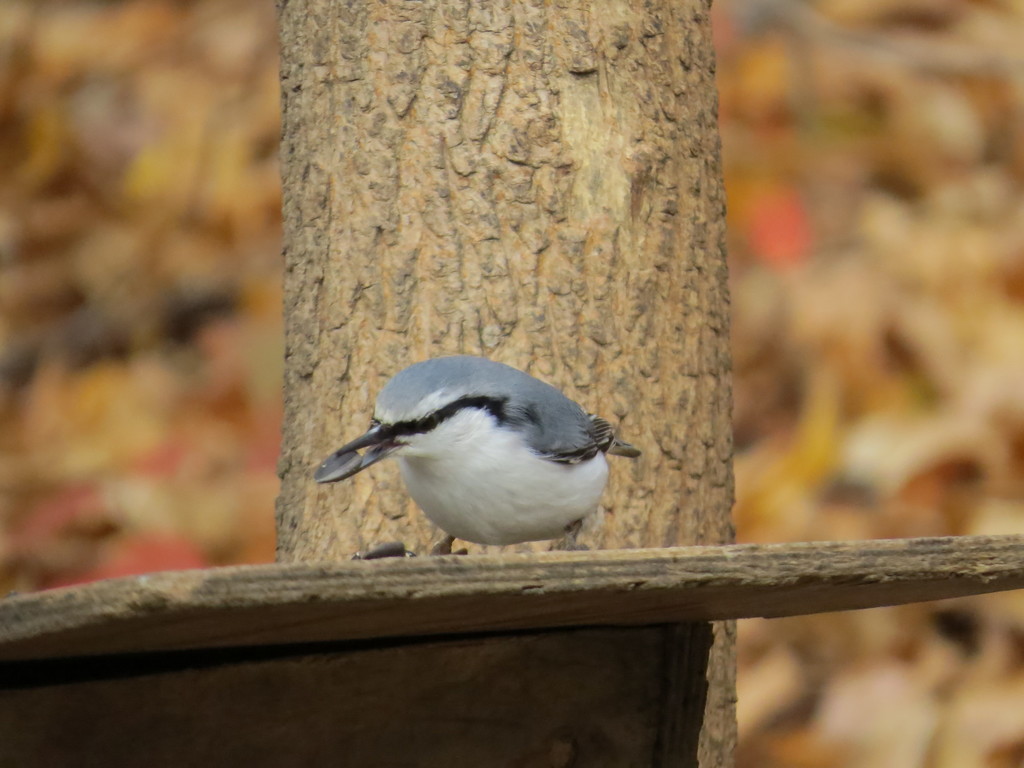
The Eurasian nuthatch, wood nuthatch (Sitta europaea), or simply nuthatch, is a small passerine bird found throughout the Palearctic and in Europe.
- Kingdom
- Animalia
- Phylum
- Chordata
- Class
- Aves
- Order
- Passeriformes
- Family
- Sittidae
- Genus
- Sitta
- Species
- Sitta europaea
Description
The Eurasian nuthatch, wood nuthatch (Sitta europaea), or simply nuthatch, is a small passerine bird found throughout the Palearctic and in Europe. Like other nuthatches, it is a short-tailed bird with a long bill, blue-gray upperparts and a black eye-stripe. It is a vocal bird with a repeated loud dwip call. There are more than 20 subspecies in three main groups; birds in the west of the range have orange-buff underparts and a white throat, those in Russia have whitish underparts, and those in the east have a similar appearance to European birds, but lack the white throat. Its preferred habitat is mature deciduous or mixed woodland with large, old trees, preferably oak. Pairs hold permanent territories, and nest in tree holes, usually old woodpecker nests, but sometimes natural cavities. If the entrance to the hole is too large, the female plasters it with mud to reduce its size, and often coats the inside of the cavity too. The six to nine red-speckled white eggs are laid on a deep base of pine or other wood chips. The Eurasian nuthatch eats mainly insects, particularly caterpillars and beetles, although in autumn and winter its diet is supplemented with nuts and seeds. The young are fed mainly on insects, with some seeds, food items mainly being found on tree trunks and large branches. The nuthatch can forage when descending trees head first, as well as when climbing. It readily visits bird tables, eating fatty man-made food items as well as seeds. It is an inveterate hoarder, storing food year-round. Its main natural predator is the Eurasian sparrowhawk. Fragmentation of woodland can lead to local losses of breeding birds, but the species's range is still expanding. It has a large population and huge breeding area, and is therefore classified by the International Union for Conservation of Nature (IUCN) as being of least concern.
Gallery
Ajouter des photos
Partagez vos photos de cette espèce (jusqu'à 20 à la fois) : elles sont vérifiées automatiquement, puis publiées.
Répartition
Occurrences observées (données GBIF). Les zones hors aire d'origine peuvent indiquer une présence introduite ou invasive.
Sources et crédits
Informations provenant de plusieurs sources vérifiées. Dernière mise à jour : .
Crédits photos (8)
- Photo : Olga Martiusheva (@ginger_owl) · CC BY-NC 4.0 · via iNaturalist
- Photo : Dérozier Violette (@violettederozier) · CC BY-NC 4.0 · via iNaturalist
- Photo : @benjamin_petra_schattanek-wiesmair · CC BY-NC 4.0 · via iNaturalist
- Photo : Вадим Синюхин (@vadimsinuhin59) · CC BY-NC 4.0 · via iNaturalist
- Photo : @le_biologiste · CC BY-NC 4.0 · via iNaturalist
- Photo : @an-ur-a · CC BY-NC 4.0 · via iNaturalist
- Photo : Neil Shepherd (@neils) · CC BY-NC 4.0 · via iNaturalist
- Photo : Dragonfyre (@dragonfyre) · CC BY-NC 4.0 · via iNaturalist
Mentions de licence
Texte disponible sous licence CC BY-SA 4.0. Il adapte notamment Wikipedia (CC BY-SA) : Eurasian nuthatch (Wikipédia, auteurs dans l’historique de l’article).
- Taxonomie : GBIF Backbone Taxonomy (CC BY 4.0)
- Carte : occurrences GBIF, fond © contributeurs OpenStreetMap (ODbL)
- Statut de conservation : Liste rouge de l'UICN, via Wikidata (CC0)
Détail : Sources et licences.
Discussion (0)
Aucun message pour l’instant. Lancez la discussion sur cette fiche (sources, précisions, débats éditoriaux).
Connectez-vous pour participer à la discussion.