
Chestnut-vented Nuthatch
Sitta nagaensis
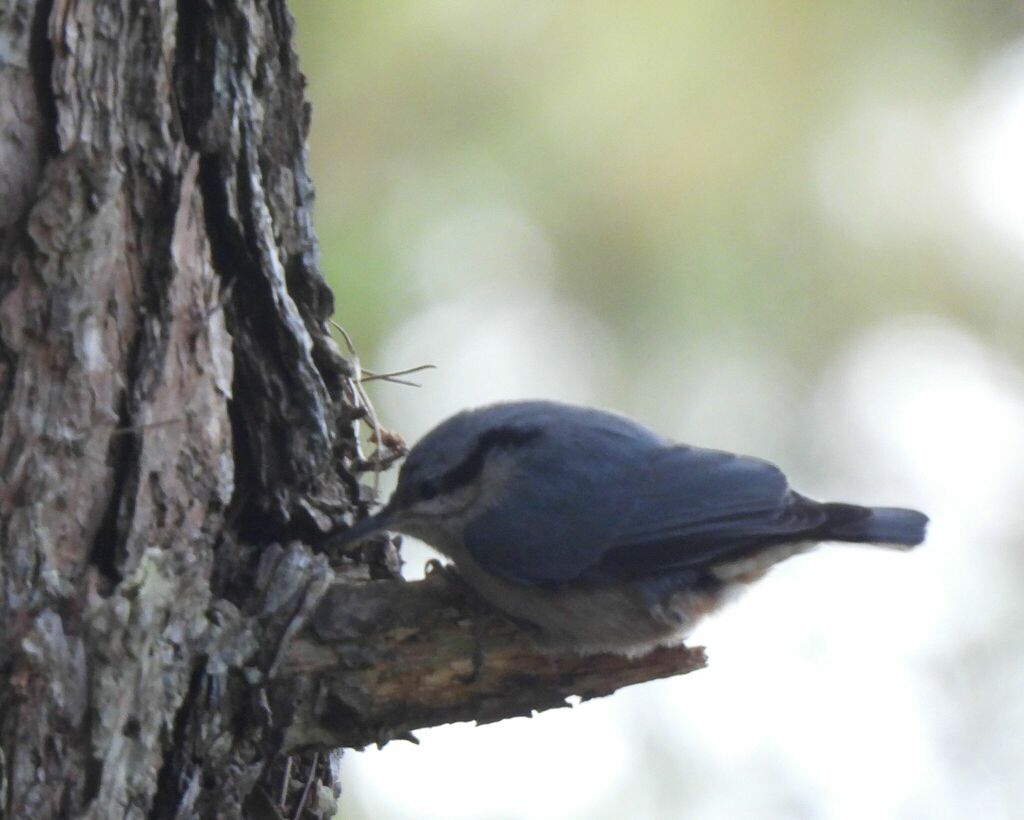
The chestnut-vented nuthatch (Sitta nagaensis) is a species of bird in the nuthatch family Sittidae.
- Kingdom
- Animalia
- Phylum
- Chordata
- Class
- Aves
- Order
- Passeriformes
- Family
- Sittidae
- Genus
- Sitta
- Species
- Sitta nagaensis
Description
The chestnut-vented nuthatch (Sitta nagaensis) is a species of bird in the nuthatch family Sittidae. It is a medium-sized nuthatch, measuring 12.5–14 cm (4.9–5.5 in) in length. The upperparts are a solid grey-blue, with a markedly black loral stripe. The underparts are uniform grey to buff from the throat to belly, with brick red on the flanks. The undertail is white with a rufous border. The chestnut-vented nuthatch utters different kinds of calls, which can sometimes sound like a wren alarm, and its song is a monotonous, stereotypical crackle, typically chichichichi. Its ecology is poorly known, but it probably feeds on small arthropods and seeds, and the breeding season begins between March and May. The nest is typically located in a hole in the trunk of a tree, and the clutch has two to five eggs. Chestnut-vented nuthatches are found in the northeast of India, in parts of Tibet and south-central China, descending into eastern Myanmar and northwestern Thailand. Isolated populations also live in southern Laos and Vietnam. It mainly lives in evergreen forests or pine forests, but can also live in mixed or deciduous forests. Its natural habitats are subtropical or tropical moist lowland forests and subtropical or tropical moist montane forests. Its altitudinal distribution varies according to the localities, but ranges from 915–4,570 m (3,002–14,993 ft). The species was described in 1874 by the British naturalist Henry Haversham Godwin-Austen, who named it Sitta nagaensis after the Naga Hills, where the type material was collected. It belongs to the S. europaea group of species, including the Kashmir nuthatch (S. cashmirensis) and the Eurasian nuthatch (S. europaea), all of which build mud entrances to their nests. The species' population is not known but appears to be declining. However, the bird's range is relatively wide, and the International Union for the Conservation of Nature currently considers the species of least concern.
Gallery
Ajouter des photos
Partagez vos photos de cette espèce (jusqu'à 20 à la fois) : elles sont vérifiées automatiquement, puis publiées.
Répartition
Occurrences observées (données GBIF). Les zones hors aire d'origine peuvent indiquer une présence introduite ou invasive.
Sources et crédits
Informations provenant de plusieurs sources vérifiées. Dernière mise à jour : .
Crédits photos (8)
- Photo : Nico Vromant (@nicochau) · CC BY-NC 4.0 · via iNaturalist
- Photo : Saniya Chaplod (@saniyachaplod) · CC BY-NC 4.0 · via iNaturalist
- Photo : ꦥꦤ꧀ꦗꦶꦒꦸꦱ꧀ꦠꦶꦄꦏ꧀ꦧꦂ (@panjigusti) · CC BY 4.0 · via iNaturalist
- Photo : @itazura · CC BY-NC 4.0 · via iNaturalist
- Photo : Yui Hong Chiu (@yuihongchiu) · CC BY-NC 4.0 · via iNaturalist
- Photo : Sajee Kongsuwan (@sajeekongsuwan) · CC BY-NC 4.0 · via iNaturalist
- Photo : Penhtah Mahakayi (@chaangnoy) · CC BY-NC 4.0 · via iNaturalist
- Photo : Xiaogang Zhou (@daiwa) · CC BY-NC 4.0 · via iNaturalist
Mentions de licence
Texte disponible sous licence CC BY-SA 4.0. Il adapte notamment Wikipedia (CC BY-SA) : Chestnut-vented nuthatch (Wikipédia, auteurs dans l’historique de l’article).
- Taxonomie : GBIF Backbone Taxonomy (CC BY 4.0)
- Carte : occurrences GBIF, fond © contributeurs OpenStreetMap (ODbL)
- Statut de conservation : Liste rouge de l'UICN, via Wikidata (CC0)
Détail : Sources et licences.
Discussion (0)
Aucun message pour l’instant. Lancez la discussion sur cette fiche (sources, précisions, débats éditoriaux).
Connectez-vous pour participer à la discussion.