
Blue-billed Teal
Spatula hottentota
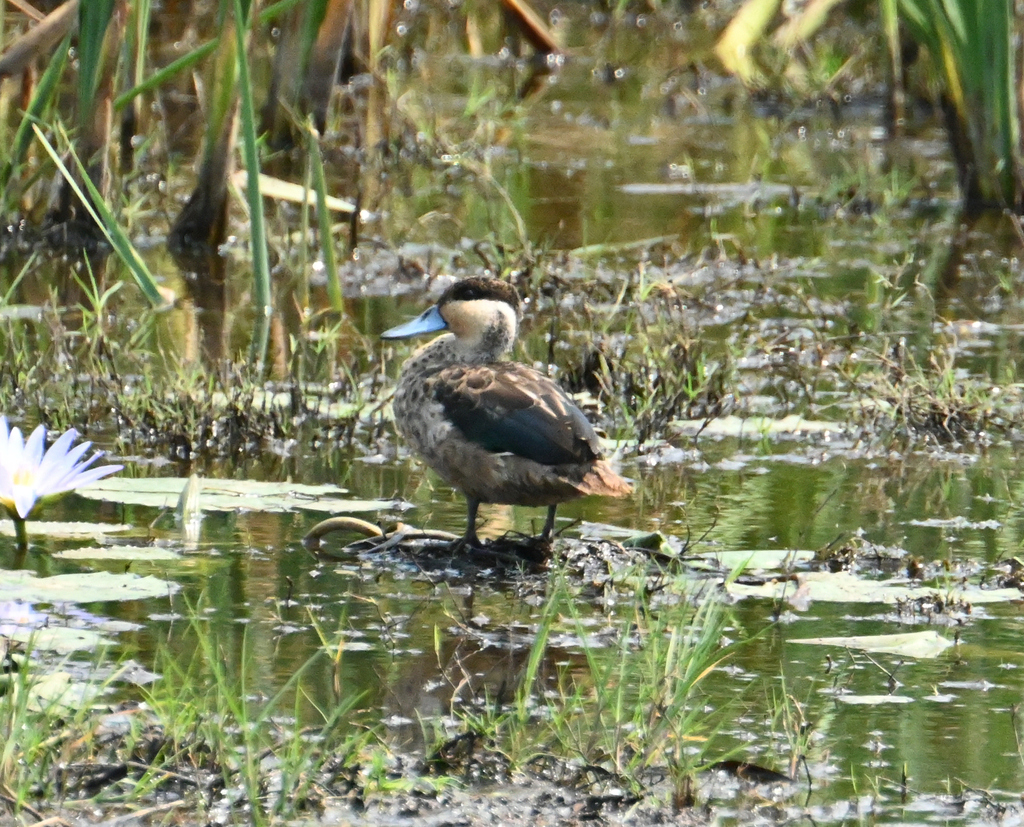
The blue-billed teal (Spatula hottentota), also sometimes called spotted teal and formerly Hottentot teal, is a species of dabbling duck of the genus Spatula.
- Kingdom
- Animalia
- Phylum
- Chordata
- Class
- Aves
- Order
- Anseriformes
- Family
- Anatidae
- Genus
- Spatula
- Species
- Spatula hottentota
Description
The blue-billed teal (Spatula hottentota), also sometimes called spotted teal and formerly Hottentot teal, is a species of dabbling duck of the genus Spatula. It is resident in eastern, southern, and western Africa, from Sudan and Ethiopia west to Niger and Nigeria, and south to South Africa and Namibia, and also in Madagascar. It is generally sedentary, but shows nomadic behaviour in response to water requirements, moving away if drought causes wetlands to dry out. The blue-billed teal breeds year round, depending on rainfall, and stays in small groups or pairs. They build nests above water in tree stumps and use vegetation. Ducklings leave the nest soon after hatching, and the mother's parenting is limited to providing protection from predators and leading young to feeding areas. This species is omnivorous and prefers smaller shallow bodies of water. The blue-billed teal is one of the species to which the Agreement on the Conservation of African-Eurasian Migratory Waterbirds (AEWA) applies. The status of the blue-billed teal on the IUCN Red List is Least Concern. Several texts still refer to this species as the Hottentot teal, however, as the word "Hottentot" is an offensive term for the Khoisan people, there has been a movement to change the vernacular name.
Gallery
Ajouter des photos
Partagez vos photos de cette espèce (jusqu'à 20 à la fois) : elles sont vérifiées automatiquement, puis publiées.
Répartition
Occurrences observées (données GBIF). Les zones hors aire d'origine peuvent indiquer une présence introduite ou invasive.
Sources et crédits
Informations provenant de plusieurs sources vérifiées. Dernière mise à jour : .
Crédits photos (8)
- Photo : Russ Hoverman (@russh) · CC BY-NC 4.0 · via iNaturalist
- Photo : Andrew Cauldwell (@littlechippie) · CC BY-NC 4.0 · via iNaturalist
- Photo : Stan van Remmerden (@stanvrem) · CC BY-NC 4.0 · via iNaturalist
- Photo : Joseph Heymans (@jaheymans) · CC BY-NC 4.0 · via iNaturalist
- Photo : Bruno - Yolande Zanette (@bruno_yolande_zanette) · CC BY 4.0 · via iNaturalist
- Photo : Bird Explorers (@birdexplorers) · CC BY-NC 4.0 · via iNaturalist
- Photo : Doug Macdonald (@dougmacsafaris) · CC BY-NC 4.0 · via iNaturalist
- Photo : Johan Heyns (@johanheyns) · CC BY-NC 4.0 · via iNaturalist
Mentions de licence
Texte disponible sous licence CC BY-SA 4.0. Il adapte notamment Wikipedia (CC BY-SA) : Blue-billed teal (Wikipédia, auteurs dans l’historique de l’article).
- Taxonomie : GBIF Backbone Taxonomy (CC BY 4.0)
- Carte : occurrences GBIF, fond © contributeurs OpenStreetMap (ODbL)
- Statut de conservation : Liste rouge de l'UICN, via Wikidata (CC0)
Détail : Sources et licences.
Discussion (0)
Aucun message pour l’instant. Lancez la discussion sur cette fiche (sources, précisions, débats éditoriaux).
Connectez-vous pour participer à la discussion.