
Crimson-headed Partridge
Haematortyx sanguiniceps
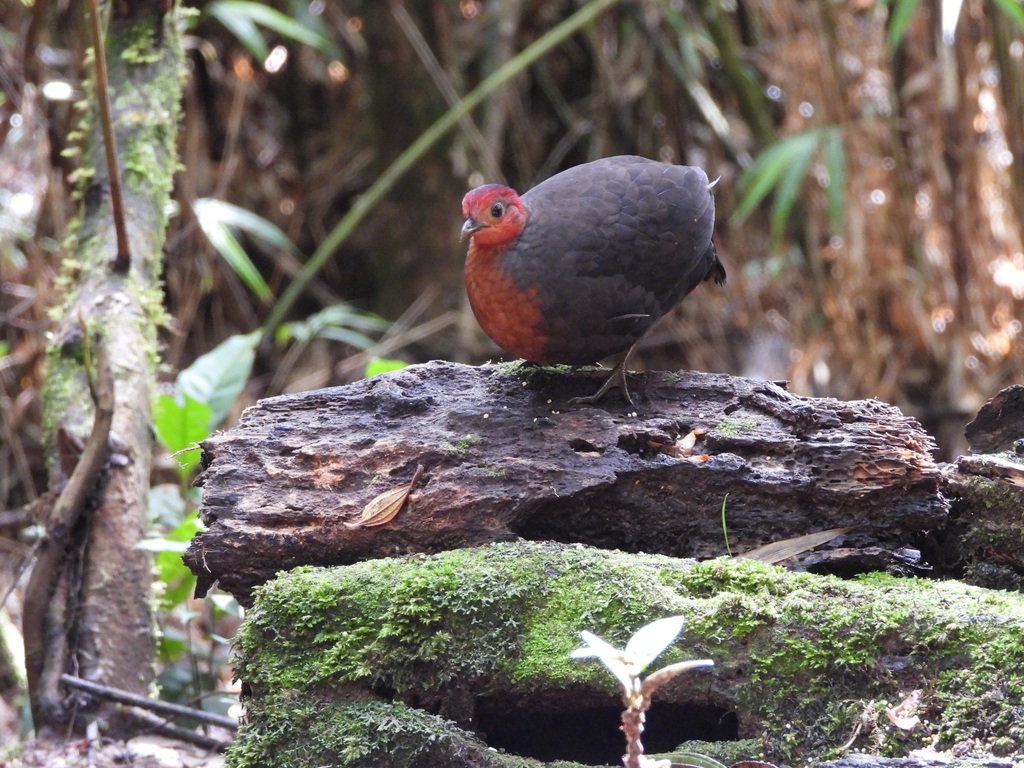
The crimson-headed partridge (Haematortyx sanguiniceps) is a species of bird in the pheasant, partridge, and francolin family Phasianidae.
- Kingdom
- Animalia
- Phylum
- Chordata
- Class
- Aves
- Order
- Galliformes
- Family
- Phasianidae
- Genus
- Haematortyx
- Species
- Haematortyx sanguiniceps
Description
The crimson-headed partridge (Haematortyx sanguiniceps) is a species of bird in the pheasant, partridge, and francolin family Phasianidae. Described by the British ornithologist Richard Bowdler Sharpe in 1879, it is the only species in the genus Haematortyx. It is endemic to Borneo, where it inhabits lower montane forest in the northern and central parts of the island. It is mainly found at elevations of 1,000–1,700 m (3,300–5,600 ft), but can be seen as low as 185 m (607 ft) and as high as 3,050 m (10,010 ft). Adult males have a striking appearance, with a dark blackish body and crimson red heads, necks, breasts, and undertail coverts. Females have a similar pattern, but with duller brownish-black colouration, orangish-red heads and breasts, and a brownish-black bill instead of a yellowish one. Juveniles are duller and have the crimson restricted to the top of the head. The species feeds on berries, insects, and small crustaceans. Nests of dry leaves are built in tussocks of grass or lichen, with eggs being laid from mid-January onwards. Clutches have 8–9 eggs and incubation takes 18–19 days in captivity. The crimson-headed partridge is classified as being of least concern by the International Union for Conservation of Nature due to its fairly large range, sufficiently large population, and a lack of significant population decline. It has a population of 1,000–10,000 total individuals and 670–6,700 mature birds which is thought to be declining.
Gallery
Ajouter des photos
Partagez vos photos de cette espèce (jusqu'à 20 à la fois) : elles sont vérifiées automatiquement, puis publiées.
Répartition
Occurrences observées (données GBIF). Les zones hors aire d'origine peuvent indiquer une présence introduite ou invasive.
Sources et crédits
Informations provenant de plusieurs sources vérifiées. Dernière mise à jour : .
Crédits photos (8)
- Photo : Catalina Tong (@catalinatong) · CC BY-NC 4.0 · via iNaturalist
- Photo : Remco Hofland (@remco) · CC BY-NC 4.0 · via iNaturalist
- Photo : Alfuil (@alfuil) · CC BY-NC 4.0 · via iNaturalist
- Photo : @lunarjade · CC BY-NC 4.0 · via iNaturalist
- Photo : Tim Forrester (@tim_forrester) · CC BY-NC 4.0 · via iNaturalist
- Photo : Pavel Smirnov (@psmirnov) · CC BY 4.0 · via iNaturalist
- Photo : owling (@morethanowls) · CC BY-NC 4.0 · via iNaturalist
- Photo : Лариса Артемьева (@tcager) · CC0 (domaine public) · via iNaturalist
Mentions de licence
Texte disponible sous licence CC BY-SA 4.0. Il adapte notamment Wikipedia (CC BY-SA) : Crimson-headed partridge (Wikipédia, auteurs dans l’historique de l’article).
- Taxonomie : GBIF Backbone Taxonomy (CC BY 4.0)
- Carte : occurrences GBIF, fond © contributeurs OpenStreetMap (ODbL)
- Statut de conservation : Liste rouge de l'UICN, via Wikidata (CC0)
Détail : Sources et licences.
Discussion (0)
Aucun message pour l’instant. Lancez la discussion sur cette fiche (sources, précisions, débats éditoriaux).
Connectez-vous pour participer à la discussion.