
Moussier's Redstart
Phoenicurus moussieri
Moussier's redstart (Phoenicurus moussieri) is a small passerine bird in the genus Phoenicurus (redstarts), formerly classed as a member of the thrush family (Turdidae), but is now classified as an Old World flycatcher (Muscicapidae).
- Kingdom
- Animalia
- Phylum
- Chordata
- Class
- Aves
- Order
- Passeriformes
- Family
- Muscicapidae
- Genus
- Phoenicurus
- Species
- Phoenicurus moussieri
Description
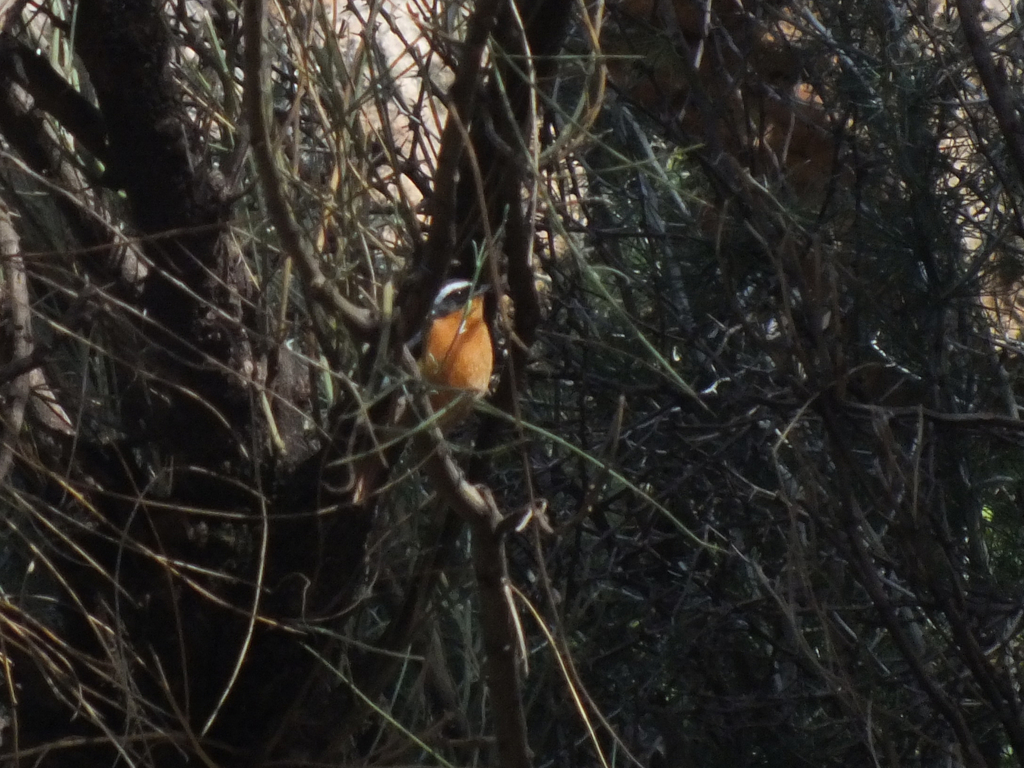
Moussier's redstart (Phoenicurus moussieri) is a small passerine bird in the genus Phoenicurus (redstarts), formerly classed as a member of the thrush family (Turdidae), but is now classified as an Old World flycatcher (Muscicapidae). It is an endemic resident breeder in the Atlas Mountains of northwest Africa. Its habitat is open woodland in rocky areas from sea level up to 3000 m altitude in the mountains. It is the smallest redstart, only 12 cm long and 14–15 g weight. The male has a black head with a broad white stripe running above each eye and down the side of the neck. The upperparts are black other than a white wing patch, and the rich chestnut tail, from which it and other redstarts get their names (start is an old word for tail). The underparts are a rich orange-red. The female has a pale brown head and upperparts, and the underparts are a paler orange than the male, although generally redder than the underparts of the similar but larger female common redstart. It is named after Jean Moussier (1795–1850) who was an amateur naturalist and a surgeon in the French Army during the Napoleonic Wars.
Gallery
Ajouter des photos
Partagez vos photos de cette espèce (jusqu'à 20 à la fois) : elles sont vérifiées automatiquement, puis publiées.
Répartition
Occurrences observées (données GBIF). Les zones hors aire d'origine peuvent indiquer une présence introduite ou invasive.
Sources et crédits
Informations provenant de plusieurs sources vérifiées. Dernière mise à jour : .
Crédits photos (8)
- Photo : Matthieu Gauvain (@matthieu_gauvain) · CC BY-NC 4.0 · via iNaturalist
- Photo : Dragonfyre (@dragonfyre) · CC BY-NC 4.0 · via iNaturalist
- Photo : Thomas Bitsch (@tombitsch) · CC BY-NC 4.0 · via iNaturalist
- Photo : Dragonfyre (@dragonfyre) · CC BY-NC 4.0 · via iNaturalist
- Photo : Stephen Moores (@stephen54) · CC BY-NC 4.0 · via iNaturalist
- Photo : Mourad Harzallah (@mourad-harzallah) · CC BY 4.0 · via iNaturalist
- Photo : Juliette Béraud (@juliette_beraud) · CC BY-NC 4.0 · via iNaturalist
- Photo : Samuel GUIRAUDOU (@samuel_guiraudou) · CC BY 4.0 · via iNaturalist
Mentions de licence
Texte disponible sous licence CC BY-SA 4.0. Il adapte notamment Wikipédia (EN) : Moussier's redstart, Rougequeue de Moussier, Wikipedia (CC BY-SA) : Moussier's redstart (Wikipédia, auteurs dans l’historique de l’article).
- Taxonomie : GBIF Backbone Taxonomy (CC BY 4.0)
- Carte : occurrences GBIF, fond © contributeurs OpenStreetMap (ODbL)
- Statut de conservation : Liste rouge de l'UICN, via Wikidata (CC0)
Détail : Sources et licences.
Discussion (0)
Aucun message pour l’instant. Lancez la discussion sur cette fiche (sources, précisions, débats éditoriaux).
Connectez-vous pour participer à la discussion.