
Goldcrest
Regulus regulus
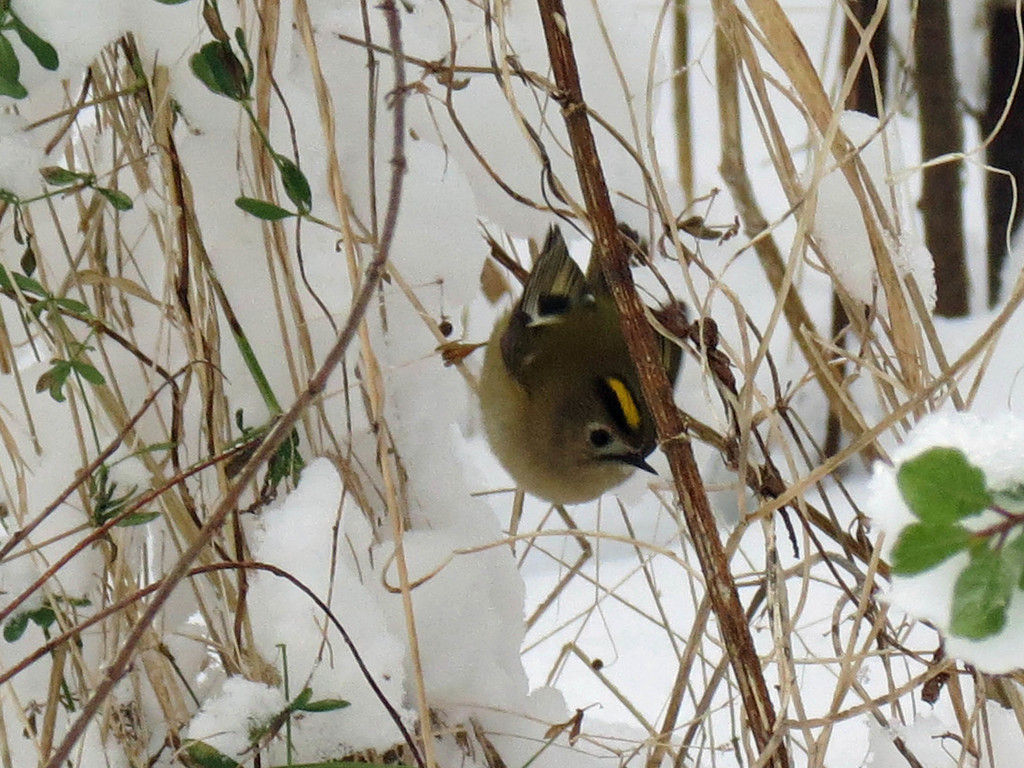
The goldcrest (Regulus regulus) is a very small passerine bird in the kinglet family.
- Kingdom
- Animalia
- Phylum
- Chordata
- Class
- Aves
- Order
- Passeriformes
- Family
- Regulidae
- Genus
- Regulus
- Species
- Regulus regulus
Description
The goldcrest (Regulus regulus) is a very small passerine bird in the kinglet family. Its colourful golden crest feathers, as well as being called the "king of the birds" in European folklore, gives rise to its English and scientific names. The scientific name, R. regulus, means 'petty king' or prince. Several subspecies are recognised across the very large distribution range that includes much of the Palearctic and the islands of Macaronesia and Iceland. Birds from the north and east of its breeding range migrate to winter further south. This kinglet has greenish upper-parts, whitish under-parts, and has two white wingbars. It has a plain face contrasting black irises and a bright head crest, orange and yellow in the male and yellow in the female, which is displayed during breeding. It superficially resembles the common firecrest (Regulus ignicapilla), which largely shares its European range, but the latter's bronze shoulders and strong face pattern are distinctive. The song is a repetition of high thin notes, slightly higher-pitched than those of its relative. Birds on the Canary Islands are now separated into two subspecies of the goldcrest, but were formerly considered to be a subspecies of the firecrest or a separate species, Regulus teneriffae. The goldcrest breeds in coniferous woodland and gardens, building its compact, three-layered nest on a tree branch. Ten to twelve eggs are incubated by the female alone, and the chicks are fed by both parents; second broods are common. This kinglet is constantly on the move as it searches for insects to eat, and in winter it is often found with flocks of tits. It may be killed by birds of prey or carry parasites, but its large range and population mean that it is not considered to present any significant conservation concerns.
Gallery
Ajouter des photos
Partagez vos photos de cette espèce (jusqu'à 20 à la fois) : elles sont vérifiées automatiquement, puis publiées.
Répartition
Occurrences observées (données GBIF). Les zones hors aire d'origine peuvent indiquer une présence introduite ou invasive.
Sources et crédits
Informations provenant de plusieurs sources vérifiées. Dernière mise à jour : .
Crédits photos (8)
- Photo : Simon Bradfield (@scompeti) · CC BY-NC 4.0 · via iNaturalist
- Photo : Олександр Гаврилюк (@havryliuk) · CC BY-NC 4.0 · via iNaturalist
- Photo : @richtigger · CC BY-NC 4.0 · via iNaturalist
- Photo : Борис Георги (@beetle23) · CC BY 4.0 · via iNaturalist
- Photo : Fedotova Elena (@fedotova_elena) · CC BY 4.0 · via iNaturalist
- Photo : @andrey19780619 · CC BY-NC 4.0 · via iNaturalist
- Photo : Соколков Юрий Павлович (@sokolkov2002) · CC BY-NC 4.0 · via iNaturalist
- Photo : Ян Адамсон (@yan_adamson) · CC BY-NC 4.0 · via iNaturalist
Mentions de licence
Texte disponible sous licence CC BY-SA 4.0. Il adapte notamment Wikipedia (CC BY-SA) : Goldcrest (Wikipédia, auteurs dans l’historique de l’article).
- Taxonomie : GBIF Backbone Taxonomy (CC BY 4.0)
- Carte : occurrences GBIF, fond © contributeurs OpenStreetMap (ODbL)
- Statut de conservation : Liste rouge de l'UICN, via Wikidata (CC0)
Détail : Sources et licences.
Discussion (0)
Aucun message pour l’instant. Lancez la discussion sur cette fiche (sources, précisions, débats éditoriaux).
Connectez-vous pour participer à la discussion.