
African Crake
Crex egregia
The African crake (Crecopsis egregia) is a small- to medium-size ground-living bird in the rail family, found in most of central to southern Africa.
- Kingdom
- Animalia
- Phylum
- Chordata
- Class
- Aves
- Order
- Gruiformes
- Family
- Rallidae
- Genus
- Crex
- Species
- Crex egregia
Description
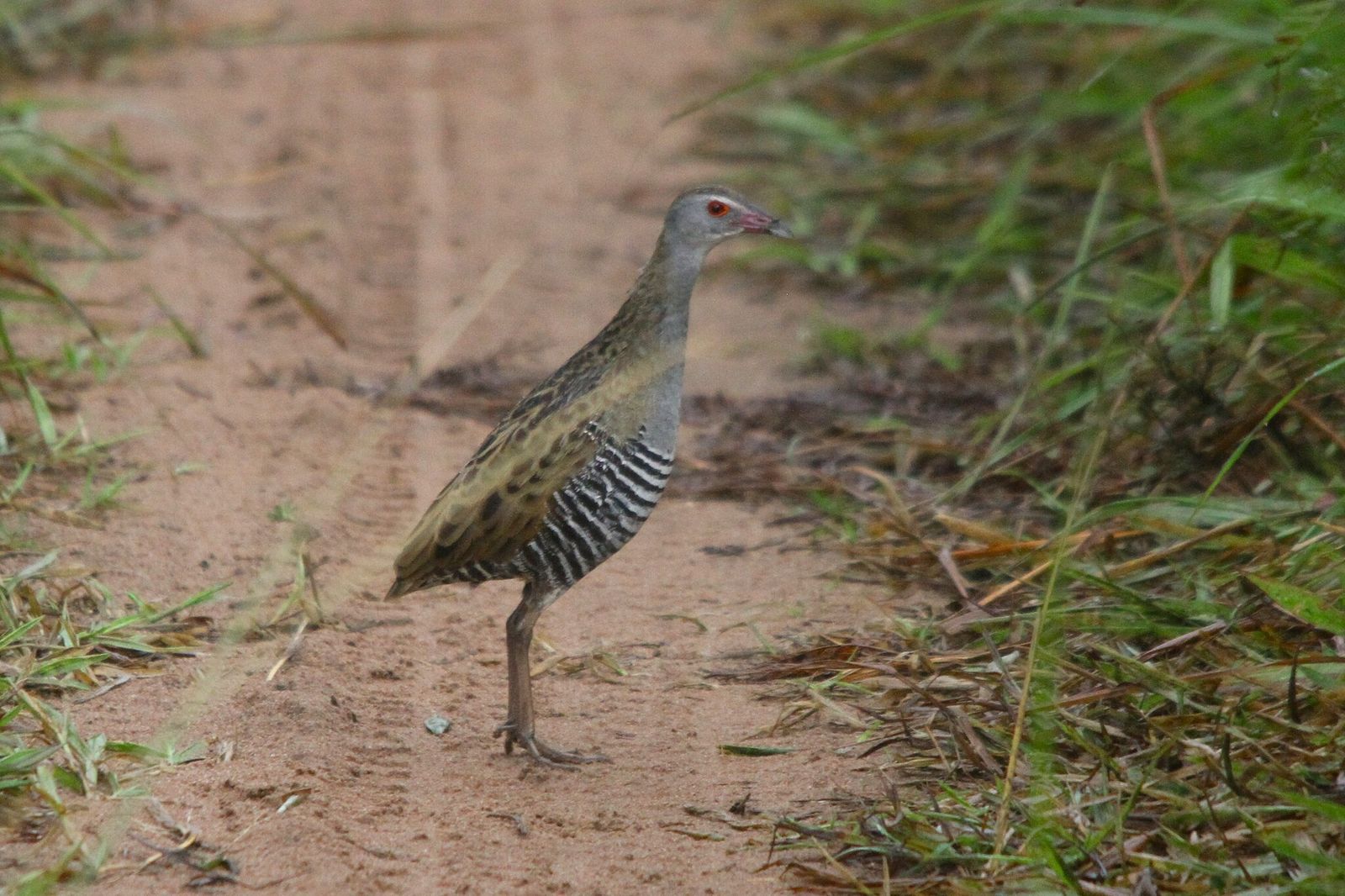
The African crake (Crecopsis egregia) is a small- to medium-size ground-living bird in the rail family, found in most of central to southern Africa. It is seasonally common in most of its range other than the rainforests and areas that have low annual rainfall. This crake is a partial migrant, moving away from the equator as soon as the rains provide sufficient grass cover to allow it to breed elsewhere. There have been a few records of vagrant birds reaching Atlantic islands. This species nests in a wide variety of grassland types, and agricultural land with tall crops may also be used. A smallish crake, the African crake has brown-streaked blackish upperparts, bluish-grey underparts and black-and-white barring on the flanks and belly. It has a stubby red bill, red eyes, and a white line from the bill to above the eye. It is smaller than the corn crake, which is also lighter-plumaged, and has an eye stripe. The African crake has a range of calls, the most characteristic being a series of rapid grating krrr notes. It is active during the day, and is territorial on both the breeding and non-breeding grounds; the male has a threat display, and may fight at territory boundaries. The nest is a shallow cup of grass leaves built in a depression under a grass tussock or small bush. The 3–11 eggs start hatching after about 14 days, and the black, downy precocial chicks fledge after four to five weeks. The African crake feeds on a wide range of invertebrates, along with some small frogs and fish, and plant material, especially grass seeds. It may itself be eaten by large birds of prey; snakes; or mammals, including humans, and can host parasites. Although it may be displaced temporarily by the burning of grassland, or permanently by agriculture, wetland drainage or urbanisation, its large range and population mean that it is not considered to be threatened.
Gallery
Ajouter des photos
Partagez vos photos de cette espèce (jusqu'à 20 à la fois) : elles sont vérifiées automatiquement, puis publiées.
Répartition
Occurrences observées (données GBIF). Les zones hors aire d'origine peuvent indiquer une présence introduite ou invasive.
Sources et crédits
Informations provenant de plusieurs sources vérifiées. Dernière mise à jour : .
Crédits photos (10)
- Photo : Joshua Rains · CC BY-NC 4.0 · via GBIF
- Photo : Joshua Rains · CC BY-NC 4.0 · via GBIF
- Photo : Nico Lubcker · CC BY-NC 4.0 · via GBIF
- Photo : Jed Bird · CC BY-NC 4.0 · via GBIF
- Photo : Inge van den Meiracker · CC BY-NC 4.0 · via GBIF
- Photo : Michael Standin Wright · CC BY-NC 4.0 · via GBIF
- Photo : Thomas Los · CC BY-NC 4.0 · via GBIF
- Photo : Lukas Sekelsky · CC BY-NC 4.0 · via GBIF
- Photo : Lukas Sekelsky · CC BY-NC 4.0 · via GBIF
- Photo : markvm · CC BY-NC 4.0 · via GBIF
Mentions de licence
Texte disponible sous licence CC BY-SA 4.0. Il adapte notamment Wikipedia (CC BY-SA) : African crake (Wikipédia, auteurs dans l’historique de l’article).
- Taxonomie : GBIF Backbone Taxonomy (CC BY 4.0)
- Carte : occurrences GBIF, fond © contributeurs OpenStreetMap (ODbL)
- Statut de conservation : Liste rouge de l'UICN, via Wikidata (CC0)
Détail : Sources et licences.
Discussion (0)
Aucun message pour l’instant. Lancez la discussion sur cette fiche (sources, précisions, débats éditoriaux).
Connectez-vous pour participer à la discussion.