
Nkulengu Rail
Himantornis haematopus
The Nkulengu rail (Himantornis haematopus) is a species of bird in the family Rallidae.
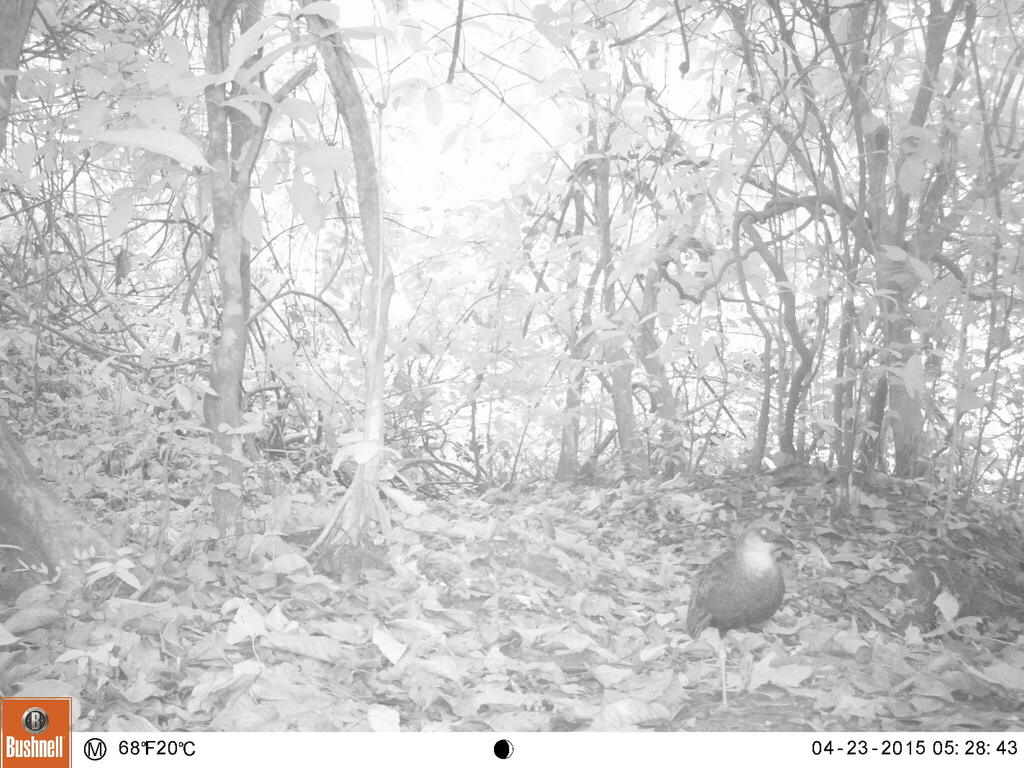
- Kingdom
- Animalia
- Phylum
- Chordata
- Class
- Aves
- Order
- Gruiformes
- Family
- Rallidae
- Genus
- Himantornis
- Species
- Himantornis haematopus
Description
The Nkulengu rail (Himantornis haematopus) is a species of bird in the family Rallidae. It belongs to the monotypic genus Himantornis. For long, this singular rail was considered a member of a distinct subfamily Himantornithinae. This was based on the assumption that it was a sort of "living fossil", as it resembles other Gruiformes rather than other rails in many traits. But as it seems, the supposed plesiomorphies are actually atavistic or otherwise re-evolved traits in reaction to its African rainforest habitat. Its closest living relatives seem to be the Asian genera Amaurornis, Gallicrex, Megacrex, and the widespread African Aenigmatolimnas, with Megacrex and Himantornis representing ancient and ecologically quite similar lineages at the extreme ends of the group's distribution. However a later genetic study found that it was basal to the radiation containing Porzana, Tribonyx, Gallinula and Fulica. It is found in Angola, Cameroon, Central African Republic, Republic of the Congo, Democratic Republic of the Congo, Ivory Coast, Equatorial Guinea, Gabon, Ghana, Guinea, Liberia, Nigeria, Sierra Leone, Togo, and Uganda. It is notoriously difficult to visually observe, preferring to hide, but has a loud and distinctive call often made in pairs.
Gallery
Ajouter des photos
Partagez vos photos de cette espèce (jusqu'à 20 à la fois) : elles sont vérifiées automatiquement, puis publiées.
Répartition
Occurrences observées (données GBIF). Les zones hors aire d'origine peuvent indiquer une présence introduite ou invasive.
Sources et crédits
Informations provenant de plusieurs sources vérifiées. Dernière mise à jour : .
Crédits photos (8)
- Photo : @thierry_aebischer_chinko · CC BY-NC 4.0 · via iNaturalist
- Photo : Don Wellmann (@don54) · CC0 (domaine public) · via iNaturalist
- Photo : @thierry_aebischer_chinko · CC BY-NC 4.0 · via iNaturalist
- Photo : Mahomed Desai (@m_d) · CC BY 4.0 · via iNaturalist
- Photo : pygmaeus (@pongo10) · CC BY-NC 4.0 · via iNaturalist
- Photo : Nik Borrow (@nikborrow) · CC BY-NC 4.0 · via iNaturalist
- Photo : Tom JAMONNEAU (@tomjamonneau) · CC BY-NC 4.0 · via iNaturalist
- Photo : Niall Perrins (@niallp) · CC BY-NC 4.0 · via iNaturalist
Mentions de licence
Texte disponible sous licence CC BY-SA 4.0. Il adapte notamment Râle à pieds rouges, Wikipedia (CC BY-SA) : Nkulengu rail (Wikipédia, auteurs dans l’historique de l’article).
- Taxonomie : GBIF Backbone Taxonomy (CC BY 4.0)
- Carte : occurrences GBIF, fond © contributeurs OpenStreetMap (ODbL)
- Statut de conservation : Liste rouge de l'UICN, via Wikidata (CC0)
Détail : Sources et licences.
Discussion (0)
Aucun message pour l’instant. Lancez la discussion sur cette fiche (sources, précisions, débats éditoriaux).
Connectez-vous pour participer à la discussion.