
Resplendent Quetzal
Pharomachrus mocinno
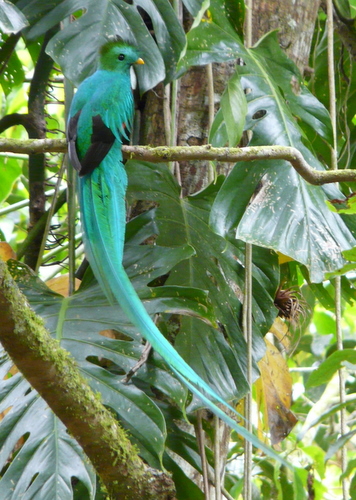
The resplendent quetzal (Pharomachrus mocinno) is a small bird found in Central America and southern Mexico that lives in tropical forests, particularly montane cloud forests.
- Kingdom
- Animalia
- Phylum
- Chordata
- Class
- Aves
- Order
- Trogoniformes
- Family
- Trogonidae
- Genus
- Pharomachrus
- Species
- Pharomachrus mocinno
Description
The resplendent quetzal (Pharomachrus mocinno) is a small bird found in Central America and southern Mexico that lives in tropical forests, particularly montane cloud forests. They are part of the family Trogonidae and have two recognized subspecies, P. m. mocinno and P. m. costaricensis. Like other quetzals, the resplendent is mostly omnivorous; its diet mainly consists of fruits of plants in the laurel family, Lauraceae, but it occasionally also preys on insects, lizards, frogs and snails. The species is well known for its colorful and complex plumage that differs substantially between sexes. Males have iridescent green plumes, a red lower breast and belly, black innerwings and a white undertail, whilst females are duller and have a shorter tail. Grey lower breasts, bellies, and bills, along with bronze-green heads are characteristic of females. These birds hollow holes in decaying trees or use ones already made by woodpeckers as a nest site. They are known to take turns while incubating, males throughout the day and females at night. The female usually lays one to three eggs, which hatch in 17 to 19 days. The quetzal is an altitudinal migrant, migrating from the slopes to the canopy of the forest. This occurs during the breeding season, which varies depending on the location, but usually commences in March and extends as far as August. The resplendent quetzal is considered near threatened on the IUCN Red List, with habitat destruction being the main threat. It has an important role in Mesoamerican mythology, and is closely associated with Quetzalcoatl, a deity. It is the national animal of Guatemala, being pictured on the flag and coat of arms; it also gives its name to the country's currency, the Guatemalan quetzal.
Gallery
Ajouter des photos
Partagez vos photos de cette espèce (jusqu'à 20 à la fois) : elles sont vérifiées automatiquement, puis publiées.
Répartition
Occurrences observées (données GBIF). Les zones hors aire d'origine peuvent indiquer une présence introduite ou invasive.
Sources et crédits
Informations provenant de plusieurs sources vérifiées. Dernière mise à jour : .
Crédits photos (8)
- Photo : Jiki · CC BY 3.0
- Photo : D.Hatcher · Domaine public
- Photo : Unknown authorUnknown author · CC BY-SA 4.0
- Photo : Wendy Feltham (@wendy5) · CC BY-NC 4.0 · via iNaturalist
- Photo : Hermes Vega (@hermes) · CC BY-NC 4.0 · via iNaturalist
- Photo : Sandra Keller (@sandykeller) · CC BY 4.0 · via iNaturalist
- Photo : @kingnothing13 · CC BY-NC 4.0 · via iNaturalist
- Photo : Red de Monitores Pavón Pavo de Cacho (@jamesbirding) · CC BY-NC 4.0 · via iNaturalist
Mentions de licence
Texte disponible sous licence CC BY-SA 4.0. Il adapte notamment Wikipedia (CC BY-SA) : Resplendent quetzal (Wikipédia, auteurs dans l’historique de l’article).
- Taxonomie : GBIF Backbone Taxonomy (CC BY 4.0)
- Carte : occurrences GBIF, fond © contributeurs OpenStreetMap (ODbL)
- Statut de conservation : Liste rouge de l'UICN, via Wikidata (CC0)
Détail : Sources et licences.
Discussion (0)
Aucun message pour l’instant. Lancez la discussion sur cette fiche (sources, précisions, débats éditoriaux).
Connectez-vous pour participer à la discussion.