
Pink-headed Fruit Dove
Ptilinopus porphyreus
The pink-headed fruit dove (Ptilinopus porphyreus) also known as pink-necked fruit dove or Temminck's fruit pigeon, is a small colourful dove.
- Kingdom
- Animalia
- Phylum
- Chordata
- Class
- Aves
- Order
- Columbiformes
- Family
- Columbidae
- Genus
- Ptilinopus
- Species
- Ptilinopus porphyreus
Description
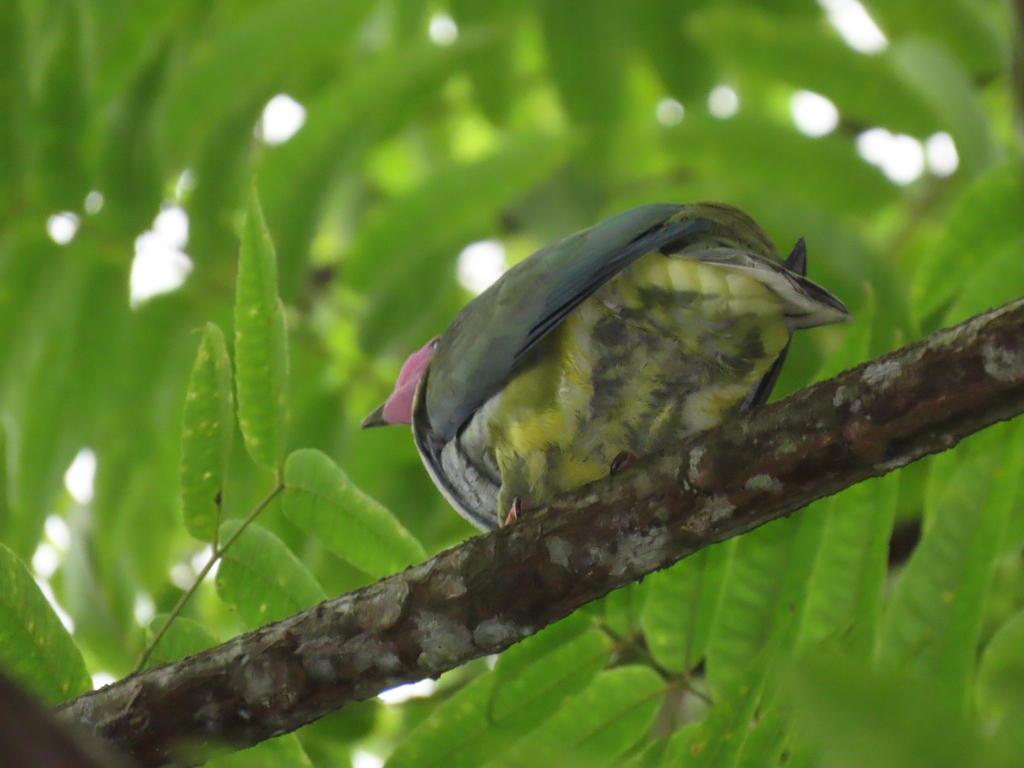
The pink-headed fruit dove (Ptilinopus porphyreus) also known as pink-necked fruit dove or Temminck's fruit pigeon, is a small colourful dove. The pink-headed fruit dove is a resident breeding endemic bird in Indonesia where it occurs in the mountain forests of Sumatra, Java and Bali at altitudes of 1000–2200 m. It builds a flimsy nest in a tree and lays one or sometimes two white eggs which are incubated for 20 days to hatching, with a further 15–16 days to fledging. It is a shy and inconspicuous species, generally seen singly or in pairs, but flocks of up to 17 birds may form at favoured fruit trees. The male has a purple-pink head, neck and throat, bordered below with a white band outlined in greenish black. The upperparts are green and the underparts grey, with yellow undertail coverts. The iris is orange, the bill is greenish, and feet are pink. The female is duller than the male, with a weaker breast band, and the juvenile is an even drabber version of the female. The call is a soft hoo. The male pink-headed fruit doves were observed to be the only ones participating in nest building, the "flimsy" nest mentioned earlier can be described as a "Pigeon-like" nest. Females were observed not participating in the nest building and instead were observed to perch in tall nearby trees. This dove feeds on figs, small fruit and berries in the upper canopy of the forest, where it is well-camouflaged amongst the green foliage. The pink-headed fruit dove is restricted to less than 12,000 km² of forest in three sites on Sumatra, sixteen on Java and one on Bali, always on forested mountains at least 2000m high. Most sites are smaller than 200 km² and shrinking. However the species is very inconspicuous and it is not yet thought to be threatened. The pink-headed fruit dove is evaluated as Least Concern on the IUCN Red List of Threatened Species. While in the past the species was rarely found on offer in traditional bird markets in Indonesia, in 2022 it was found that dozens of pink-headed fruit doves were openly offered for sale on Indonesian Facebook pages and other social media platforms
Gallery
Ajouter des photos
Partagez vos photos de cette espèce (jusqu'à 20 à la fois) : elles sont vérifiées automatiquement, puis publiées.
Répartition
Occurrences observées (données GBIF). Les zones hors aire d'origine peuvent indiquer une présence introduite ou invasive.
Sources et crédits
Informations provenant de plusieurs sources vérifiées. Dernière mise à jour : .
Crédits photos (8)
- Photo : Alfian surya Fathoni (@mas_bod) · CC BY-NC 4.0 · via iNaturalist
- Photo : ꦥꦤ꧀ꦗꦶꦒꦸꦱ꧀ꦠꦶꦄꦏ꧀ꦧꦂ (@panjigusti) · CC BY 4.0 · via iNaturalist
- Photo : ꦥꦤ꧀ꦗꦶꦒꦸꦱ꧀ꦠꦶꦄꦏ꧀ꦧꦂ (@panjigusti) · CC BY 4.0 · via iNaturalist
- Photo : Legawa, Everest C. (@everestlegawa) · CC BY 4.0 · via iNaturalist
- Photo : Deni (@deni_tm) · CC BY-NC 4.0 · via iNaturalist
- Photo : Muhammad Taufiq Arrachman (@topek) · CC BY-NC 4.0 · via iNaturalist
- Photo : Allika Firhandini (@firhandinia) · CC BY-NC 4.0 · via iNaturalist
- Photo : Forest Botial-Jarvis (@tiluchi) · CC BY 4.0 · via iNaturalist
Mentions de licence
Texte disponible sous licence CC BY-SA 4.0. Il adapte notamment Ptilope porphyre, Wikipedia (CC BY-SA) : Pink-headed fruit dove (Wikipédia, auteurs dans l’historique de l’article).
- Taxonomie : GBIF Backbone Taxonomy (CC BY 4.0)
- Carte : occurrences GBIF, fond © contributeurs OpenStreetMap (ODbL)
- Statut de conservation : Liste rouge de l'UICN, via Wikidata (CC0)
Détail : Sources et licences.
Discussion (0)
Aucun message pour l’instant. Lancez la discussion sur cette fiche (sources, précisions, débats éditoriaux).
Connectez-vous pour participer à la discussion.