
Beautiful Fruit Dove
Ptilinopus pulchellus
The beautiful fruit dove (Ptilinopus pulchellus), also known as the rose-fronted pigeon or crimson-capped fruit dove, is a small, approximately 19 cm (7+1⁄2 in) long, mainly green fruit dove.
- Kingdom
- Animalia
- Phylum
- Chordata
- Class
- Aves
- Order
- Columbiformes
- Family
- Columbidae
- Genus
- Ptilinopus
- Species
- Ptilinopus pulchellus
Description
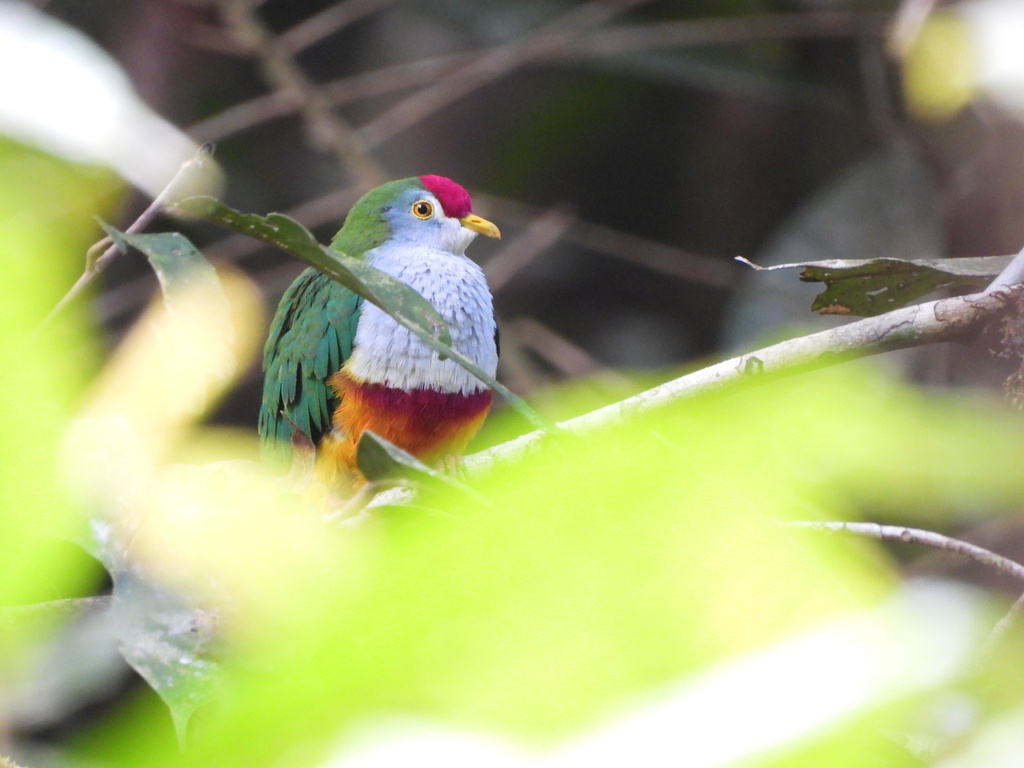
The beautiful fruit dove (Ptilinopus pulchellus), also known as the rose-fronted pigeon or crimson-capped fruit dove, is a small, approximately 19 cm (7+1⁄2 in) long, mainly green fruit dove. It has a red crown, whitish throat, a greenish-yellow bill and purplish-red feet. It has a blue-grey breast and yellowish orange belly, with a reddish purple patch in between. Both sexes are similar. The beautiful fruit dove is distributed in rainforests of New Guinea and the islands of Batanta, Waigeo, Salawati and Misool in West Papua, Indonesia, primarily in flat terrain. The female usually lays a single white egg. Its diet consists mainly of various fruits from trees, palms and vines. In the Port Moresby area, birds were found to eat a mixed diet in May. Large Tristiropsis canarioides fruit were taken when available, but the species gets displaced from fruiting trees by larger pigeons such as the collared imperial pigeon (Ducula mullerii). Small Endiandra sp. fruit were very often eaten, but made up only a small quantity of food volume. Other food were Gymnacranthera paniculata and small quantities of Polyalthia sp., Livistona palm fruit, and occasionally pepper (Piper) berries. Despite their small size, they are able to swallow fruits of 5 cm³ volume, which would translate into a diameter of about 2 cm in spherical fruit. (Frith et al. 1976) Widespread and common throughout its large range, the beautiful fruit dove is evaluated as Least Concern on the IUCN Red List of Threatened Species.
Gallery
Ajouter des photos
Partagez vos photos de cette espèce (jusqu'à 20 à la fois) : elles sont vérifiées automatiquement, puis publiées.
Répartition
Occurrences observées (données GBIF). Les zones hors aire d'origine peuvent indiquer une présence introduite ou invasive.
Sources et crédits
Informations provenant de plusieurs sources vérifiées. Dernière mise à jour : .
Crédits photos (8)
- Photo : Ahmad Yasin Chumaedi (@kareopadi) · CC BY-NC 4.0 · via iNaturalist
- Photo : @tegerforester · CC BY-NC 4.0 · via iNaturalist
- Photo : Royle Safaris (@roylesafaris) · CC BY-NC 4.0 · via iNaturalist
- Photo : Ganjar Cahyo Aprianto (@ganjaraprianto) · CC BY-NC 4.0 · via iNaturalist
- Photo : wisata Alam Liar kalaimis (@anis_wild_adventure) · CC BY-NC 4.0 · via iNaturalist
- Photo : Lisa_James (@lisa_james) · CC BY-NC 4.0 · via iNaturalist
- Photo : Jonathan M (@isidoreajar) · CC BY-NC 4.0 · via iNaturalist
- Photo : @crocattackdatabase · CC BY-NC 4.0 · via iNaturalist
Mentions de licence
Texte disponible sous licence CC BY-SA 4.0. Il adapte notamment Ptilope mignon, Wikipedia (CC BY-SA) : Beautiful fruit dove (Wikipédia, auteurs dans l’historique de l’article).
- Taxonomie : GBIF Backbone Taxonomy (CC BY 4.0)
- Carte : occurrences GBIF, fond © contributeurs OpenStreetMap (ODbL)
- Statut de conservation : Liste rouge de l'UICN, via Wikidata (CC0)
Détail : Sources et licences.
Discussion (0)
Aucun message pour l’instant. Lancez la discussion sur cette fiche (sources, précisions, débats éditoriaux).
Connectez-vous pour participer à la discussion.