
Mariana Fruit Dove
Ptilinopus roseicapilla
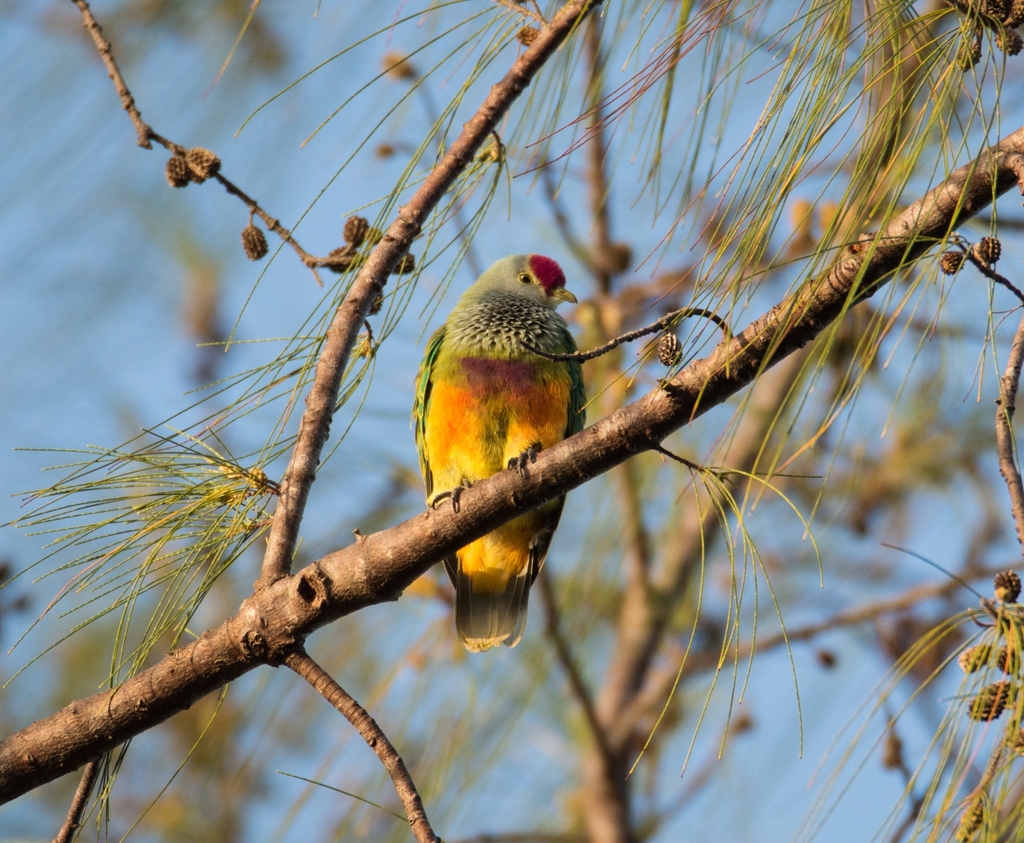
The Mariana fruit dove (Ptilinopus roseicapilla), totot in the Northern Marianas Islands or Paluman totut on Guam, also known as mwee'mwe in the Carolinian language, is a small, up to 24 cm (9.4 in) long, green fruit dove native and…
- Kingdom
- Animalia
- Phylum
- Chordata
- Class
- Aves
- Order
- Columbiformes
- Family
- Columbidae
- Genus
- Ptilinopus
- Species
- Ptilinopus roseicapilla
Description
The Mariana fruit dove (Ptilinopus roseicapilla), totot in the Northern Marianas Islands or Paluman totut on Guam, also known as mwee'mwe in the Carolinian language, is a small, up to 24 cm (9.4 in) long, green fruit dove native and endemic to the Northern Marianas Islands in the Pacific and Guam. It has a red forehead; greyish head, back and breast; and yellow belly patch and undertail coverts. Sightings of the Mariana Fruit Dove on Guam are rare with up to two sightings per year. The female lays a single white egg. The chick and egg are tended to by both parents. Its diet consists mainly of fruits. Culturally, the Mariana fruit dove is a very important symbol of the region. This species is the official bird of the Northern Marianas Islands.[1]. In 2005, the Mariana fruit dove was originally chosen as the official mascot of the 2006 Micronesian Games in Saipan.[2] However, the official website for the games shows a tropicbird as the official symbol instead of the Mariana fruit dove.[3] The species faces extinction due to habitat loss throughout its range. A larger threat to the Mariana fruit dove has been the accidental introduction of the brown tree snake to Guam during World War II. The snakes decimated the native bird populations of the island, which were unaccustomed to predators. They are extinct on Guam since 1984 and the Mariana fruit dove is highly endangered on other islands in its range. The spread of the snakes to the Northern Marianas Islands could be devastating. Several zoos have started captive breeding programs. The St. Louis Zoo, in St. Louis, Missouri, has one of the most successful captive breeding programs. The program began in 1993.[4] Due to ongoing habitat loss, limited range, small population size and invasive alien species, the Mariana fruit dove is evaluated as near threatened on the IUCN Red List of Threatened Species.
Gallery
Ajouter des photos
Partagez vos photos de cette espèce (jusqu'à 20 à la fois) : elles sont vérifiées automatiquement, puis publiées.
Répartition
Occurrences observées (données GBIF). Les zones hors aire d'origine peuvent indiquer une présence introduite ou invasive.
Sources et crédits
Informations provenant de plusieurs sources vérifiées. Dernière mise à jour : .
Crédits photos (8)
- Photo : Trenton Voytko (@trentonamora) · CC BY-NC 4.0 · via iNaturalist
- Photo : Kalin Antonio Ocaña (@kalinocana) · CC BY-NC 4.0 · via iNaturalist
- Photo : Andria Kroner (@andria4) · CC BY-NC 4.0 · via iNaturalist
- Photo : @drgonfly · CC BY-NC 4.0 · via iNaturalist
- Photo : Alfred Daniel J (@alfred_daniel_j) · CC BY-NC 4.0 · via iNaturalist
- Photo : Jose Quan (@ginenmarianas) · CC BY-NC 4.0 · via iNaturalist
- Photo : @kaeliswift · CC BY-NC 4.0 · via iNaturalist
- Photo : @keishajohnson048 · CC BY-NC 4.0 · via iNaturalist
Mentions de licence
Texte disponible sous licence CC BY-SA 4.0. Il adapte notamment Ptilope des Mariannes, Wikipedia (CC BY-SA) : Mariana fruit dove (Wikipédia, auteurs dans l’historique de l’article).
- Taxonomie : GBIF Backbone Taxonomy (CC BY 4.0)
- Carte : occurrences GBIF, fond © contributeurs OpenStreetMap (ODbL)
- Statut de conservation : Liste rouge de l'UICN, via Wikidata (CC0)
Détail : Sources et licences.
Discussion (0)
Aucun message pour l’instant. Lancez la discussion sur cette fiche (sources, précisions, débats éditoriaux).
Connectez-vous pour participer à la discussion.