
Pallas's Leaf Warbler
Phylloscopus proregulus
Pallas's leaf warbler (Phylloscopus proregulus) or Pallas's warbler is a bird that breeds in mountain forests from southern Siberia east to northern Mongolia and northeast China.
- Kingdom
- Animalia
- Phylum
- Chordata
- Class
- Aves
- Order
- Passeriformes
- Family
- Phylloscopidae
- Genus
- Phylloscopus
- Species
- Phylloscopus proregulus
Description
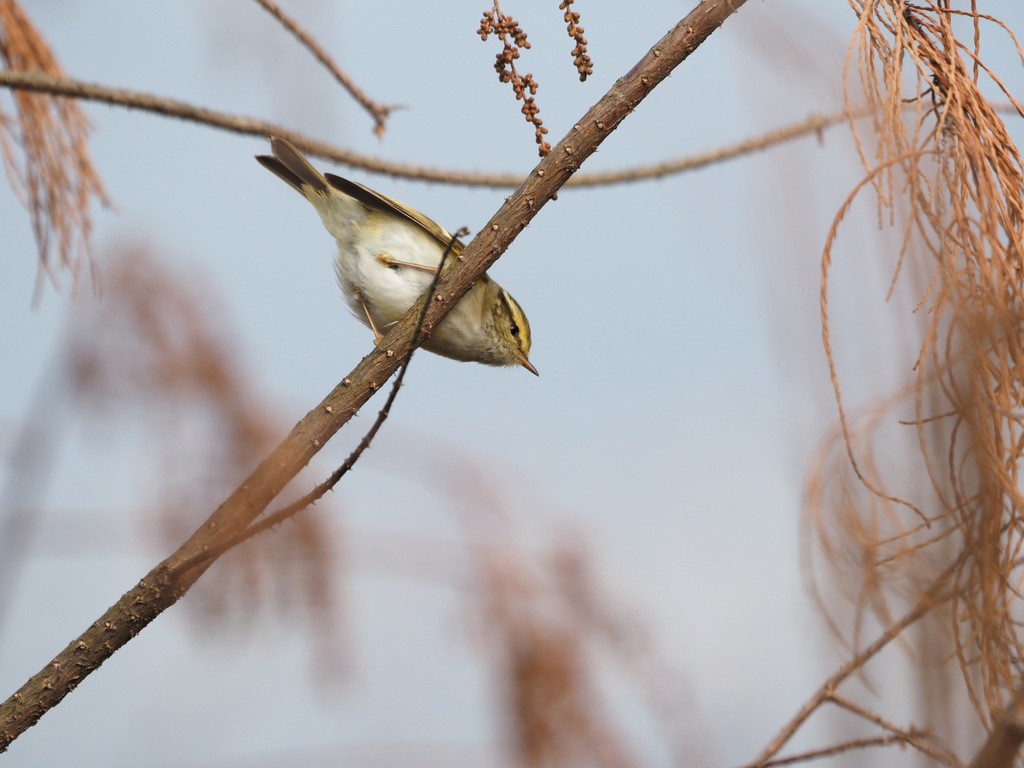
Pallas's leaf warbler (Phylloscopus proregulus) or Pallas's warbler is a bird that breeds in mountain forests from southern Siberia east to northern Mongolia and northeast China. It is named after the German zoologist Peter Simon Pallas, who first formally described it. This leaf warbler is strongly migratory, wintering mainly in south China and adjacent areas of southeast Asia, although in recent decades increasing numbers have been found in Europe in autumn. Pallas's leaf warbler is one of the smallest Palearctic warblers, with a relatively large head and short tail. It has greenish upperparts and white underparts, a lemon-yellow rump, and yellow double wingbars, supercilia and central crown stripe. It is similar in appearance to several other Asian warblers, including some that were formerly considered to be subspecies of it, although its distinctive vocalisations aid identification. The female builds a cup nest in a tree or bush, and incubates the four to six eggs, which hatch after 12–13 days. The chicks are fed mainly by the female and fledge when they are 12–14 days old; both parents then bring food for about a week. Pallas's leaf warbler is insectivorous, feeding on the adults, larvae and pupae of small insects and spiders. Birds forage in bushes and trees, picking items from leaves or catching prey in short flights or while hovering. The Pallas's leaf warbler has a large range, and its numbers are believed to be stable. It therefore is evaluated as of "least concern" by the International Union for Conservation of Nature (IUCN).
Gallery
Ajouter des photos
Partagez vos photos de cette espèce (jusqu'à 20 à la fois) : elles sont vérifiées automatiquement, puis publiées.
Répartition
Occurrences observées (données GBIF). Les zones hors aire d'origine peuvent indiquer une présence introduite ou invasive.
Sources et crédits
Informations provenant de plusieurs sources vérifiées. Dernière mise à jour : .
Crédits photos (8)
- Photo : 小铖/Smalltown (@smalltown_huang) · CC BY-NC 4.0 · via iNaturalist
- Photo : 零摄氏度可乐Sam (@nj_sam) · CC BY-NC 4.0 · via iNaturalist
- Photo : Simba (@simbason) · CC BY-NC 4.0 · via iNaturalist
- Photo : @dimitriskokkinidis · CC BY-NC 4.0 · via iNaturalist
- Photo : Ricarda Bergen (@flyber) · CC BY-NC 4.0 · via iNaturalist
- Photo : 小铖/Smalltown (@smalltown_huang) · CC BY-NC 4.0 · via iNaturalist
- Photo : @elegy-of-the-unchartedstar · CC BY-NC 4.0 · via iNaturalist
- Photo : Andrew Bazdyrev (@andrewbazdyrev) · CC BY 4.0 · via iNaturalist
Mentions de licence
Texte disponible sous licence CC BY-SA 4.0. Il adapte notamment Wikipedia (CC BY-SA) : Pallas's leaf warbler (Wikipédia, auteurs dans l’historique de l’article).
- Taxonomie : GBIF Backbone Taxonomy (CC BY 4.0)
- Carte : occurrences GBIF, fond © contributeurs OpenStreetMap (ODbL)
- Statut de conservation : Liste rouge de l'UICN, via Wikidata (CC0)
Détail : Sources et licences.
Discussion (0)
Aucun message pour l’instant. Lancez la discussion sur cette fiche (sources, précisions, débats éditoriaux).
Connectez-vous pour participer à la discussion.