
Stub-tailed Spadebill
Platyrinchus cancrominus
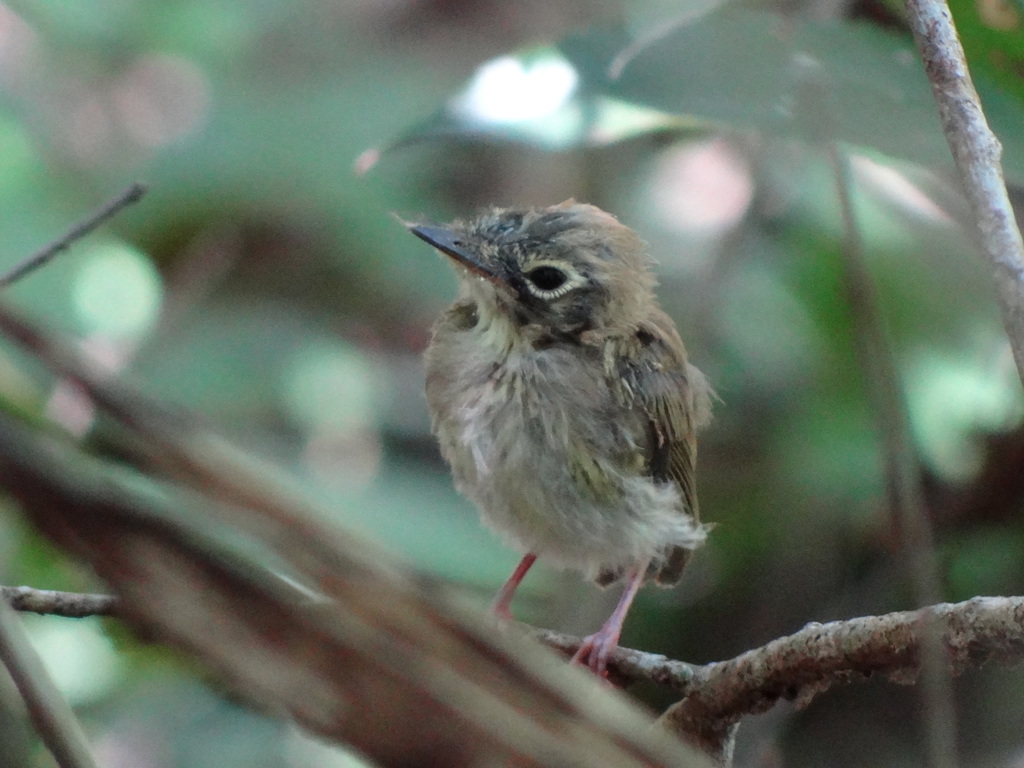
The stub-tailed spadebill (Platyrinchus cancrominus) is a passerine bird in the Tyrannidae family.
- Kingdom
- Animalia
- Phylum
- Chordata
- Class
- Aves
- Order
- Passeriformes
- Family
- Tyrannidae
- Genus
- Platyrinchus
- Species
- Platyrinchus cancrominus
Description
The stub-tailed spadebill (Platyrinchus cancrominus) is a passerine bird in the Tyrannidae family. It is commonly found in tropical dry rainforests or tropical moist lowlands throughout Central America. First scientifically described in 1860, it was originally thought to be the same as Platyrinchus mystaceus but was later reclassified as a sympatric species. The stub-tailed spadebill may grow up to 9.5 cm (3.74 in) long and may weigh up to 12 g (0.42 oz). It has a white throat, yellow breast, and brown mantle and wings. The stub-tailed spadebill is most easily recognizable due to its stubby tail, broad bill, and its distinctive bird song. Some morphological differences like its greatly reduced crown differentiate it from other related species. The stub-tailed spadebill is found in elevation ranges up to 500 m (1,640 ft) above sea level. As an omnivore it feeds on both arthropods such as spiders, beetles, and ants as well as low hanging berries and fruits in the lower strata of the rainforests. While many individuals may live in solitude, pairs that live together often nest in deep cone-shaped nests made with scavenged fibres. Stub-tailed spadebills also engage in mixed-species foraging flocks with other species commonly found in the same habitat. Engaging in this flocking behaviour is still not fully understood and is believed to be done for protection from predation. It is categorized as a species of least concern by the International Union for Conservation of Nature
Gallery
Ajouter des photos
Partagez vos photos de cette espèce (jusqu'à 20 à la fois) : elles sont vérifiées automatiquement, puis publiées.
Répartition
Occurrences observées (données GBIF). Les zones hors aire d'origine peuvent indiquer une présence introduite ou invasive.
Sources et crédits
Informations provenant de plusieurs sources vérifiées. Dernière mise à jour : .
Crédits photos (8)
- Photo : @alexpacheco · CC BY-NC 4.0 · via iNaturalist
- Photo : @charliemancera · CC BY-NC 4.0 · via iNaturalist
- Photo : @axelvasquez20 · CC BY-NC 4.0 · via iNaturalist
- Photo : @alexpacheco · CC BY-NC 4.0 · via iNaturalist
- Photo : Luis Trinchan (@trinchan) · CC BY-NC 4.0 · via iNaturalist
- Photo : David Garrigues (@davgarrigues) · CC BY-NC 4.0 · via iNaturalist
- Photo : Francisco Dubón (@fcodubon) · CC BY-NC 4.0 · via iNaturalist
- Photo : Don Wellmann (@don54) · CC0 (domaine public) · via iNaturalist
Mentions de licence
Texte disponible sous licence CC BY-SA 4.0. Il adapte notamment Wikipedia (CC BY-SA) : Stub-tailed spadebill (Wikipédia, auteurs dans l’historique de l’article).
- Taxonomie : GBIF Backbone Taxonomy (CC BY 4.0)
- Carte : occurrences GBIF, fond © contributeurs OpenStreetMap (ODbL)
- Statut de conservation : Liste rouge de l'UICN, via Wikidata (CC0)
Détail : Sources et licences.
Discussion (0)
Aucun message pour l’instant. Lancez la discussion sur cette fiche (sources, précisions, débats éditoriaux).
Connectez-vous pour participer à la discussion.