
European Rock Pipit
Anthus petrosus
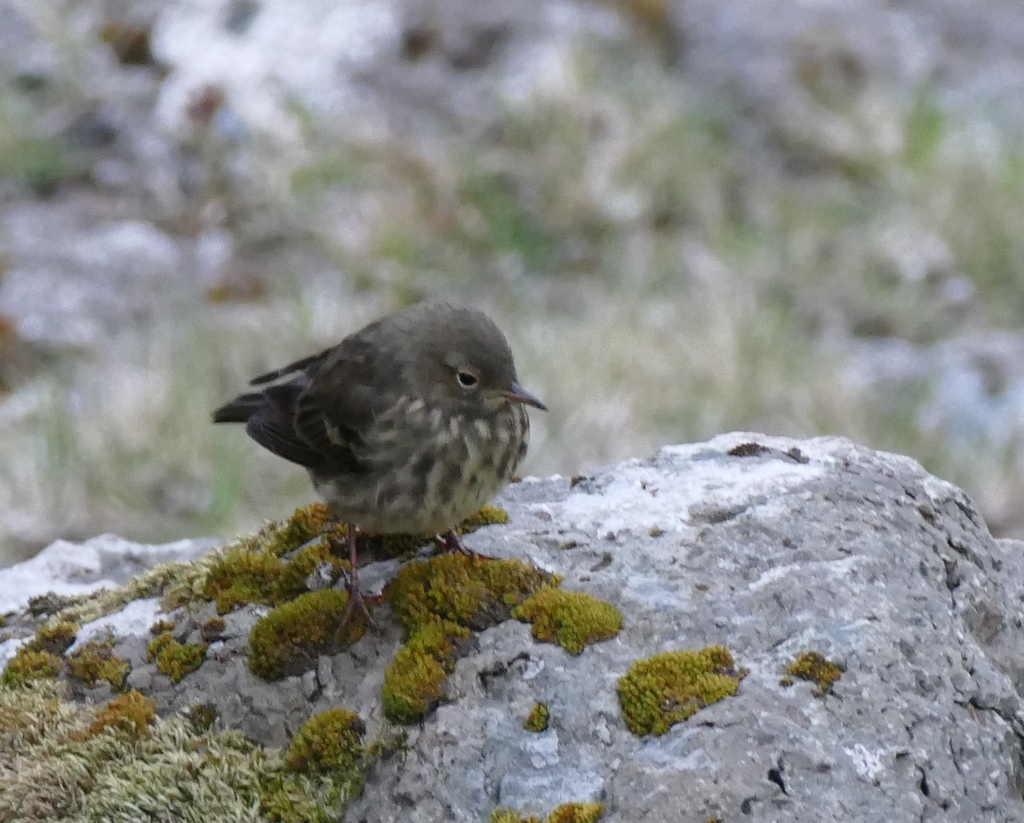
The European rock pipit (Anthus petrosus), or simply rock pipit, is a species of small passerine bird that breeds in western Europe on rocky coasts.
- Kingdom
- Animalia
- Phylum
- Chordata
- Class
- Aves
- Order
- Passeriformes
- Family
- Motacillidae
- Genus
- Anthus
- Species
- Anthus petrosus
Description
The European rock pipit (Anthus petrosus), or simply rock pipit, is a species of small passerine bird that breeds in western Europe on rocky coasts. It has streaked greyish-brown upperparts and buff underparts, and is similar in appearance to other European pipits. There are two subspecies, of which the nominate is non-migratory, and the Fennoscandian one is migratory, wintering in shoreline habitats further west and south in Europe. The European rock pipit is territorial at least in the breeding season, and year-round where it is resident. Males will sometimes enter an adjacent territory to assist the resident in repelling an intruder, behaviour only otherwise known from the African fiddler crab. European rock pipits construct a cup nest under coastal vegetation or in cliff crevices and lay four to six speckled pale grey eggs which hatch in about two weeks with a further 16 days to fledging. Although insects are occasionally caught in flight, the pipits feed mainly on small invertebrates picked off the rocks or from shallow water. The European rock pipit may be hunted by birds of prey, infested by parasites such as fleas, or act as an involuntary host to the common cuckoo, but overall its population is large and stable, and it is therefore evaluated as a species of least concern by the International Union for Conservation of Nature (IUCN).
Gallery
Ajouter des photos
Partagez vos photos de cette espèce (jusqu'à 20 à la fois) : elles sont vérifiées automatiquement, puis publiées.
Répartition
Occurrences observées (données GBIF). Les zones hors aire d'origine peuvent indiquer une présence introduite ou invasive.
Sources et crédits
Informations provenant de plusieurs sources vérifiées. Dernière mise à jour : .
Crédits photos (8)
- Photo : @tanhk · CC BY-NC 4.0 · via iNaturalist
- Photo : Phil James (@wyvern63) · CC BY 4.0 · via iNaturalist
- Photo : @ikelman · CC BY 4.0 · via iNaturalist
- Photo : Alexandra Laking (@lakinga) · CC BY-NC 4.0 · via iNaturalist
- Photo : Stephen Moores (@stephen54) · CC BY-NC 4.0 · via iNaturalist
- Photo : @malvina86 · CC BY-NC 4.0 · via iNaturalist
- Photo : Norre007 (@norre007) · CC BY-NC 4.0 · via iNaturalist
- Photo : @manue22 · CC BY-NC 4.0 · via iNaturalist
Mentions de licence
Texte disponible sous licence CC BY-SA 4.0. Il adapte notamment Wikipedia (CC BY-SA) : European rock pipit (Wikipédia, auteurs dans l’historique de l’article).
- Taxonomie : GBIF Backbone Taxonomy (CC BY 4.0)
- Carte : occurrences GBIF, fond © contributeurs OpenStreetMap (ODbL)
- Statut de conservation : Liste rouge de l'UICN, via Wikidata (CC0)
Détail : Sources et licences.
Discussion (0)
Aucun message pour l’instant. Lancez la discussion sur cette fiche (sources, précisions, débats éditoriaux).
Connectez-vous pour participer à la discussion.