
Black Guineafowl
Agelastes niger
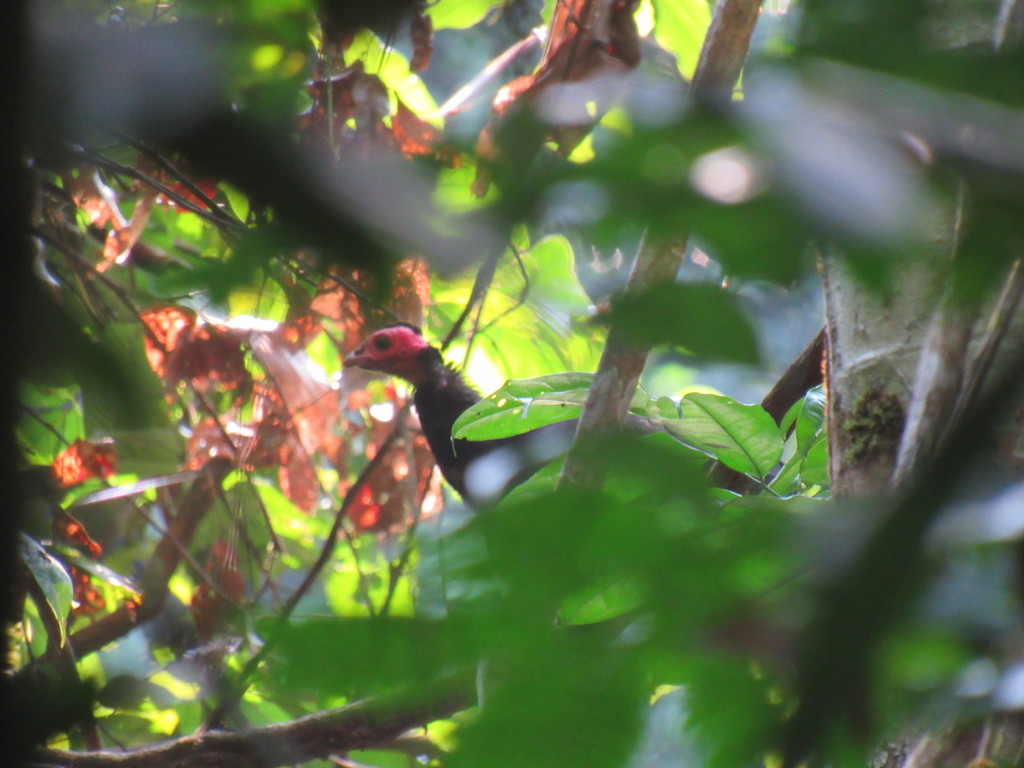
The black guinea fowl (Agelastes niger) is a terrestrial bird of the Numididae (guinea fowl) family found in humid forests in West-Central Africa.
- Kingdom
- Animalia
- Phylum
- Chordata
- Class
- Aves
- Order
- Galliformes
- Family
- Numididae
- Genus
- Agelastes
- Species
- Agelastes niger
Description
The black guinea fowl (Agelastes niger) is a terrestrial bird of the Numididae (guinea fowl) family found in humid forests in West-Central Africa. It is a medium-sized, black galliforme bird with a bare, orange-pink head and upper neck. As it inhabits dense, potentially inaccessible, regions of equatorial African jungle, little is known of black guinea fowl behaviour or habits. By all accounts, it is a more reclusive, secretive bird when compared to the other, more sociable guinea fowl species; i.e., researchers have been able to successfully observe and document far more information on the confident, gregarious and open grassland-dwelling helmeted guinea fowl (Numidia meleagris), or even the more exotic vulturine guinea fowl (Acryllium vulturinum). Compared to the black guinea fowl, the aforementioned species (and most guinea fowl) tend to be found in more exposed, dry savanna and arid open forest habitat, and congregate in larger communal flocks. Black guinea fowl are seemingly very wary birds, living in smaller social groups than other guinea fowl, and are constantly looking for signs of danger-the slightest hint of which will send the group darting into the bush to hide.
Gallery
Ajouter des photos
Partagez vos photos de cette espèce (jusqu'à 20 à la fois) : elles sont vérifiées automatiquement, puis publiées.
Répartition
Occurrences observées (données GBIF). Les zones hors aire d'origine peuvent indiquer une présence introduite ou invasive.
Sources et crédits
Informations provenant de plusieurs sources vérifiées. Dernière mise à jour : .
Crédits photos (8)
- Photo : @johnhartdrc · CC BY-NC 4.0 · via iNaturalist
- Photo : Xavier Rufray (@xrufray) · CC BY-NC 4.0 · via iNaturalist
- Photo : @koenbetjes · CC BY-NC 4.0 · via iNaturalist
- Photo : @markusgmeiner · CC BY-NC 4.0 · via iNaturalist
- Photo : @thierry_aebischer_chinko · CC BY-NC 4.0 · via iNaturalist
- Photo : Gwili Gibbon (@gwili) · CC BY-NC 4.0 · via iNaturalist
- Photo : Dérozier Violette (@violettederozier) · CC BY-NC 4.0 · via iNaturalist
- Photo : ChimpAndSee (@chimpandsee) · CC BY-NC 4.0 · via iNaturalist
Mentions de licence
Texte disponible sous licence CC BY-SA 4.0. Il adapte notamment Pintade noire, Wikipedia (CC BY-SA) : Black guinea fowl (Wikipédia, auteurs dans l’historique de l’article).
- Taxonomie : GBIF Backbone Taxonomy (CC BY 4.0)
- Carte : occurrences GBIF, fond © contributeurs OpenStreetMap (ODbL)
- Statut de conservation : Liste rouge de l'UICN, via Wikidata (CC0)
Détail : Sources et licences.
Discussion (0)
Aucun message pour l’instant. Lancez la discussion sur cette fiche (sources, précisions, débats éditoriaux).
Connectez-vous pour participer à la discussion.