
Masked Shrike
Lanius nubicus
The masked shrike (Lanius nubicus) is a species of bird in the shrike family, Laniidae.
- Kingdom
- Animalia
- Phylum
- Chordata
- Class
- Aves
- Order
- Passeriformes
- Family
- Laniidae
- Genus
- Lanius
- Species
- Lanius nubicus
Description
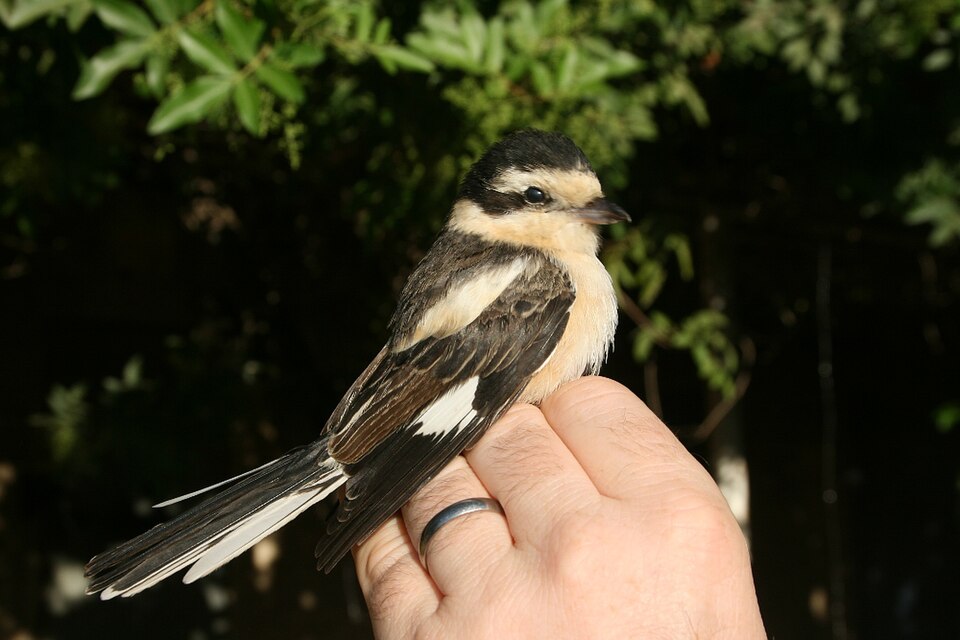
The masked shrike (Lanius nubicus) is a species of bird in the shrike family, Laniidae. It breeds in southeastern Europe and at the eastern end of the Mediterranean, with a separate population in eastern Iraq and western Iran. It is migratory, wintering mainly in northeast Africa. Although it is a short-range migrant, vagrants have occurred widely elsewhere, including northern and western Europe. It is the smallest member of its genus, long-tailed and with a hooked bill. The male has mainly black upperparts, with white on its crown, forehead and supercilium and large white patches on the shoulders and wings. The throat, neck sides and underparts are white, with orange flanks and breast. The female is a duller version of the male, with brownish black upperparts and a grey or buff tone to the shoulders and underparts. The juvenile has grey-brown upperparts with a paler forehead and barring from the head to rump, barred off-white underparts and brown wings аpart from the white primary patches. The species' calls are short and grating, but the song has melodic warbler-like components. The masked shrike's preferred habitat is open woodland with bushes and some large trees. It is less conspicuous than its relatives, avoiding very open country and often perching in less exposed locations. The nest is a neat cup built in a tree by both adults, and the clutch is normally 4–6 eggs, which are incubated by the female for 14–16 days until hatching. The chicks are fed by both parents until they fledge 18–20 days later, and remain dependent on the adults for about 3–4 weeks after leaving the nest. The masked shrike eats mainly large insects, occasionally small vertebrates; it sometimes impales its prey on thorns or barbed wire. Populations are decreasing in parts of the European range, but not rapidly enough to raise serious conservation concerns, and the species is therefore classified by the International Union for Conservation of Nature as being of least concern.
Gallery
Ajouter des photos
Partagez vos photos de cette espèce (jusqu'à 20 à la fois) : elles sont vérifiées automatiquement, puis publiées.
Répartition
Occurrences observées (données GBIF). Les zones hors aire d'origine peuvent indiquer une présence introduite ou invasive.
Sources et crédits
Informations provenant de plusieurs sources vérifiées. Dernière mise à jour : .
Crédits photos (6)
- Photo : Henrike Mühlichen · CC BY-SA 3.0
- Photo : Ali Ali (@ali__ali) · CC BY-NC 4.0 · via iNaturalist
- Photo : Yves Bas (@yvesbas) · CC BY 4.0 · via iNaturalist
- Photo : Simon Bradfield (@scompeti) · CC BY-NC 4.0 · via iNaturalist
- Photo : Itay Berger (@greenstep_itay) · CC BY-NC 4.0 · via iNaturalist
- Photo : Alexander Naumov (@alexander_naumov) · CC BY-NC 4.0 · via iNaturalist
Mentions de licence
Texte disponible sous licence CC BY-SA 4.0. Il adapte notamment Wikipedia (CC BY-SA) : Masked shrike (Wikipédia, auteurs dans l’historique de l’article).
- Taxonomie : GBIF Backbone Taxonomy (CC BY 4.0)
- Carte : occurrences GBIF, fond © contributeurs OpenStreetMap (ODbL)
- Statut de conservation : Liste rouge de l'UICN, via Wikidata (CC0)
Détail : Sources et licences.
Discussion (0)
Aucun message pour l’instant. Lancez la discussion sur cette fiche (sources, précisions, débats éditoriaux).
Connectez-vous pour participer à la discussion.