
Black-billed Magpie
Pica hudsonia
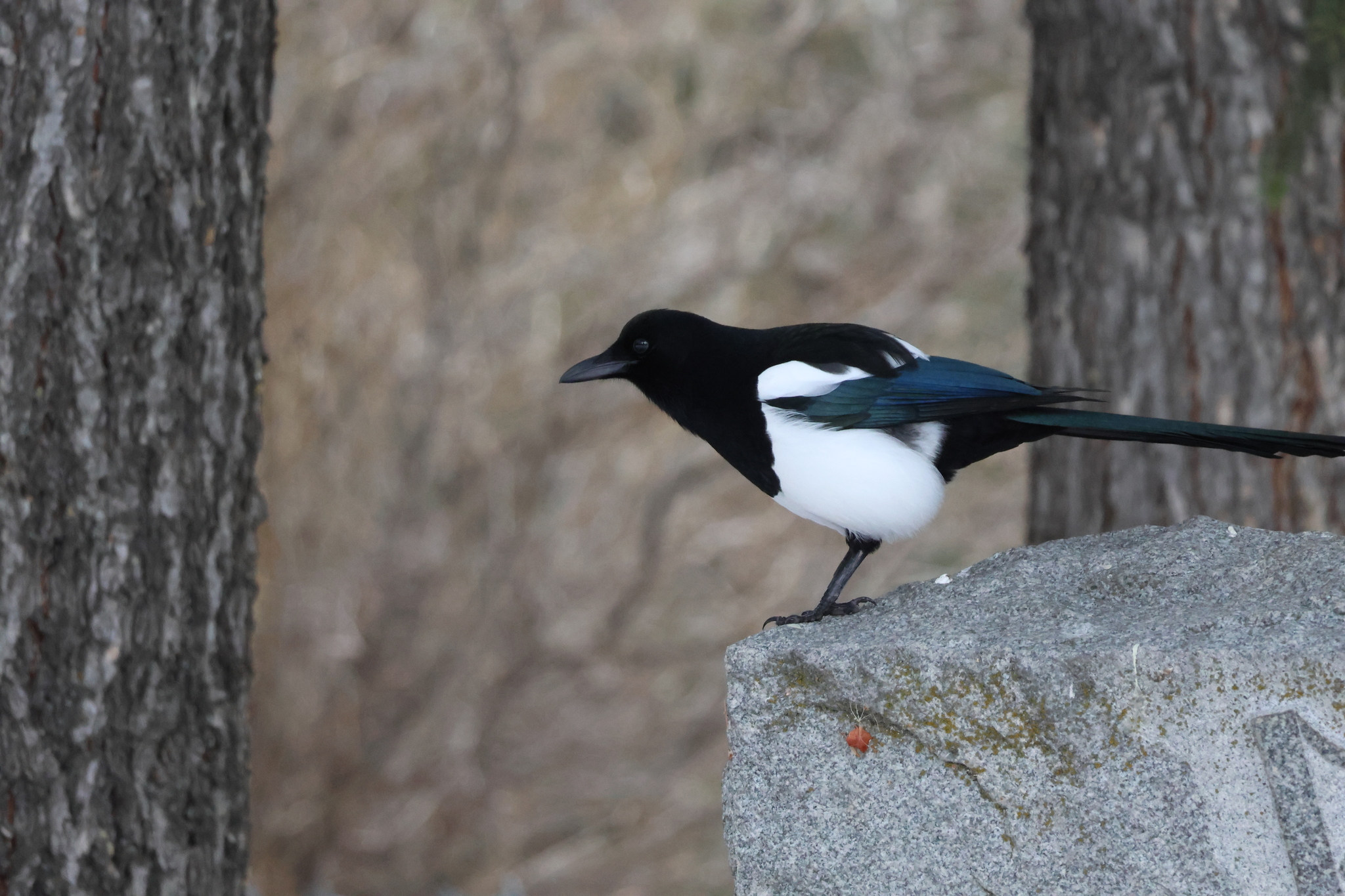
The black-billed magpie (Pica hudsonia), also known as the American magpie, is a bird in the corvid family found in the western half of North America.
- Kingdom
- Animalia
- Phylum
- Chordata
- Class
- Aves
- Order
- Passeriformes
- Family
- Corvidae
- Genus
- Pica
- Species
- Pica hudsonia
Description
The black-billed magpie (Pica hudsonia), also known as the American magpie, is a bird in the corvid family found in the western half of North America. It is black and white, with the wings and tail showing black areas and iridescent hints of blue and blue-green. It was formerly treated as a subspecies of Pica pica (Eurasian magpie), but was separated as a species in its own in 2000 based on genetic studies. This species prefers generally open habitats with clumps of trees, but can also commonly be found in farmlands and suburban areas. Historically associated with bison herds, it now lands on the backs of cattle to glean ticks and insects from them. Black-billed magpies commonly follow large predators, such as wolves, to scavenge from their kills. The species also walks or hops on the ground, where it obtains food items such as beetles, grasshoppers, worms, and small rodents. The black-billed magpie builds domed nests which are made up of twigs and are located near the top of trees, usually housing six to seven eggs. Incubation, by the female only, starts when the clutch is complete, and lasts 16–21 days. The nestling period is three to four weeks. Black-billed magpies in the wild have a lifespan of six to seven years. Black-billed magpies have a long history with humans, being featured in stories told by Indigenous tribes of the Great Plains. Where persecuted it becomes very wary, but otherwise it is fairly tolerant of human presence. Due to their perceived negative impact on cattle and game birds, black-billed magpies were hunted as a pest during the 1900s, and their population suffered as a result. Today, they are considered a species of least concern by the IUCN, and they are commonly seen throughout their range.
Gallery
Ajouter des photos
Partagez vos photos de cette espèce (jusqu'à 20 à la fois) : elles sont vérifiées automatiquement, puis publiées.
Répartition
Occurrences observées (données GBIF). Les zones hors aire d'origine peuvent indiquer une présence introduite ou invasive.
Sources et crédits
Informations provenant de plusieurs sources vérifiées. Dernière mise à jour : .
Crédits photos (6)
- Photo : Allison Rognlie · CC BY-NC 4.0 · via GBIF
- Photo : Michael John Oldham (@michael_oldham) · CC BY-NC 4.0 · via iNaturalist
- Photo : Suzanne Dingwell (@suzanne11) · CC BY-NC 4.0 · via iNaturalist
- Photo : Jonathan Tales (@goatnotes) · CC BY-NC 4.0 · via iNaturalist
- Photo : @tmedley316 · CC BY-NC 4.0 · via iNaturalist
- Photo : Violet Kosack (@violets4u) · CC BY-NC 4.0 · via iNaturalist
Mentions de licence
Texte disponible sous licence CC BY-SA 4.0. Il adapte notamment Wikipedia (CC BY-SA) : Black-billed magpie (Wikipédia, auteurs dans l’historique de l’article).
- Taxonomie : GBIF Backbone Taxonomy (CC BY 4.0)
- Carte : occurrences GBIF, fond © contributeurs OpenStreetMap (ODbL)
- Statut de conservation : Liste rouge de l'UICN, via Wikidata (CC0)
Détail : Sources et licences.
Discussion (0)
Aucun message pour l’instant. Lancez la discussion sur cette fiche (sources, précisions, débats éditoriaux).
Connectez-vous pour participer à la discussion.